
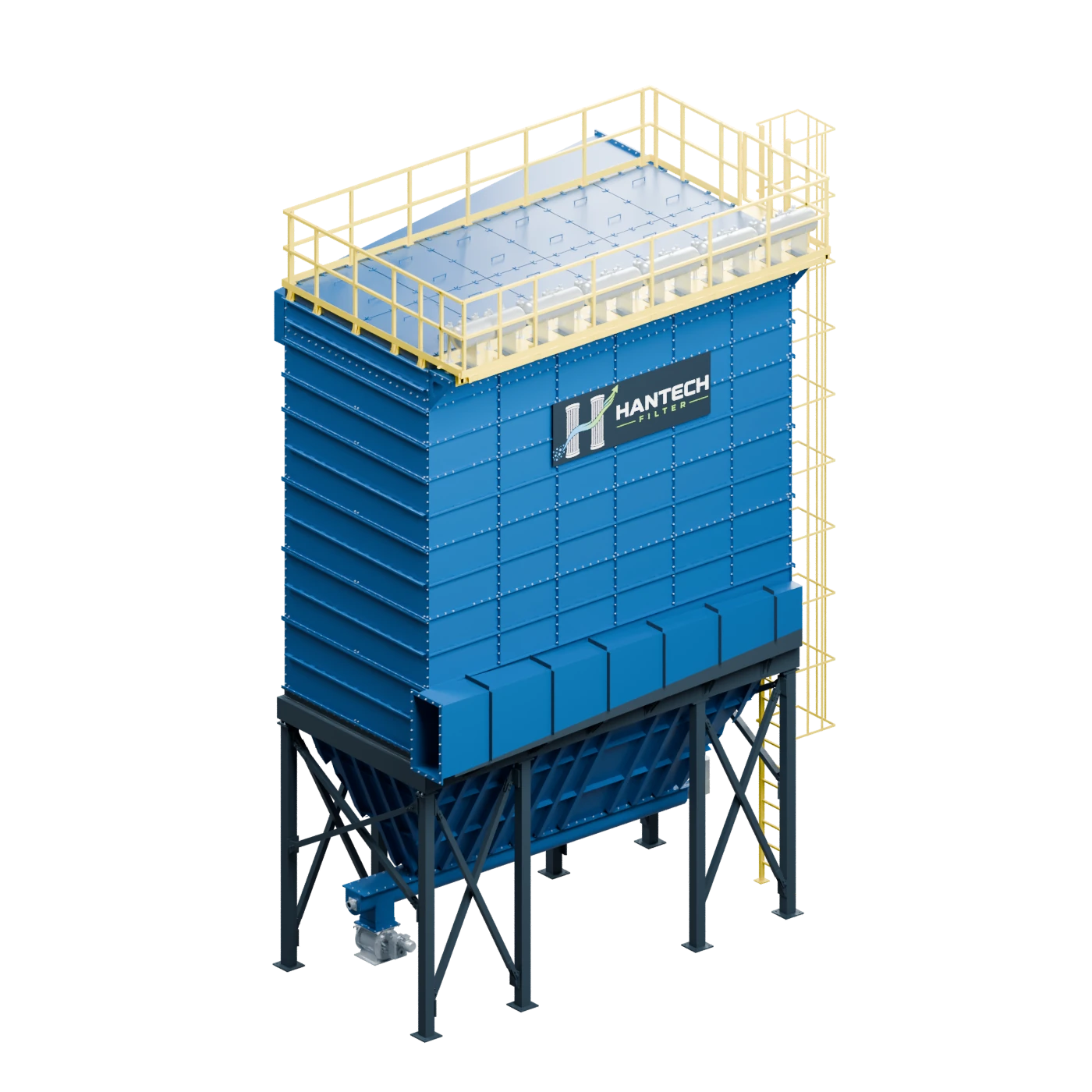
Baghouse filter systems pass dust-laden air through filter bags in industrial processes to provide clean air and controlled dust discharge.
How Does a Baghouse Filter System Work?
The question What Is a Baghouse Filter? Where Is It Used? has direct commercial consequences for industrial plants in terms of emission control, occupational safety, and process continuity. A business searching for a baghouse filter, bag filter, industrial dust collector, or dust collection system is usually not looking for just an equipment name but for a workable solution that reduces downtime risk, simplifies the maintenance plan, and ensures compliance with legal emission limits. For this reason, the right answer is not limited to picking a product from a catalog; it requires evaluating process data, dust behavior, air flow rate, temperature, humidity, maintenance access, and spare parts continuity together.
Hantech Filter's core principle is this: the fundamental job of a baghouse filter system is to control emissions by passing dusty process air through filter bags, and to safely discharge the collected dust. When this principle is applied correctly, the filter housing, bag, cage, pulse-jet valve, rotary airlock, screw conveyor and industrial fan are treated not as disconnected parts, but as compatible components of the same system. In this article, we explain the key technical decision points in a simple, actionable way, using the concepts that businesses researching this topic actually need.
Where Is a Baghouse Filter Used?
This becomes especially important in heavy dust-generating areas such as cement mills, packing lines, silo tops, crusher outlets, transfer points, and lime and mineral plants. Dust load, particle size, temperature, humidity, explosivity, and abrasiveness are not the same for every application. For example, the fine, dry dust in a cement packing line and the coarser, more impact-laden dust at a crusher transfer point do not require the same filtration velocity, the same filter bag media, or the same maintenance strategy. This is why the application point must be clearly defined when selecting a system.
On the field side, the right solution isn't just about achieving clean air at the outlet. How the dust is discharged beneath the hopper, the capacity of the rotary airlock or screw conveyor, the fan's operating point, pressure losses along the ductwork, accessibility of maintenance doors, and bag replacement time all determine overall performance. Even if a poorly designed system runs fine on day one, it can drive up operating costs within a few months through high differential pressure, frequent bag replacement, valve failure, or dust leaks.
How Are Flow Rate, Filtration Velocity, and Filter Bag Media Selected?
The first technical parameter is flow rate. Air flow rate in m³/h directly determines the filter area and fan capacity. If flow rate is calculated too low, dust capture efficiency drops; if calculated too high, it results in unnecessary energy consumption and investment cost. The second parameter is filtration velocity. Also expressed as the A/C ratio or air-to-cloth ratio, this value shows the amount of air passing through the bag surface. A high filtration velocity can cause faster dust loading on the bag and higher pressure drop.
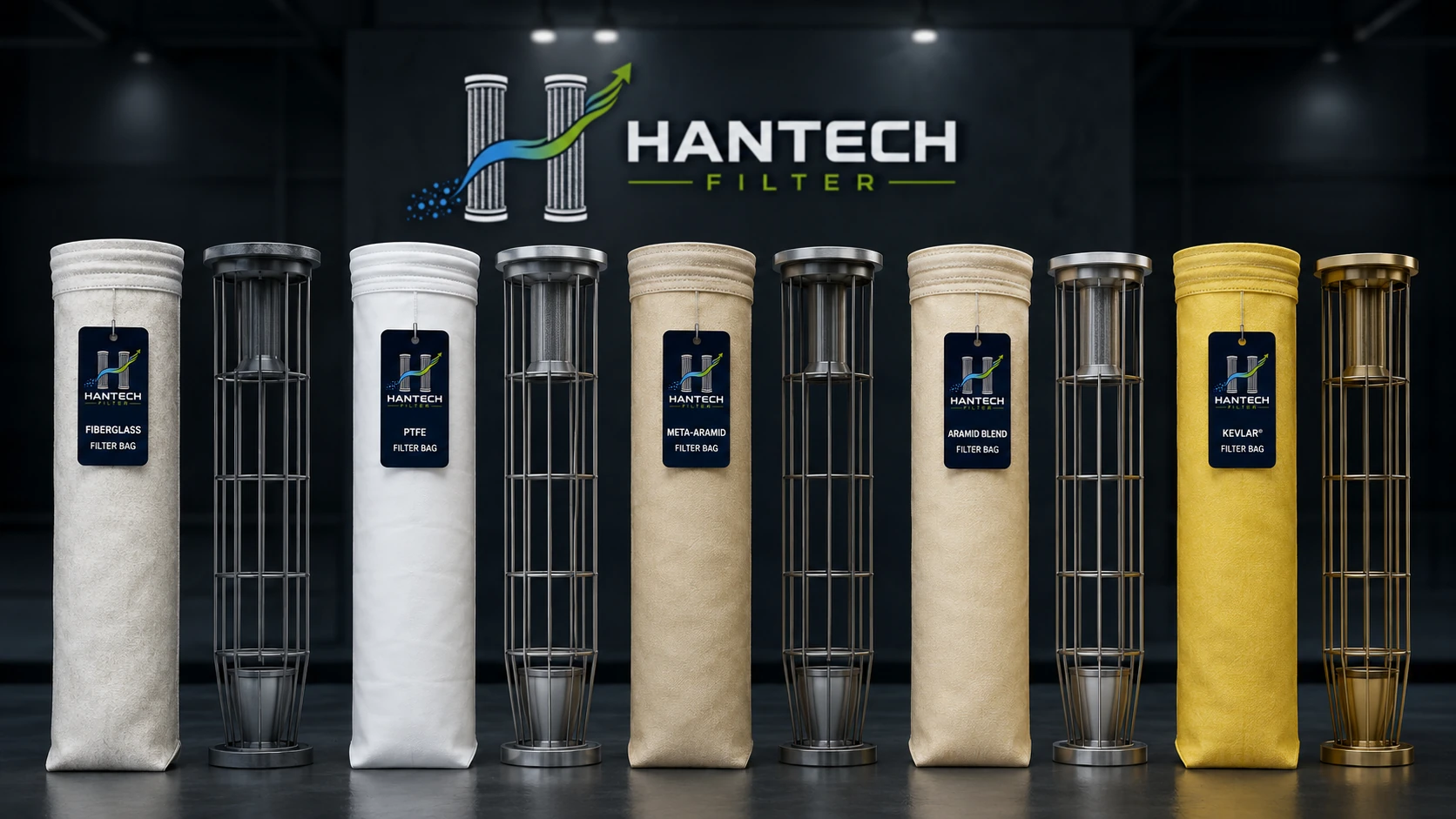
Temperature and humidity are decisive factors in filter bag media selection. Polyester can be an economical choice in most standard applications, but at high temperatures, media such as PPS, Aramid, or P84 may come into play. Chemical environment, acid or alkali exposure, condensation risk, and oily/moist dust behavior must always be considered. The need for antistatic bags is evaluated separately, based on whether the process carries a combustible dust risk.
Filter cage selection is just as important as the bag itself. Cage diameter, wire count, venturi design, surface coating, and corrosion-resistance requirements all affect bag life. On sensitive surfaces such as PTFE membrane bags, an unsuitable cage can cause abrasion damage to the bag. This is why Hantech Filter evaluates the bag and cage not separately, but as a pair that works together.
The Most Common Filtration Mistakes Seen in the Field
The most common mistake is insufficient filter area, excessive filtration velocity, unsuitable filter bag media, and incorrect fan selection. This mistake often makes the initial investment look lower, but after a few maintenance cycles it comes back as higher bag consumption, energy costs, downtime, and emission risk. The second mistake is selecting the fan independently of the filter housing. Fan flow rate and pressure must be calculated together with duct length, number of elbows, filter pressure drop, and hopper and outlet conditions.
The third mistake is evaluating the pulse-jet cleaning system based only on valve diameter. Air tank volume, pressure regulator, blow pipe hole pattern, valve quality, diaphragm life, and control algorithm all determine cleaning efficiency. Pulsing too frequently can shorten bag life, while insufficient pulsing raises differential pressure. The right balance is established using process data.
Maintenance, Spare Parts, and Total Cost of Ownership
The real cost of a filtration system is not just the purchase price. Bag life, cage durability, valve maintenance intervals, fan energy consumption, rotary airlock sealing, and downtime all make up the total cost of ownership. This is why, at the quotation stage, you should question not only the equipment list but also ease of maintenance and continuity of spare parts supply.
Regular differential pressure monitoring, leak checks, compressed air quality, humidity and condensation control, bag replacement records, and continuous hopper discharge all indicate the operational health of the system. A seemingly simple blockage problem can stem from incorrect media selection, oil or water in the compressed air, or insufficient capacity in the rotary valve running beneath the hopper.
Performance Verification with Field Data
To make a sound decision on What Is a Baghouse Filter? Where Is It Used?, as much measurable data as possible should be gathered before requesting a quote. The number of suction points, the approximate flow rate at each point, duct diameters, the existing fan nameplate, motor power, operating hours, dust temperature, moisture condition, particle size, and any available stack test results directly improve selection quality. If a revision to an existing filter is being considered, how differential pressure changes over a shift, the pulse period, air tank pressure, compressor capacity, and the date of the last bag replacement should also be noted.
Performance verification should not be based solely on a clean-stack appearance at initial start-up. In industrial filtration systems, real success becomes clear once production load increases, the bags build up a dust cake, and the maintenance team moves into routine operation. This is why filter outlet, fan suction, hopper discharge, and the compressed air line must all be monitored together. Plants that keep regular records extend bag life, reduce unnecessary valve replacements, and catch abnormal increases in energy consumption early.
What Information Should Be Shared for a Technical Quote?
For a new investment or spare parts request involving a baghouse filter, industrial dust collector, or dust collection system, getting the right quote depends on describing the need in technical terms. Dimensions or quantity alone are often not enough, because two filter bags of the same size can perform completely differently under different temperatures, dust loads, and emission expectations. Bag length, diameter, top structure, bottom detail, cage size, venturi type, valve connection, electrical control panel, and fan operating point should be evaluated together as much as possible.
A short technical summary sent to Hantech Filter speeds up the quotation process. Sharing the process name, material type, approximate flow rate, temperature, operating hours, current problem, targeted improvement, and, if available, photos or drawings, enables a clearer product selection. This way, the result is not just a price comparison, but a field-applicable solution proposal in terms of filter bag media, cage coating, pulse-jet valve compatibility, rotary airlock capacity, and fan pressure requirements.
Long-Term Filter Operating Strategy
Dust collection systems are equipment that evolve alongside the plant's production capacity. Increases in output, changes in raw material or fuel, grinding fineness, seasonal humidity variation, or changes in maintenance discipline all affect filter behavior. This is why checking the system at regular intervals after the initial installation is more effective than only intervening once a failure occurs. If a small leak, a loose cage connection, or an incorrect pulse setting goes unnoticed, it can snowball into bag rupture and a serious emission problem.
A good operating strategy includes stocking critical spare parts, making sure the maintenance team knows the bag replacement procedure, maintaining compressed air quality, and monitoring fan vibration. Preparing a planned maintenance schedule for filter bags, cages, diaphragm valves, solenoid valves, rotary airlock seals, and sensors reduces downtime. In industrial plants, the goal is not just regulatory compliance, but a safe working environment, low energy consumption, stable production, and predictable maintenance costs.
Technical Selection and Quotation Approach with Hantech Filter
For baghouse filter system and spare parts requests, Hantech Filter first clarifies the process information. Quick price comparisons made without understanding flow rate, temperature, dust type, operating hours, existing equipment, emission expectations and maintenance conditions can be misleading. A proper quote should clearly show which problem the system will solve, which combination of parts is recommended, and which risks it will reduce in the field.
If your facility needs a new investment, revision or spare parts related to a baghouse filter, industrial dust collector or dust collection system, you can get technical selection support by sharing your current process data. Hantech Filter evaluates the combination of filter bag, cage, pulse-jet valve, rotary airlock, screw conveyor, air slide fabric and industrial fan based on your facility's operating conditions. This way, instead of simply buying a product, you arrive at an integrated filtration solution that reduces emission, maintenance and downtime risk.
Technical Selection Matrix for Baghouse Filters
| Parameter | Why does it matter? | Hantech check |
|---|---|---|
| Flow rate and A/C ratio | It determines the filter area, dP trend, and bag life. | Gross/net area, offline compartments, and actual process flow rate are calculated together. |
| Dust micron size and abrasiveness | It changes the decision on media, cyclone pre-separator, and inlet protection. | Fine 1-3 µm dust, coarse mineral dust, and sticky cake are read separately. |
| Temperature and humidity | It affects the choice between PES/PPS/aramid/P84/PTFE and the risk of hydrolysis. | Continuous/peak temperature, dew point, and start-stop behavior are required. |
| Gas chemistry | It creates a risk of oxidation, acid/alkali attack, and corrosion. | SOx/SO3, NOx/NO2, HCl, HF, O2, and humidity are evaluated together. |
| Filter cage and snap-band compatibility | Good media can tear prematurely if paired with the wrong cage. | Cage OD, tube sheet hole size, sheet thickness, and weld burrs are checked. |
Worked Example: A/C Ratio Pre-Check
Sample calculation
- Flow Rate
- 60,000 m³/h
- Bag diameter
- Ø160 mm
- Bag size
- 6,000 mm
- Bag count
- 240 bags
- One bag area
- π × 0.16 × 6.0 = 3.02 m²
- Total Area
- 240 × 3.02 = 724.8 m²
- Gross A/C
- 60,000 / 60 / 724.8 = 1.38 m/min
This result alone is not a “suitable” or “unsuitable” verdict. If you're dealing with fine 1-3 µm dust, a moist/sticky cake, or a low-emission target, a lower filtration velocity, a membrane, or a different surface treatment may be needed. For coarse, dry mineral dust, abrasion, inlet distribution, and cyclone pre-separation can become more critical. You can send your dimensions, flow rate, and current dP data through the Hantech technical quote form.
My First Choice Under These Conditions
Frequently Asked Questions
What technical information is required for a quote?
Process, flow rate, temperature, humidity/dew point, dust micron size, chemistry, current dP trend, bag size/quantity, cage size, and photos of any damage all speed up the selection process.
Is PTFE or membrane always the better choice?
No. If a more economical media meets the process limits, premium media can be an unnecessary investment. Hantech bases its selection on total operating risk and technical constraints.
What should the first action be at high dP?
First, check the flow rate, filter area, pulse energy, humidity/dew point, hopper discharge, and false air. Replacing the bags alone is not a root-cause analysis.