
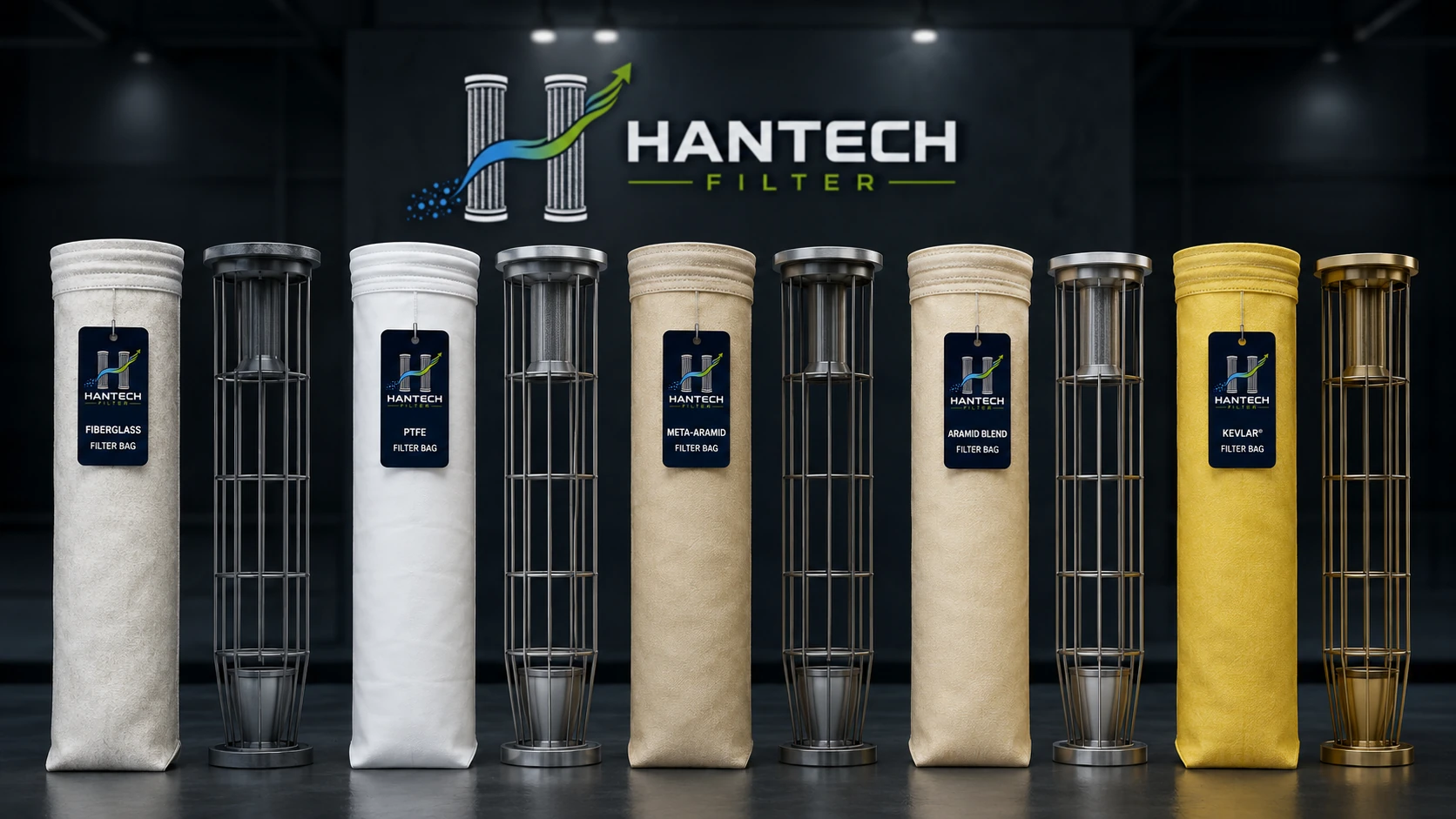
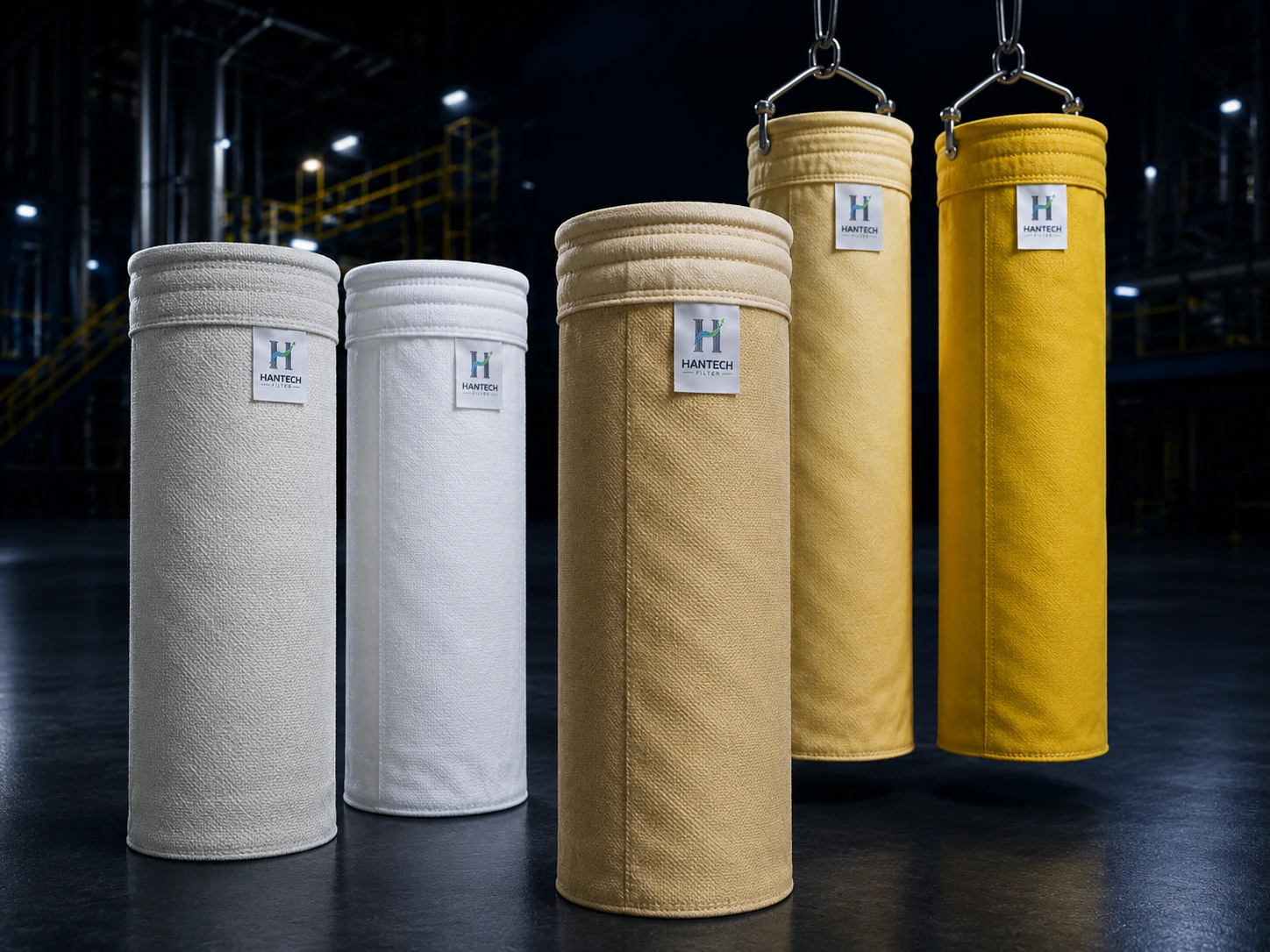
Polyester PES filter bags are selected based on process data for dry, moderate-temperature, and economical pulse-jet applications. Moisture, hydrolysis, antistatic, and finish options are evaluated together.
What Is a Polyester PES Filter Bag?
Polyester PES filter bags are one of the most common economical filter bag families for dry, moderate-temperature jet-pulse dust collection applications. In cement packaging, silo-top filters, mineral dust, dry processes outside feed/food, wood/MDF dust and general industrial dust collection, they can be the first option to consider when process limits allow.
The values shown are general references for technical selection. Hantech Filter establishes dimensions, process conditions, surface treatment, cage and snap-band compatibility, and the technical scope of supply. Final selection must be verified against the manufacturer's data sheet and site data.
In Which Processes Is It an Economical and Safe Candidate?
| It's a must. | PES COMMENT | Hantech decision |
|---|---|---|
| Dry, normal operation at 110–140°C | PES is an economical and strong candidate in most standard pulse-jet applications. | PES is evaluated first; premium media is not automatically recommended. |
| 150°C short peak | As an educational/RFQ basis, a short peak can be considered; duration and repetition frequency remain critical. | If peaks are frequent or long, PPS, aramid, P84, or PTFE are compared. |
| Moisture + high temperature | Hydrolysis and sticky cake risk can reduce bag life. | Dew point, humidity, acid gas, and dP trend data are requested. |
| Explosive/combustible dust risk | Antistatic PES may be required; process safety is evaluated separately. | Antistatic fiber/finish, grounding, and system safety are clarified. |
| Fine 1-3 µm dust + low emission target | Standard felt may embed the dust; dP/emission risk can increase. | An ePTFE membrane or surface finish is evaluated on a justified basis. |
Temperature and Humidity Limits
For polyester, Hantech's training/RFQ baseline is a normal operating range of roughly 110–140°C, a continuous upper limit of 140°C, and a short-peak allowance of roughly 150°C. These figures are not a universal guarantee; they are a preliminary selection range that must be verified against media construction, the manufacturer's datasheet, humidity, gas chemistry, start-stop behavior, and process records.
Worked A/C Ratio Check Example
- Flow Rate
- 60,000 m³/h
- Bag diameter
- 160 mm
- Bag size
- 6,000 mm
- One bag area
- π × 0.16 × 6.0 = 3.02 m²
- Bag count
- 240 bags
- Total filter area
- 240 × 3.02 = 724.8 m²
- A/C ratio
- 60,000 / 60 / 724.8 = 1.38 m/min
1.38 m/min can work in some dry, coarse-dust applications; the risk increases with fine, sticky, or moist dust. The PES decision is made not by temperature alone but together with the A/C ratio, dust particle size, moisture, and cleaning efficiency.
Antistatic, Oil/Water-Repellent, and Membrane Options
PES is not a single product. Standard, singed/glaze, oil-water repellent, antistatic, or ePTFE-membrane options are chosen based on process risk. The antistatic feature is only the bag-side part of process safety; it does not replace ATEX/explosion-safety design. Oil-water repellent finish is not a chemical-resistance media; it can improve humidity/cake-release issues to a limited, application-dependent extent.
When to Switch Between PES, PPS, and PTFE?
| Decision Point | PES may be sufficient | Alternative required |
|---|---|---|
| Heat | 110–140°C dry, stable process | Frequent 150°C peaks, continuous operation above 140°C |
| Moisture / dew point | Dry gas, stable start-stop | PPS/PTFE comparison when moisture + temperature + acid gas occur together |
| Emission and micron | Medium/coarse dust, reasonable emission target | Membrane/finish comparison for fine 1–3 µm dust with a low mg/Nm³ target |
| Expense | An economical solution if the process meets PES limits | A justified upgrade when premium media actually addresses the real risk |
I Would Not Choose Polyester Under These Conditions
Hantech's decision is not to force the cheapest product. If conditions allow, PES avoids unnecessary premium cost; if conditions do not allow it, a low initial price ends up costing more through reduced bag life, dP, and emission problems.
Information Required for a Quote
Minimum data set for a quote: normal/peak temperature, peak duration and frequency, humidity/dew point, gas chemistry, dust particle size and stickiness, filter bag diameter/length/quantity, top/bottom construction, snap-band size, cage OD and surface condition, pulse pressure, dP trend, antistatic/oil-water repellent/membrane requirement, current filter bag service life, and failure photos.
You can send this information via the technical quote form for PES filter bag. For the general product family, review the industrial filter bags, including polyester page.
Related Technical Guides
To clarify the decision, you can read the technical guide to polyester PES filter bags, how to choose a filter bag, antistatic filter bags, and oil-water repellent polyester filter bags together.
Frequently Asked Questions
At what temperature does a Polyester PES filter bag operate?
For preliminary selection, 110-140°C normal operation and approximately 150°C short peaks can be taken as a basis; the actual limit must be verified against the manufacturer's datasheet, humidity, gas chemistry, and peak duration.
When is PPS or PTFE required instead of PES?
If temperature exceeds the PES limit, if moisture/acid gas risk is high, or if very fine dust conflicts with a low emission target, PPS, PTFE, or alternative media/finish options are compared.
Does antistatic PES provide explosion safety on its own?
No. The antistatic bag addresses only the bag side of static charge management; process safety, grounding, and system equipment are evaluated separately.