
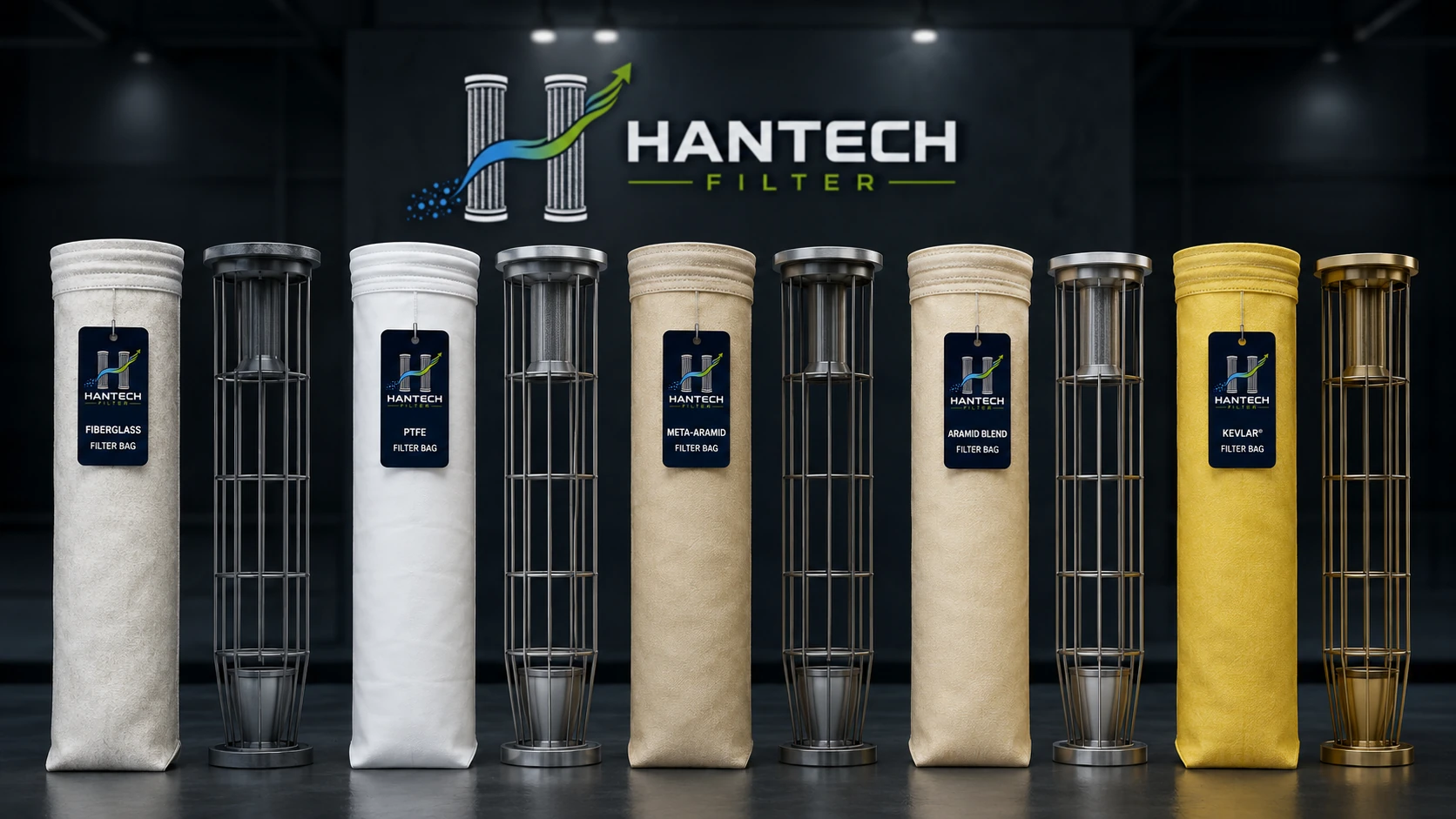
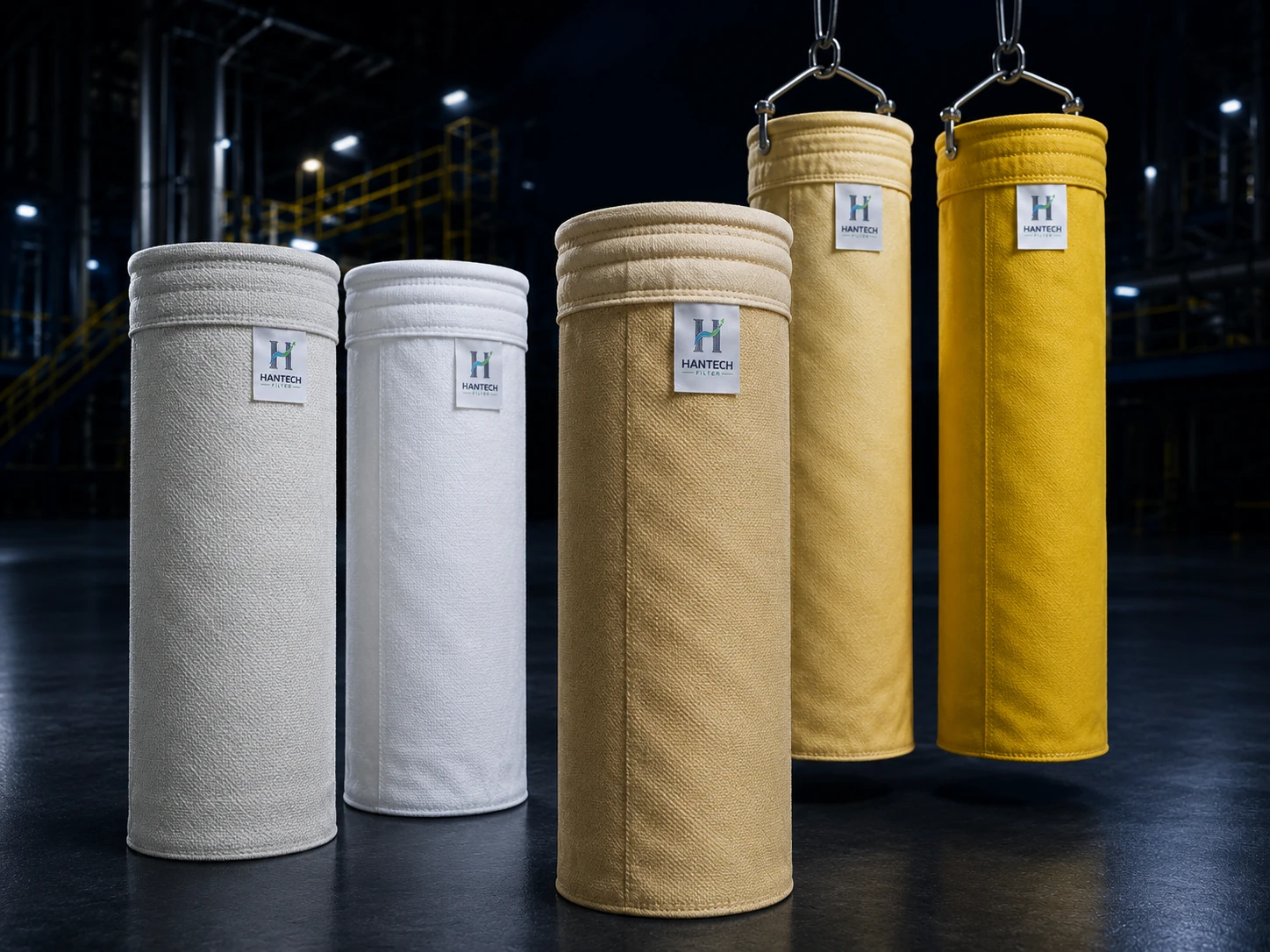
Polyester/PES filter bags are an economical and strong option in dry, moderate-temperature processes, but moisture, hydrolysis, high temperature, and fine dust behavior must be correctly assessed.
What Is a Polyester / PES Filter Bag?
Polyester PES filter bags are one of the most widely used economical needle-felt media families in baghouse filters. Under the right conditions, they offer a balanced cost/performance profile for cement packaging, silo-top filters, feed, food, mineral, wood/MDF and many other dry dust processes.
The advantage of a PES bag is not that it works under all conditions; it is that it is cost-effective under the right temperature, humidity, and chemical conditions. Hantech evaluates PES not as a cheap substitute for premium media, but as a strong primary option when process limits allow.
Operating Temperature and Humidity Limit
As a general RFQ/educational basis, for PES, normal operation should be taken as 110-140°C, continuous maximum as 140°C, and short peak as 150°C. The 150°C value should be read as a short-term limit, not a comfortable continuous operating value.
| Condition | PES COMMENT | Risk |
|---|---|---|
| Dry 80-130°C process | Strong economic candidate | Dust fineness and A/C ratio are checked |
| 140°C continuous | Border region | Datasheet and actual temperature record are required |
| Humidity + temperature | Approach with caution | Hydrolysis and dP increase |
| Above 150°C | Generally not recommended | Alternatives such as Aramid/PPS/P84 are reviewed |
Areas of Use
| Sector | Typical spot | Hantech note |
|---|---|---|
| Cement | Packaging, silo, and some mill surroundings | PES 500 glaze/WOR is frequently considered |
| MDF Wood | Sawdust and fiber powder | Spark/antistatic risk is assessed separately |
| Food/feed | Transfer and screening | Hygiene and moisture behavior are checked |
| Mineral | Dry grinding/packaging | Abrasiveness and micron distribution are important |
The Difference Between PES, Antistatic PES, and Oil-Water Repellent PES
Standard PES is for dry processes. Antistatic PES, built with carbon/conductive fiber, is considered when there's a flammable/explosive dust risk; but it doesn't replace a full ATEX design on its own. Oil-and-water repellent PES can improve cake release in medium-temperature processes with moisture or aerosol behavior, but it shouldn't be treated as a chemical-resistant media.
When Should I Choose to GIVE UP?
Sample A/C Comment
Example
- Flow Rate
- 36,000 m³/h
- Bag
- Ø160 x 5,000 mm
- Quantity
- 160
- Area
- 160 x π x 0.16 x 5 = 402 m²
- A/C
- 36,000 / 60 / 402 = 1.49 m/min
This value can be risky with fine, moist dust. Before selecting PES, dust particle size, moisture, dP trend, and surface finish should be checked.
Information for Quotes and Related Links
For a PES filter bag, diameter, length, quantity, weight, surface treatment, temperature, moisture, dust type, dP trend, cage size, and snap-band information are required. You can submit this data via the quote form. Filter bags, the bag types guide, and the dP guide can be read together.
Frequently Asked Questions
At what temperature does a PES filter bag operate?
The general basis is 110-140°C normal, 140°C continuous upper limit, and 150°C short peak; manufacturer data should be verified.
Can PES bags be used in humid processes?
Moisture and temperature together create risk. A hydrophobic/oleophobic surface finish or alternative media may be required.
Should PES or PTFE be selected?
If the process stays within PES limits, PTFE is not automatically required; chemistry/temperature/emission targets must justify PTFE.
Engineering Selection Parameters: Media Name Alone Is Not Enough
When selecting a filter bag, the media name is only a starting point. The same PES / polyester bag can run stably under a low A/C ratio, dry dust, and a properly functioning pulse system, but under high airflow, a damp cake, a poor cage, or an incorrect snap-band size, it can develop a dP or emission problem within a short time. That is why, in Hantech's evaluation, the bag is read together with the fan, filter area, cage, cell plate, pulse valve, and hopper behavior.
| Parameter | - why it is critical | Data requested for the quote |
|---|---|---|
| Normal / peak temperature | Media aging, shrinkage, and seam strength | Shift records, alarm history |
| Moisture and dew point | Sticky cake, hydrolysis, or chemical aging | Gas moisture, insulation, start-stop behavior |
| Gas chemistry | SOx/SO3, NOx/NO2, HCl, HF, O2, and an alkaline environment change media life | Gas analysis or process recipe |
| Powder micron distribution | 1-3 µm dust embeds into the felt; coarse abrasive dust wears down the housing | Particle analysis or site observation |
| A/C ratio | High filtration velocity causes rising dP and short bag life | Flow rate, bag diameter-length-count |
| dP trend | Indicates blinding, leaks, or inadequate cleaning | Pa/mmWG chart after new bags |
| Cage outer diameter and surface | Incorrect OD, burrs, or rust mechanically abrade the bag | Cage photo, OD, wire count |
| Snap-band / cell plate | Mouth leakage produces low dP + high emissions | Hole diameter, sheet thickness, bead detail |
This approach matters especially for PES / polyester, because on site the problem often looks like 'bad media' when the root cause may actually be the A/C ratio, pulse energy, moisture, cage surface, or collar sealing.
Which Field Symptom Changes Which Decision?
| Site indication | Possible root cause | Hantech approach |
|---|---|---|
| dP rises above 1800-2200 Pa after new bags | High A/C, fine dust penetration, moist cake, or weak pulsing | Surface treatment/membrane need and filter area are checked together |
| Low dP but dust at the stack | Filter bag tear, snap-band leakage, or bypass | Cell plate, collar detail, and cage contact marks are checked |
| Vertical wear on the filter bag body | Cage burrs, incorrect OD, or bag chafing | Bag performance cannot be upgraded without replacing the cage surface and wires/rings |
| Dust traces at the filter bag top | Snap-band isn't seating properly, or sheet thickness is wrong | Double cord, band size, and hole tolerance are re-measured |
| dP increases on humid days | Dew point, condensation, or sticky cake | Thermal insulation, hydrophobic surface, and process control are evaluated together |
This table is used at the quoting stage to avoid selling the customer an unnecessary premium media. If the symptom stems from a mechanical or process issue, choosing a more expensive bag will not be a lasting solution.
Comparison with Alternative Media
PES is usually the correct first candidate; but comparison with PPS, Aramid, P84, or PTFE is made only once temperature/chemistry limits are reached. Hantech's approach is not to push a single brand or the most expensive option, but to balance the most economical, safe solution that is adequate against process risk.
| Comparison criterion | Comment for this media | Alternative decision |
|---|---|---|
| Heat | 110-140°C is taken as normal operation, 140°C as the continuous upper limit, and 150°C as the short-term peak basis. | If the limit is exceeded, a higher-grade media is considered |
| Fine dust / low emission | A need for surface treatment or a membrane can arise | ePTFE membrane, P84, or PTFE is compared |
| Moisture / acid | Media chemical resistance is not read on its own -- it's assessed together with dew point | Options such as PPS/PTFE/fiberglass PTFE may be required |
| Mechanical risk | Cage and installation errors can ruin even good filter media | The cage/snap-band/pulse system is corrected first |
| Expense | Premium media is selected only when there is a real risk or target | Adequate candidates such as PES/PPS/Aramid are not ruled out |
I Would Not Choose PES / Polyester Under These Conditions
Worked Example: PES 500 g/m² Packaging Filter
Sample account and comment
- Flow Rate
- 60,000 m³/h
- Bag size
- Ø160 x 6,000 mm
- Bag count
- 240
- One bag area
- π x 0.16 x 6.0 = 3.02 m²
- Total Area
- 240 x 3.02 = 724.8 m²
- Gross A/C
- 60,000 / 60 / 724.8 = 1.38 m/min
- First decision
- PES / polyester is evaluated based on dust micron size, moisture, and dP trend
This example value is not good or bad on its own. 1.38 m/min may look acceptable for dry, medium-grain mineral dust, but risky for fine (1-3 µm), sticky, or moist dust. If dP rises quickly after a new bag is installed, the surface finish, pulse energy, filter area, and inlet distribution should be reviewed together, not just the media.
PES, with the right A/C ratio and surface treatment, is one of the most economical primary candidates in dry, medium-temperature processes. However, this choice should not be turned into a final quote until cage surface and snap-band fit are verified.
RFQ / Quotation Checklist
A complete quotation for PES / polyester bags requires more than just dimensions and quantity. The minimum data set is: bag diameter, bag length, quantity, top connection type, bottom cap detail, current media and weight (gsm), surface finish, normal/peak temperature, moisture or dew-point risk, gas chemistry, dust type, particle size distribution, dP trend, target emission level, cage outer diameter, cell-plate hole, sheet thickness, pulse pressure, and photos of the current bag/cage.
Once this information is available, Hantech evaluates filter bags, filter cages, pulse-jet valves, and if needed performance measurement together. You can submit the data via the quote form.
Technical Review Note
Technical review: Doğuhan Kırmacı — industrial filtration, dust collection systems and filter bag selection applications.
This content has been prepared by comparing process data, manufacturer technical limits, field failure behavior, and bag-cage-pulse compatibility. The values here are for preliminary selection; the final selection must be verified against the manufacturer's datasheet, site measurements, and process conditions.