
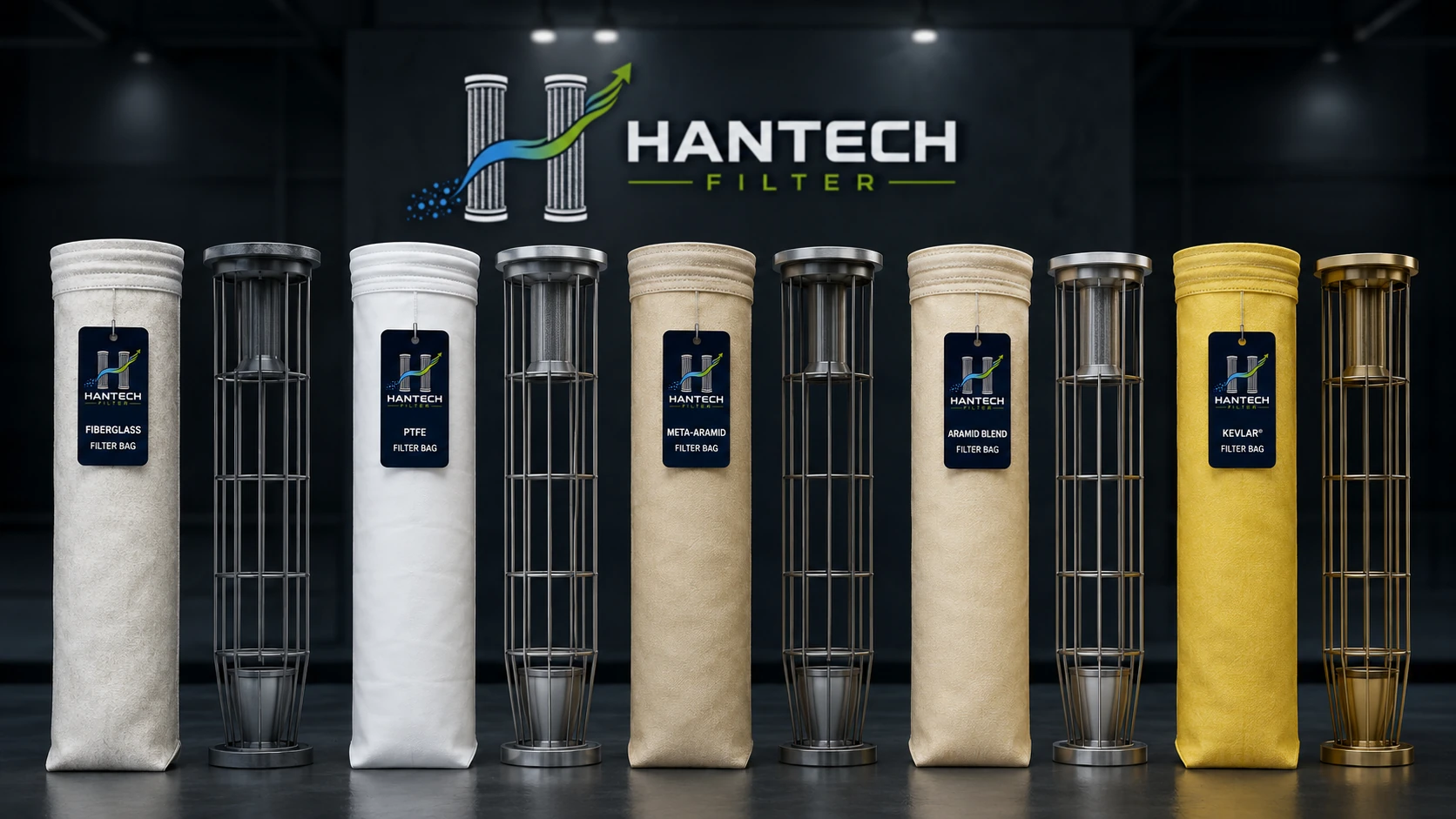
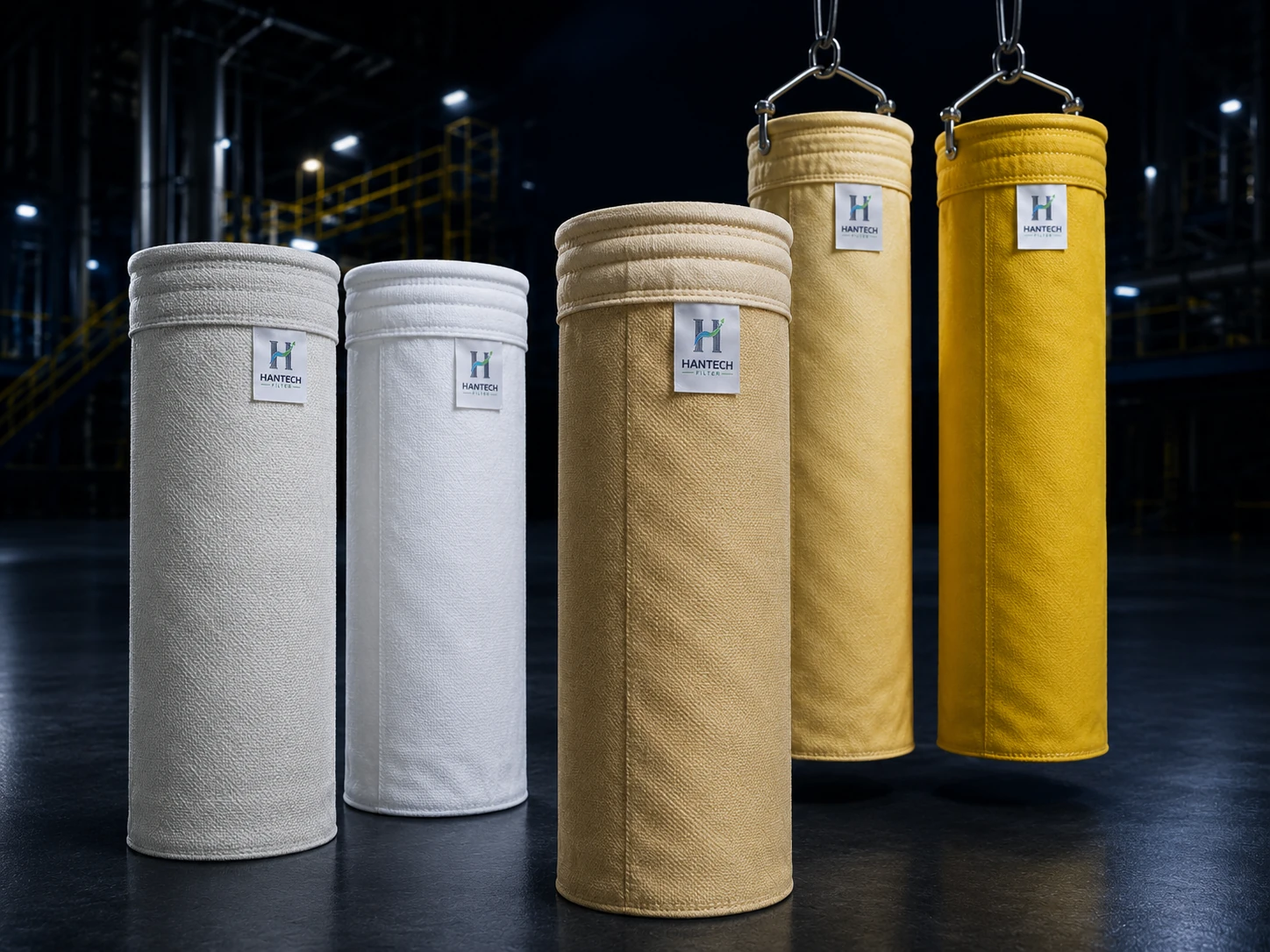
Oil-water repellent filter bags are considered for medium-temperature processes involving moisture, light oil/aerosol, and sticky cake behavior. They should not be automatically treated as a chemical-resistance or membrane solution.
What Is an Oil and Water Repellent Filter Bag?
Water-oil repellent filter bag is a family of filter bags in which a hydrophobic and/or oleophobic surface treatment is applied, mostly on polyester/PES base media. The goal is to reduce dust adhesion to the felt caused by water droplets, a damp cake, or light oil/aerosol, and to help keep differential pressure behavior more stable.
The values shown are general references for technical selection. Hantech Filter assesses the suitability of a water- and oil-repellent (WOR) finish using process data and defines the scope of dimensional and construction checks, verified sourcing and site application support. Final limits must be verified against the base media data sheet and actual site conditions.
In Which Processes Is It Considered?
| It's a must. | Oil-water repellent bag assessment | Hantech decision |
|---|---|---|
| Damp mineral or cement packaging dust | WOR finish can help improve cake release behavior. | Dew point, ambient humidity, start-stop cycles, and dP trend are requested together. |
| Light oil/aerosol trace | An oleophobic surface treatment can be considered. | Selection is not finalized until the oil source, temperature, and gas analysis are clarified. |
| Dry and stable powder | Standard PES may be sufficient. | No unnecessary finish cost is incurred. |
| Aggressive acid/alkali chemistry | WOR finish is not a chemical-resistance media. | PPS, PTFE, or a different media family is compared. |
| Fine 1–3 µm dust + low-emission target | Finish alone does not provide surface filtration. | The ePTFE membrane, A/C ratio, and pulse behavior are evaluated separately. |
WOR Finish, Membrane, and Base Media: The Distinction
Oil-water repellent finish is a surface treatment that changes the base media's water/oil-holding behavior. An ePTFE membrane, on the other hand, forms a separate surface-filtration layer. For this reason, a WOR bag does not automatically substitute for a membrane, nor does a membrane automatically substitute for WOR finish in every moisture problem. The root cause is identified first: is it moisture/dew point, oil aerosol, fine dust penetration, or high A/C ratio with insufficient pulsing?
Field dP check example
- Process
- Cement packaging filter
- Recording
- dP of 900–1200 Pa on dry days; a rapid rise above 1800 Pa on humid days
- Control
- Ambient/process humidity, dew point, pulse tank pressure, A/C ratio, dust fineness, and existing bag surface area are examined together.
- Comment
- WOR PES can be a candidate; but if condensation continues, the finish alone will not be a lasting solution.
Oil-Water Repellent PES vs. Standard PES, Antistatic, and Membrane: A Comparison
| Option | Strong side | Critical risk | Hantech comment |
|---|---|---|---|
| Standard PES | Economic dry process | dP increase in damp/sticky cake | Can be the first candidate if conditions are dry. |
| Oil-water repellent PES | Cake release support under moisture/aerosol effects | Is not a guarantee of chemical resistance or emissions. | Justified with the dP trend and humidity data. |
| Antistatic PES | Contributes to static charge control | Doesn't solve the moisture/caking problem on its own. | Evaluated separately if there is a combustible dust risk. |
| ePTFE membrane | Surface filtration for fine dust and low emission targets | Cost, filter cage/pulse compatibility, and cleaning pressure | Justified by dust micron size and the emission target. |
| Media change such as PPS/PTFE | May be required at temperature/chemistry limits | Unnecessary premium cost | Compared when base PES limits are exceeded. |
I Would Not Choose an Oil-and-Water Repellent Bag Under These Conditions
Hantech's approach is not to make an oil-and-water-repellent (WOR) finish the automatic answer to every dP problem. If moisture/aerosol is genuinely the root cause, WOR makes sense; if the problem is pulse settings, A/C ratio, false air, or the wrong media, that root cause is corrected first.
Information Required for a Quote
Minimum data set for a quote: normal/peak temperature, process humidity, dew point risk, oil/aerosol source, dust type/particle size/stickiness, dP trend, emission target, filter bag diameter/length/quantity, top/bottom construction, snap-band, cage OD/surface condition, pulse pressure, current filter bag finish information, and failure photos.
You can send this information via the water-oil repellent filter bag technical quote form. For the general product family, review the filter bags by process condition, including water-oil repellent options page.
Related Technical Guides
To clarify the decision, the oil-water repellent polyester filter bag guide, polyester PES filter bags, antistatic filter bags, PTFE membrane filter bags, and the guide to rising differential pressure can be read together.
Frequently Asked Questions
Is an oil-water repellent filter bag waterproof?
No. This is a surface treatment for a process filter; it should not be read as a guarantee of absolute water resistance or trouble-free operation under condensation.
Can a WOR bag replace a membrane bag?
No. A WOR finish helps with moisture/aerosol behavior, while the membrane is a separate structure for fine-particle and surface filtration.
Does an oil-water repellent bag increase chemical resistance?
Chemical resistance is determined by the base media and the process gas. Under heavy acid/alkali risk, not just the finish but the entire media family should be reselected.