
Pressure drop in a baghouse filter can rise due to a high A/C ratio, incorrect bag media, moist or fine dust, weak pulse-jet cleaning, the fan operating point, and hopper discharge problems. When the dP trend is read correctly, bag life, extraction performance, and energy consumption can all be improved together.
What Is Pressure Drop in Baghouse Filters and Why Is It a Critical Indicator?
Pressure drop in a baghouse filter is the differential pressure between the dirty-air side and the clean-air side, and it is usually monitored in Pa or mmWG. In a new or healthy filter, dP fluctuates within a certain band: dust cake builds up, pulse-jet cleaning engages, and the pressure drops again. When this rhythm breaks down, the plant experiences it as reduced suction, a strained fan, high energy consumption, filter bag blinding, or a leak risk at the stack.
dP by itself is not the name of a failure; it is the pulse of the system. A high dP can indicate that the bag is dirty, but it can equally mean the wrong media was selected, excess air flow, damp dust, weak pulsing, a clogged hopper, an incorrect fan operating point, or a process change. This is why, when evaluating a baghouse filter system, Hantech Filter reads the dP trend together with the bag, cage, pulse-jet valve, fan, and dust characteristics.
The practical read is this: if dP settles in the 900–1100 Pa range after a new bag and drops in a controlled way after cleaning, the system can be considered stable. If dP climbs above 1800–2200 Pa shortly after a new bag and does not drop after cleaning, replacing the valve alone is usually not enough — the entire process must be checked.
How Should the dP Trend Be Read?
| dP behavior | Possible meaning | First Check |
|---|---|---|
| Rapidly above 1800-2200 Pa with new bags | High A/C, incorrect media, fine dust penetration, or moist cake | Flow rate, bag area, dust particle size, moisture, and media surface |
| dP not dropping after the pulse | Cleaning energy is insufficient, or the dust cake is not releasing from the filter bag | Valve, tank pressure, blow pipe alignment, pulse duration |
| Low dP + high emissions | Leakage, bypass, or incorrect snap-band seating | Filter bag top, cell plate, cage, and leak test |
| Gradual rise within a shift | Hopper discharge, process load, or moisture variation | Rotary airlock, screw conveyor, shift production load |
| Pulsing too frequently but dP still high | May not be a cleaning system problem, but a media/process mismatch | Dust stickiness, filtration velocity, membrane/surface treatment |
The dP trend should be read from a time-based graph, not an instantaneous reading. The same filter running at 1100 Pa in the morning, 1900 Pa in the afternoon, and back to 1300 Pa at night may be related to process humidity, production flow rate, or hopper discharge pattern. A consistently high dP, on the other hand, points to bag blinding or a systematic pulse-cleaning shortfall.
High A/C Ratio and Insufficient Filter Area
The A/C ratio, or air-to-cloth ratio, indicates the volume of air passing through the filter surface per minute. When flow rate increases, or when the number/area of filter bags is insufficient, dust strikes the bag surface at a higher velocity. This causes the dust to become embedded in the felt, the cake to compact, and dP to fail to drop sufficiently after pulsing. Especially with fine 1-10 µm dust, a high filtration velocity can cause much faster blinding.
Sample A/C calculation
- Flow Rate
- 60,000 m³/h
- Bag size
- Ø160 x 6,000 mm
- Bag count
- 240
- One bag area
- π x 0.16 x 6.0 = 3.02 m²
- Total Area
- 240 x 3.02 = 724.8 m²
- A/C
- 60,000 / 60 / 724.8 = 1.38 m/min
This value is not good or bad on its own; it must be interpreted together with the dust's particle size, moisture, stickiness, and emissions target. The same A/C ratio produces different results across processes such as fine cement dust, clinker dust, or raw meal. If flow has been increased on an existing filter without increasing bag area, a rise in dP can become unavoidable.
Incorrect Bag Media, Moisture, and Dust Character
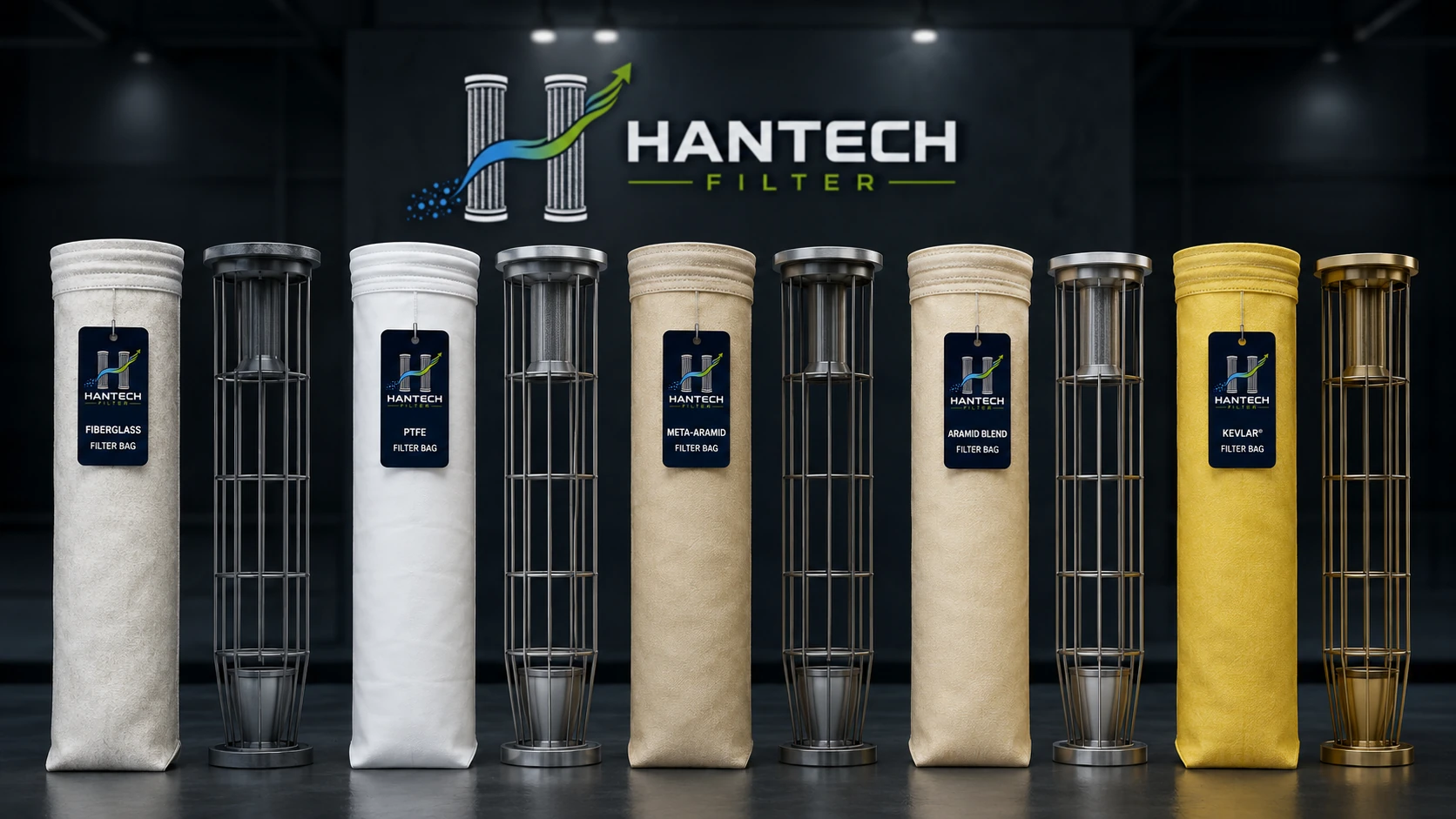
If filter bag selection is made based on temperature limit alone, the pressure drop problem gets overlooked. Dust particle-size distribution, particle shape, abrasiveness, moisture, oily/sticky behavior, and dew point risk all directly affect dP. Polyester bags can be economical in dry, standard-temperature processes; but with moist, fine dust, if a suitable surface finish is not used, the dust embeds into the felt and cleaning becomes difficult.
| Process requirement | dP risk | Technical approach |
|---|---|---|
| Dry, medium-coarse mineral dust | Controllable | Economical media such as PES/PPS can be considered. |
| Fine 1-3 µm dust + low-emission target | High penetration and blinding risk | An ePTFE membrane or special surface finish may be required. |
| Operation close to the dew point with moisture | Sticky cake and rapid dP rise | Process temperature, insulation, and hydrophobic surface are checked. |
| SOx/NOx/HCl/HF chemistry | Media aging and permeability change | Media is selected using the chemical compatibility table. |
| Abrasive coarse particles | Filter bag damage and leakage | Pre-separator, inlet distribution, and cage compatibility are examined. |
A PTFE membrane is not the automatic answer to every high-dP problem. If the problem stems from fan flow rate, hopper discharge, or pulse misalignment, a membrane bag can also run into trouble in short order. A membrane is a strong candidate when fine-dust penetration, a low emission target, or a need for surface filtration is clearly the issue.
Pulse-Jet Cleaning, Valve, and Compressed Air Faults
The pulse-jet system is the active side of dP management. If the valve fails to open, the diaphragm is torn, the solenoid coil isn't receiving a signal, tank pressure drops too fast during the pulse, or the blow-pipe holes are misaligned with the bag centerline, the dust cake won't release from the bag. In that case, operators usually respond by increasing the cleaning frequency; but if the real problem is insufficient energy or misalignment, more frequent pulsing only damages the bags without permanently lowering dP.
On a general educational/RFQ basis, aggressive cleaning pressures such as 5-6 bar should not be used on PTFE membrane bags. For membrane bags, a 3-4 bar approach with a maximum of 4 bar is safer; higher values should only be considered with manufacturer and process approval. Higher pressure, combined with an incorrect cage or venturi, can cause mechanical damage to the bag surface.
Fan Operating Point and System Pressure Chain
Baghouse filter pressure drop must be evaluated together with the fan. A fan cannot be considered adequate based on motor kW alone; the actual flow-static pressure curve must be read. Duct resistance, elbows, filter dP, any additional pressure loss from a cyclone or damper, the stack line, and the production load all add up in the same chain. When filter dP rises, fan flow can drop; when flow drops, dust leakage can begin at the extraction points.
If a revision is planned on an existing line, rather than simply replacing the filter bags, the fan's operating point and duct losses should also be measured. In some plants dP appears high, but the real issue is an incorrect damper position, a blocked duct, or an unbalanced/fouled fan wheel. For this reason, performance measurement is a valuable diagnostic step for high dP complaints.
When Is a Filter Bag Change Enough, and When Is a Retrofit Required?
Hantech approaches this decision not only from a sales perspective but from an operating-cost perspective. On a site where the real problem is not addressed, even the most expensive bag can have a short service life; conversely, with the correct pulse setting and a suitable cage, a more economical media can run stably for a long time.
What Information Is Needed for a Quote?
For a technical evaluation of a high dP problem, please provide the current filter type, bag diameter/length/quantity, bag media, cage size, fan data, approximate flow rate, process temperature, dust type, moisture/dew point, date of last bag change, dP trend, pulse pressure, number of valves, tank volume, and stack measurement results if available. Photos and a short video — especially of blow pipe alignment and the bag surface — speed up diagnosis.
You can submit your data through the quote form. This topic should often be evaluated together with pulse-jet valve failure, filter bag selection, and filter cage selection.
Frequently Asked Questions
What should the normal pressure drop be in a baghouse filter, in Pa?
There is no single value. It depends on filter type, filter bag media, dust load, and A/C ratio. On many sites, the trend matters more than the absolute value.
If dP rises, what should be checked first?
Flow rate, bag area, pulse pressure, valve operation, moisture/dew point, bag surface, and hopper discharge should be checked together.
Does high dP always mean the bags need replacing?
No. A pulse-jet problem, fan operating point, damp dust, or hopper blockage can also cause high dP.
Does a membrane filter bag solve a dP problem?
Can help when there is fine dust penetration or a low emission target. However, a membrane alone is not a guarantee unless fan, pulse, or humidity issues are resolved first.
Does increasing pulse frequency lower dP?
It can temporarily lower it; however, unnecessarily frequent pulsing increases air consumption and can shorten bag life.