
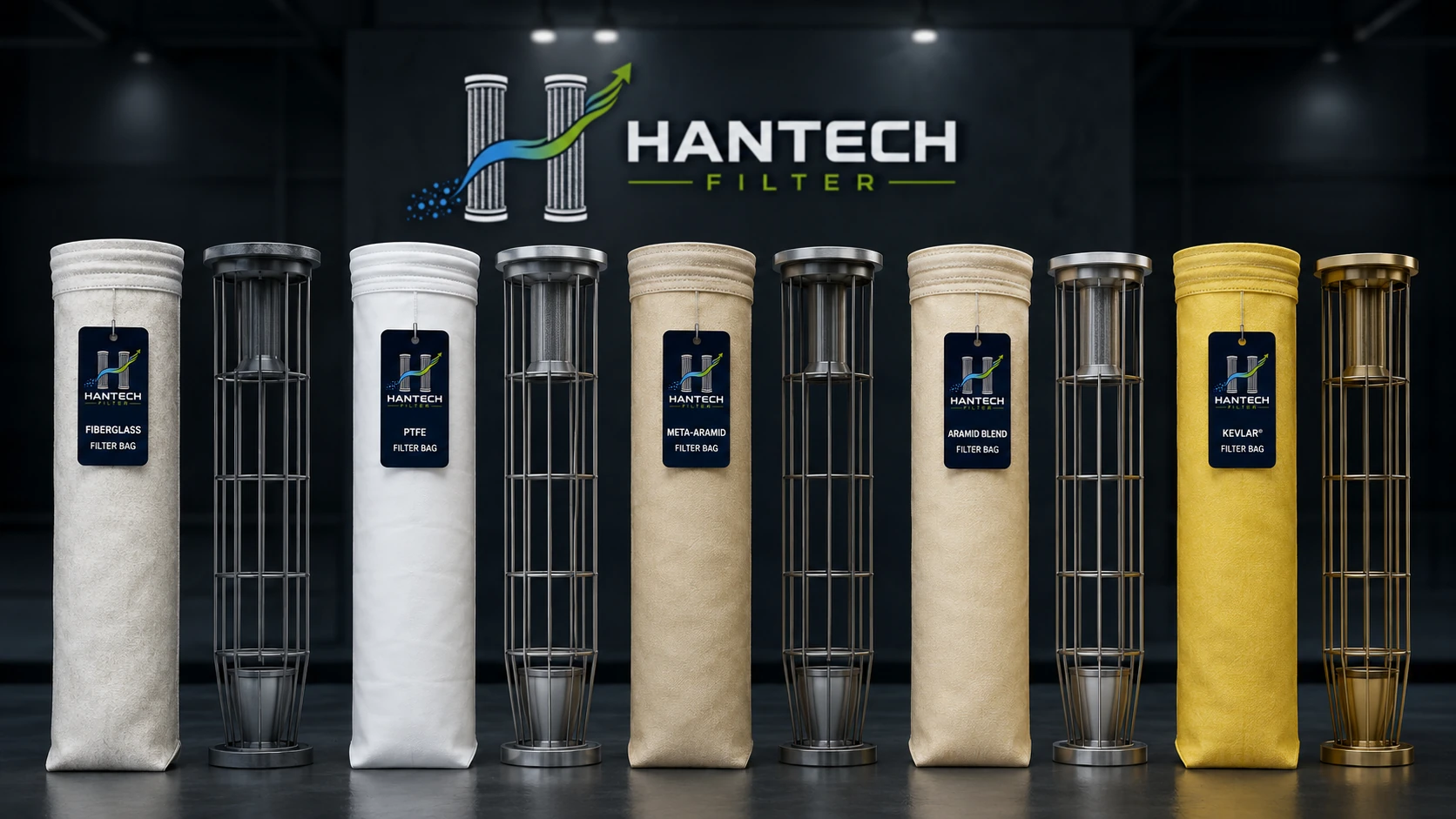
Fiberglass PTFE filter bags are evaluated based on process data for high-temperature, chemical-risk and low-emission targets. Hantech Filter provides technical selection, verified sourcing and field application support.
What Is a Fiberglass PTFE Filter Bag?
Fiberglass PTFE filter bags are a high-temperature filter bag family produced by applying surface/chemical protection layers — such as PTFE coating, PTFE impregnation or ePTFE membrane — onto a fiberglass carrier structure. They are considered in cement, lime, asphalt, foundry, power generation and hot mineral processes where standard polyester/PES or PPS limits are exceeded.
The values shown are general references for technical selection. For this product, Hantech establishes dimensions, process conditions, bag-to-cage compatibility, packaging and the technical scope of supply. Final selection must be verified against the manufacturer's data sheet and site data.
In Which Processes Is It Considered?
| Process requirement | Technical commentary | Hantech PRE-MANUFACTURING decision |
|---|---|---|
| Hot gas above 200°C + dry mineral dust | A fiberglass carrier can be a strong candidate for high temperatures; a PTFE/ePTFE surface can help with cake release and emission targets. | An RFQ is not closed until cage surface, A/C ratio, pulse settings, and wear photos have been checked. |
| Fine dust + low mg/Nm³ target | An ePTFE membrane can strengthen surface filtration; the carrier media's temperature limit must also be verified. | The need for a membrane is justified by the emission target, dust micron size, and dP trend. |
| Moisture + acid dew point risk | PTFE can provide a chemical resistance advantage; but condensation increases both mechanical and chemical risk. | SOx/NOx/HCl/HF, moisture, O₂, and peak temperature are all needed together. |
| Worn/burred cage, misaligned blow pipe | Fiberglass brittleness can lead to early failure. | Cage/venturi/pulse improvements are required first; simply replacing the filter bag is not considered sufficient. |
Temperature, Chemical Risk, and ePTFE Membrane Decision
The decision for a fiberglass + PTFE construction is not made from a temperature table alone. Normal/peak temperature, SOx/SO3, NOx/NO2, HCl, HF, O₂, moisture, dew point, dust micron size, and target emissions are read together. An ePTFE membrane can be a strong candidate for fine dust and a low emission target; however, the membrane does not automatically raise the temperature limit of the carrier media.
Worked A/C Ratio Check Example
- Flow Rate
- 180,000 Am³/h
- Bag count
- 6,000 pcs
- Bag size
- Ø160 × 6,000 mm
- One bag area
- π × 0.16 × 6.0 = 3.02 m²
- Gross filter area
- 6,000 × 3.02 = 18,120 m²
- Gross A/C
- 180,000 / 60 / 18,120 = 0.166 m/min
Even when the gross A/C looks low in this example, the fiberglass PTFE decision is not made on filter area alone. The offline compartment effect, peak temperature, gas chemistry, moisture/dew point, cage surface, pulse pressure, and bag installation risk are all checked together.
Cage, Venturi, and Pulse Pressure Compatibility
Fiberglass fabric is not as mechanically forgiving as polyester or PPS. Cage weld burrs, incorrect OD, rust, a missing venturi, misaligned blow pipe, or aggressive pulse pressure can cause the bag to crack or tear quickly. For sensitive high-temperature bags, a smooth cage, correct wire count, venturi, and controlled cleaning pressure should be treated as part of the quotation scope.
I Would Not Choose Fiberglass PTFE Under These Conditions
What matters here is that Hantech makes an engineering decision rather than a sales decision: if a more economical media safely meets the process limits, we do not try to sell fiberglass PTFE; and if there is a genuine need for high temperature resistance, chemical resistance, or low emissions, we do not simply recommend the cheapest bag either.
Information Required for a Quote
Minimum data set for a quote: flow rate, normal/peak temperature, gas chemistry, humidity/dew point, O₂, dust type, particle size distribution, abrasiveness, stickiness, filter bag dimensions, top/bottom construction, snap-band size, tube sheet thickness, cage OD/wire count/venturi, pulse pressure, dP trend, emission target, and current failure photos.
You can send this information via the technical quote form for fiberglass PTFE filter bag. For the general product family, review the industrial filter bags and technical sourcing page.
Related Technical Guides
To clarify the decision, you can read the fiberglass PTFE filter bag selection guide, when to use a PTFE membrane filter bag, and how to choose a filter bag together.
Frequently Asked Questions
At what temperature is a fiberglass PTFE filter bag used?
The fiberglass family can be a candidate in many high-temperature applications; however, the actual continuous and peak limits must be verified against media construction, PTFE finish, sewing thread, manufacturer datasheet, and process gas.
Is an ePTFE membrane required on every fiberglass filter bag?
No. The need for a membrane must be justified by fine dust, a low emission target, cake release behavior, and the dP trend.
Can a poor-quality filter cage ruin a premium filter bag?
Yes. A burred, rusty, incorrectly sized, or venturi-less cage creates a risk of premature mechanical damage to fiberglass/PTFE bags.