
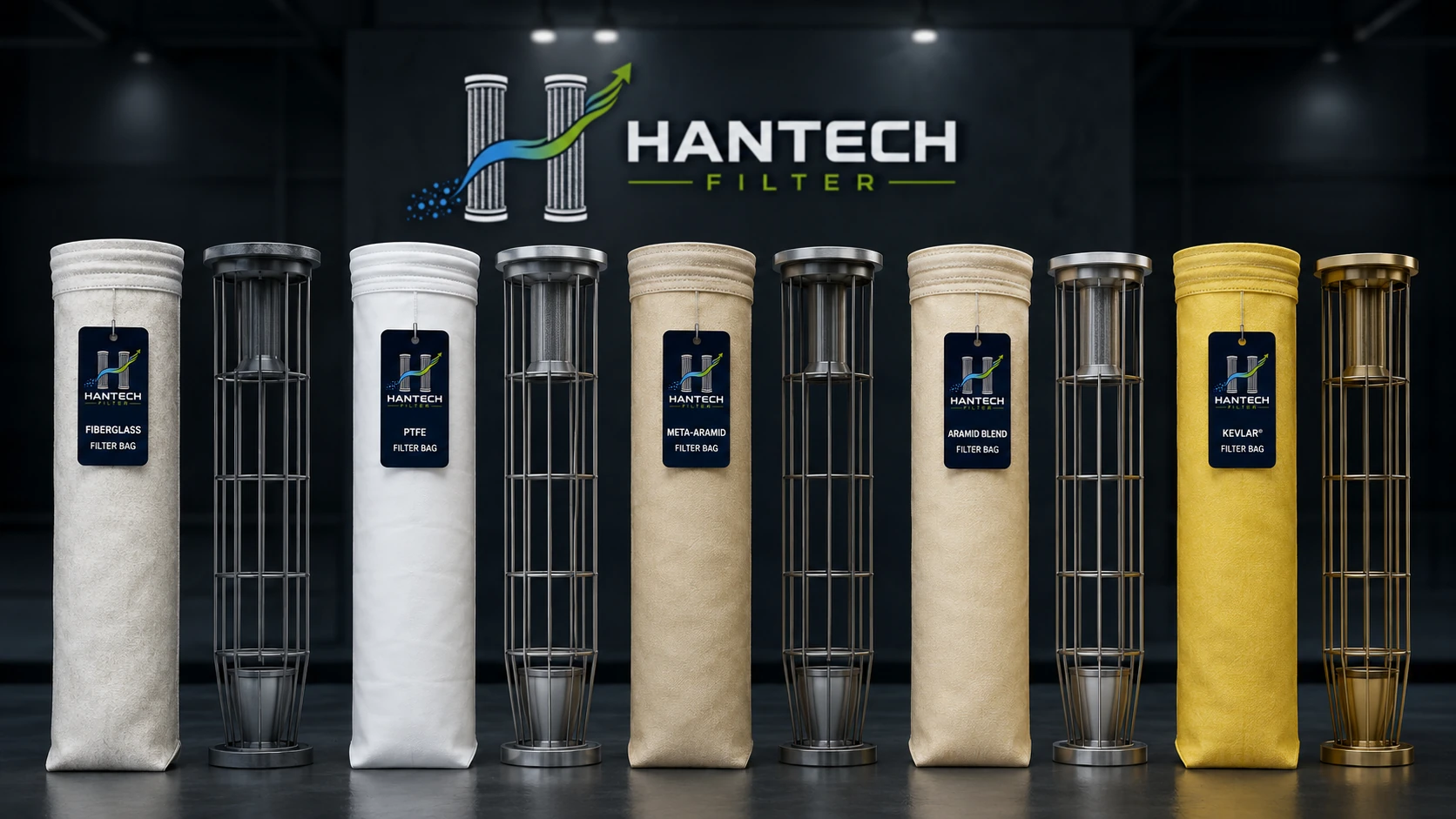
Fiberglass PTFE filter bags are a strong option in heavy-duty processes that combine high temperature, chemical resistance and low-emission requirements. However, because of the brittle nature of glass fiber, an expensive bag can be damaged in a short time if the cage, pulse pressure, installation and packaging conditions are not properly managed.
What Is a Fiberglass PTFE Filter Bag?
Fiberglass PTFE filter bags are high-temperature filter bags produced by applying surface/chemical protection layers — such as PTFE coating, PTFE impregnation or ePTFE membrane — onto a woven or needle-punched fiberglass structure. These bags are particularly considered in processes such as cement, lime, asphalt, foundry, power generation, boilers, mineral drying and hot gas filtration, where standard polyester or PPS limits are exceeded.
The main advantage of fiberglass is its dimensional stability and chemical resistance potential at high temperature. The PTFE layer can strengthen the bag for surface filtration, chemical resistance, cake release, and low-emission targets. But this construction is not mechanically "forgiving." A poor cage surface, high pulse pressure, sharp bending, crushing during transport, or incorrect installation can drive a fiberglass bag to failure very quickly.
For this reason, Hantech does not select a fiberglass PTFE bag merely because it "withstands high temperature." Gas chemistry, moisture/dew point, particle abrasiveness, A/C ratio, cage surface, venturi compatibility, pulse settings, and maintenance discipline are all evaluated together.
How Does the Fiberglass + PTFE Construction Work?
When dusty hot gas reaches the bag surface, filtration behavior is determined not only by the glass fiber but also by the PTFE treatment on the surface. A PTFE membrane or coating can reduce fine dust from embedding into the fabric and help the cake form more on the surface. This provides an advantage for low emission targets and in some processes with a risk of caking/blinding.
However, fiberglass fibers are not as flexible as polyester or PPS. Because of the brittle nature of the fiber, the bag is sensitive to abrasion where it contacts the cage, to folding during installation, and to aggressive pulse impacts. For this reason, a properly designed fiberglass bag is never specified on its own — it is considered together with a smooth cage, the correct wire count, a matching venturi, controlled cleaning pressure, and dedicated packaging.
Why Are Cage and Bag Tension Critical in Selection?
In a fiberglass PTFE bag, the cage is not simply a part that supports the bag; it is the main contact surface that determines the bag's mechanical life. For sensitive high-temperature and membrane bags, instead of a light 10/12-wire cage, most heavy-duty applications should use a 20-wire, venturi-equipped cage compatible with membrane bags. The cage material — SS304, galvanized, or coated — is additionally verified against the gas chemistry.
The bag must sit taut and straight on the cage. A bag that is loose, wrinkled, twisted, or billowing on the cage rubs during pulsing, causes micro-fracturing in the glass-fiber filaments, and increases the risk of early failure at the seams and neck. For this reason, a final selection should not be made until cage outer diameter, cage length, bag length, snap-band/cell-plate fit, cell-plate sheet thickness, and bottom clearance are verified against site measurements.
Technical Figures: Typical Value, Manufacturer Data, or Design Limit?
| Parameter | Typical engineering commentary | Welding discipline |
|---|---|---|
| Working temperature | The fiberglass family is considered in the high-temperature class; for some applications the 240-260°C range is discussed. | Manufacturer data + process gas record required. |
| Short peak temperature | Higher peaks can occur; the bag, stitching, and surface finish are checked separately. | Not a design limit; project-specific confirmation is required. |
| Pulse pressure | For membrane/sensitive surfaces, a controlled low-pressure approach is required for training/RFQ purposes. | Field recommendation; verified against the valve/blow-pipe/OEM design. |
| Chemical resistance | PTFE is a very strong candidate; but humidity, acid gas, and temperature are read together. | A manufacturer chemical resistance chart and process analysis are required. |
| Risk of vulnerability | Fiberglass is sensitive to handling, installation, and cage friction. | Field experience and installation quality control. |
These values should not be read as a universal law from Hantech. The actual allowable temperature, cleaning pressure, and chemical resistance vary with media construction, PTFE finish type, the bag manufacturer's datasheet, the filter OEM's design, cage/venturi geometry, gas composition, moisture, and operating discipline.
Hantech Selection Matrix: When Does Fiberglass PTFE Make Sense?
| Process requirement | Fiberglass PTFE assessment | Hantech decision |
|---|---|---|
| High temperature + dry mineral dust | He/she can be a strong candidate | The cage, A/C ratio, and wear are checked. |
| High temperature + acidic/corrosive gas | PTFE can provide a chemical benefit. | SOx/NOx/HCl/HF/moisture are all needed together. |
| Low-emission target + fine dust | PTFE membrane provides a surface-filtration advantage. | Pulse pressure, venturi, and compatibility with the 20-wire cage are checked specifically. |
| High mechanical impact / poor cage | At risk | The cage/flow/installation issue is resolved first; the bag is verified to sit taut on the cage. |
| Standard 110-140°C dry process | This is often an unnecessary premium. | Economical candidates such as PES/PPS are examined first. |
| Damp operation close to the dew point | The risk of blinding and sticking increases. | Insulation, temperature control, and a hydrophobic approach are evaluated. |
Comparison of PES, PPS, Aramid, P84, and Fiberglass PTFE
| Media | Area of strength | Weak/risky area | Hantech comment |
|---|---|---|---|
| PES / Polyester | Economical, dry, medium-temperature processes | Hydrolysis risk under moisture + high temperature | Still a strong candidate in the normal 110-140°C range. |
| PPS | A balanced option for temperature and certain chemical conditions | High O2/oxidation risk | Oxygen and temperature are checked together. |
| Aramid / Nomex | High temperature and mechanical strength | Risk in acidic moisture environments | It is not selected automatically if the gas chemistry is not clear. |
| P84 | High temperature and fine-dust performance | Cost and chemical limits | No overselling is done if there is no real need. |
| Fiberglass PTFE | High temperature + chemical + low-emission combination | Brittleness, installation, filter cage, and pulse sensitivity | Strong with the right system; an expensive risk with poor mechanics. |
This table is a starting point for selection. For the final media choice, we request normal/peak temperature, O2, SOx/SO3, NOx/NO2, HCl, HF, moisture, dew point, dust particle-size distribution, abrasiveness, dP trend, and photos of the current bag/cage.
When Should I Not Choose Fiberglass PTFE?
What matters here is that Hantech makes an engineering decision rather than a sales decision: if a more economical media safely meets the process limits, we do not try to sell fiberglass PTFE. Conversely, if there is a genuine need for high temperature resistance, chemical resistance, or low emissions, we do not simply recommend a cheap bag either — we set up the entire system correctly.
Worked Example: A/C Ratio Check on a 180,000 Am³/h Hot Gas Line
Sample calculation
- Flow Rate
- 180,000 Am³/h
- Bag count
- 6,000 pcs
- Bag size
- Ø160 × 6,000 mm
- One bag area
- π × 0.16 × 6.0 = 3.02 m²
- Gross filter area
- 6,000 × 3.02 = 18,120 m²
- Gross A/C
- 180,000 / 60 / 18,120 = 0.166 m/min
- Offline compartment effect
- If one compartment is offline for cleaning, the net area is reduced accordingly.
In this example the gross A/C looks low, but that alone does not mean the bag is correctly selected. If the temperature is around 240°C, SOx/moisture risk is high, and the particles are fine, fiberglass PTFE can be a strong candidate. But if the cages on that same line are old, there is no venturi, pulse cleaning is very aggressive, and bag installation is difficult, then brittleness risk must be placed at the center of the engineering decision.
That is why Hantech's calculation checks not only the filter area, but also the actual net A/C ratio, the number of offline compartments, the dP trend, pulse pressure, blow pipe alignment, and bag-to-cage contact together.
Field Failure Scenario: Right Media, Wrong Cage
Sample site problem
- Process
- Lime/clinker hot gas filter
- Bag
- Fiberglass PTFE membrane
- Symptom
- Localized tearing and increased emissions within 3-4 months
- Initial finding
- Burrs on cage welds, bending on some cages
- dP behavior
- Stable at first, then low dP + stack dust
In this scenario, the problem comes not from the bag's temperature resistance but from a mechanical mismatch. Low dP combined with high emissions does not mean the bag surface is cleaning well — it can point to a tear, mouth leakage, or bypass risk. Because fiberglass bags are sensitive, cage surface, wire count, ring spacing, and venturi compatibility must be clearly specified at the purchasing stage.
Packaging and Handling: The Hidden Risk with Fiberglass Filter Bags
Fiberglass/PTFE bags are not products that can be shipped with a standard export packing note. For P84, Nomex/meta-aramid, fiberglass/PTFE membrane fiberglass, and similar sensitive high-temperature bags, special moisture-protected packaging should be required: inner PE or waterproof film, sealed bundle wrapping, a suitable outer woven cover or carton, clear material/size/quantity labeling, and moisture protection suitable for sea freight.
Fiberglass/PTFE bags must not be crushed at the bottom of a heavy stack; excessive compression, sharp bending, moisture contact, and friction should be avoided. If this detail is not stated in the quotation document, the bag can arrive on site already weakened even if it was manufactured correctly.
What Information Is Needed for a Quote?
Dimensions and quantity alone are not enough for a fiberglass PTFE filter bag quote. You should share the process name, flow rate, normal and peak temperature, gas composition, SOx/SO3, NOx/NO2, HCl, HF, O2, humidity, dew-point risk, dust type, particle size distribution, abrasiveness, ΔP trend, emission target, current bag media, bag dimensions, top/bottom cuff detail, cage outer diameter, cage length, number of wires, cage surface condition, cell plate hole size, sheet thickness, venturi, bag tension/seating condition, pulse pressure, and photos of any existing damage.
You can submit this data via the quote form. For related technical reading, the guides on filter bag selection, PTFE membrane filter bag, filter cage selection, and pressure drop in baghouse filters should be read together.
Technical Review Note
Technical review: Doğuhan Kırmacı — industrial filtration and dust collection.
This content has been prepared by comparing process data, manufacturer technical limits, field failure behavior, and bag-cage-pulse compatibility. The values here are for preliminary selection; the final selection must be verified against the manufacturer's datasheet and site conditions.
The aim is to help evaluate the fiberglass PTFE filter bag not simply as a premium product, but as an engineering decision that performs strongly under the right conditions and becomes fragile and costly under the wrong ones.
Frequently Asked Questions
At what temperatures is a fiberglass PTFE filter bag used?
The fiberglass family is considered for high-temperature applications; on many projects the 240-260°C range can be discussed. However, the actual allowable value depends on the media construction, PTFE treatment, manufacturer datasheet, and process conditions.
Does fiberglass PTFE bag crack?
Fiberglass construction is mechanically sensitive. A poor cage, sharp bending, crushing, aggressive pulsing, or incorrect installation increases the risk of fiber breakage and early failure.
Are PTFE coating and PTFE membrane the same thing?
No. PTFE impregnation/coating, surface treatment, and ePTFE membrane are different manufacturing approaches. Filtration efficiency, cake release, and dP behavior vary depending on the application type.
Should fiberglass PTFE always be chosen instead of PES/PPS?
No. If economical PES/PPS options are sufficient at lower temperatures and under mild chemical conditions, fiberglass PTFE can be an unnecessary premium.
Why does the cage matter for a fiberglass PTFE bag?
Cage surface and geometry determine the mechanical life of the bag. Weld burrs, an incorrect outer diameter, insufficient wire support, or venturi mismatch can cause premature failure of a fiberglass bag.