
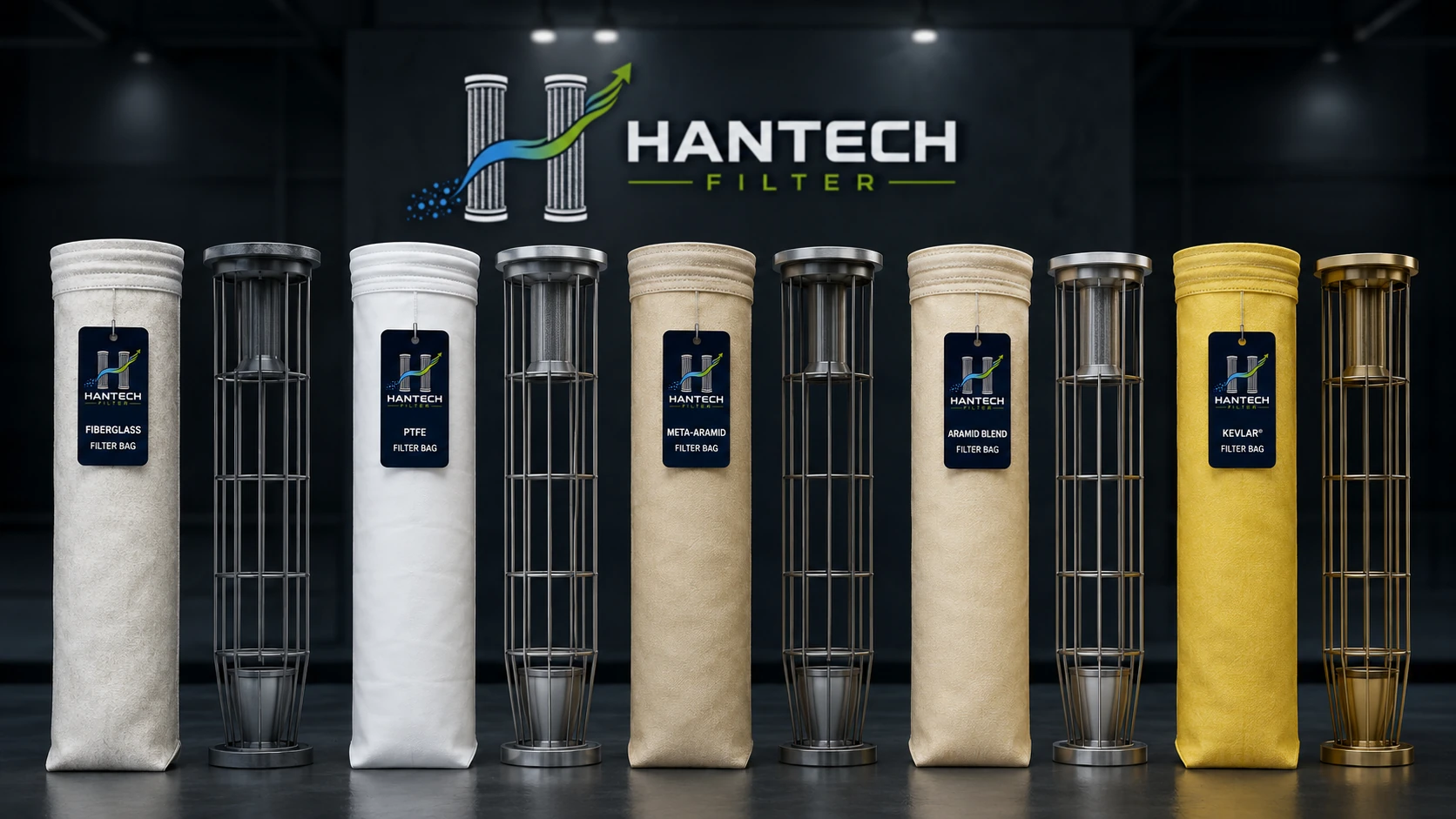
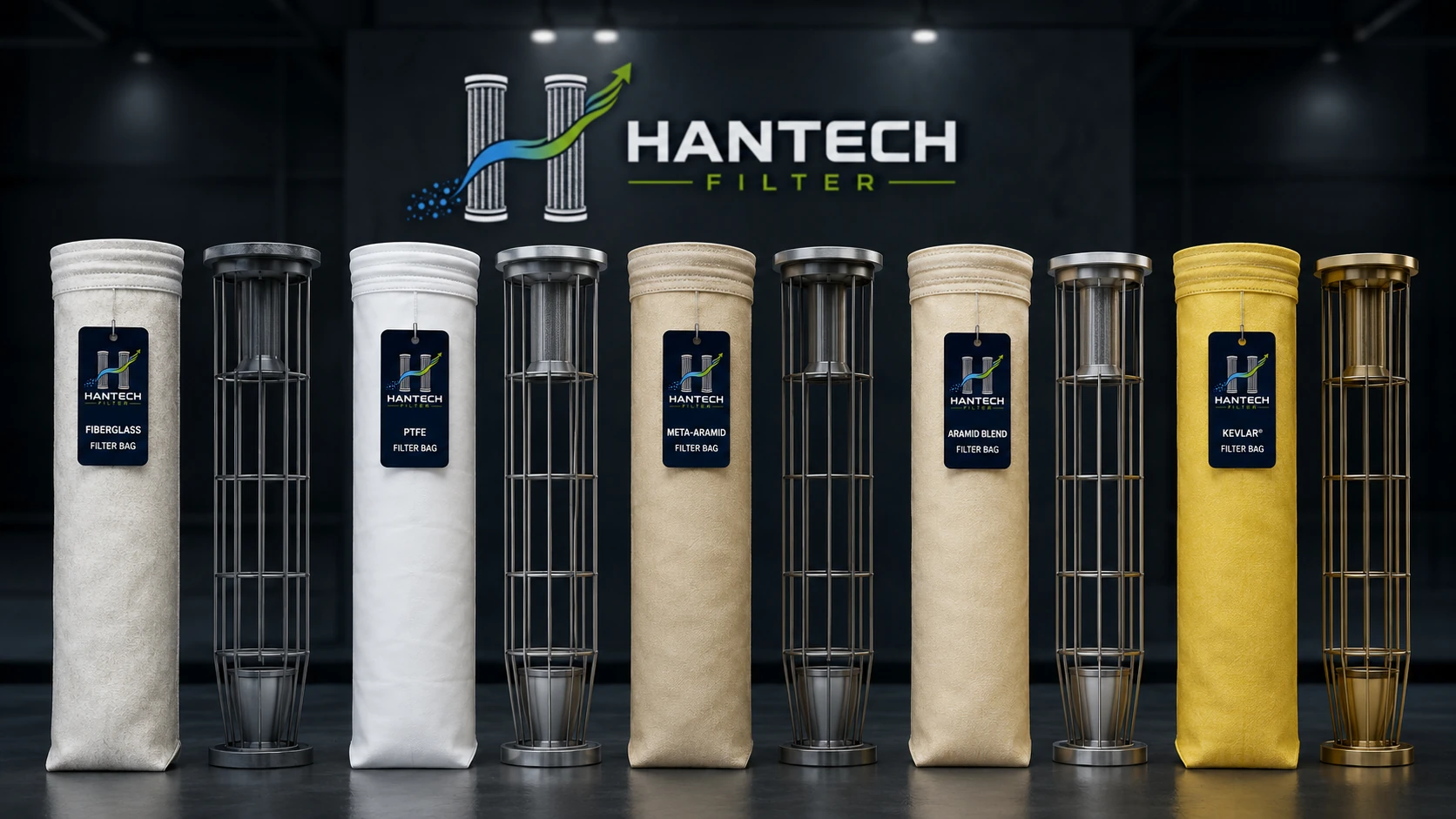
A PTFE membrane is considered in processes where fine dust penetrates the felt, a low emission target is required, and more stable surface filtration is desired. A membrane alone does not imply a 240°C temperature class; the limit is set by the carrier media and the overall bag construction.
When Is a PTFE Membrane Filter Bag Used?
PTFE membrane filter bags are considered for processes where fine dust penetrates deep into the felt and makes cleaning difficult, where a low emission target applies, and where more stable differential pressure is required. The ePTFE membrane is a microporous layer that helps retain dust on the bag surface rather than between the fibers.
Critical distinction: A PTFE membrane alone doesn't mean an operating temperature of 240°C or above. The membrane can be applied over different carrier media such as polyester, PPS, P84, aramid, fiberglass, or PTFE. The bag's continuous and peak temperature limit is determined by verifying the carrier media, scrim, sewing thread, chemical environment, and manufacturer's data sheet together.
Are a PTFE Membrane and Fully PTFE Felt the Same Thing?
| Structure | Position | The main factor that determines the decision |
|---|---|---|
| ePTFE membrane | A thin layer that improves surface filtration and cake release behavior | Compatibility with support media and lamination quality |
| Carrier felt | Provides the mechanical body and the base temperature/chemical resistance class | Selecting PES, PPS, P84, aramid, fiberglass, or PTFE |
| Fully PTFE felt | Media designed for severe chemical conditions through PTFE fiber/scrim construction | Gas chemistry, temperature, mechanical load, and total cost |
For this reason, the phrase "PTFE membrane" alone is not enough to describe a bag's temperature or chemical class. Both the membrane and the base media must be clearly stated in the quote and technical datasheet.
Technical Decision Matrix for Membrane Requirement
| Question | Control | Decision effect |
|---|---|---|
| Is fine dust embedding into the felt? | Particle distribution, bag cross-section, and residual dust after cleaning | A membrane can help if there is a depth-filtration problem |
| What Is the Emission Target? | Project mg/Nm³ target and current measurement trend | A low target makes sealing and membrane quality critical |
| What is the temperature? | Continuous/peak value and manufacturer datasheet | The carrier media class is selected instead of a membrane |
| What is gas chemistry? | SOx, NOx, HCl, HF, O₂, moisture, and acid dew point | Chemical/condensation risk can change the media selection |
| Is the cleaning system suitable? | Pulse pressure, duration, blow-pipe alignment, and dP setpoints | Excessive pulsing can shorten membrane and bag life |
| Is the cage suitable? | Diameter, wire count, weld burrs, venturi, and surface finish | Friction or sharp surfaces can damage the membrane |
When Can a PTFE Membrane Be an Unnecessary Cost?
If the dust cleans easily, the emission target is met consistently with standard media, and the differential pressure stays within an acceptable range, a membrane is not automatically required. If the real cause of high dP is insufficient filter area, a full hopper, incorrect pulse settings, wet compressed air, or the fan operating point, simply switching to a membrane bag will not fix the root problem.
The membrane decision should not be based on purchase price, but on total cost of ownership, evaluating emissions, energy, filter bag life, cleaning frequency, and downtime cost together.
I Would Not Choose PTFE Membrane Under These Conditions
Worked Example: Membrane Decision for Fine Dust
Sample field reading
- Flow Rate
- 60,000 m³/h
- Bag size
- Ø160 × 6,000 mm
- Bag count
- 240 bags
- Gross A/C
- 60,000 / 60 / (240 × π × 0.16 × 6.0) = 1.38 m/min
- Dust behavior
- Fine 1-3 µm dust, with embedding into the felt after cleaning
- First decision
- A membrane may be a candidate; however, pulse pressure, filter cage surface, and moisture/dew point must also be verified.
In this example, the membrane decision comes not only from the emission target but from how the fine dust penetrates the felt. At the same A/C ratio, a membrane can be an unnecessary investment for coarse dust that forms an easy cake.
Support Media Selection and Temperature Limit
Polyester, PPS, P84, aramid, fiberglass, and PTFE carriers each behave differently with temperature and chemistry. Selection should not be based on a single continuous-temperature figure found online. The real limit must be verified against the manufacturer's product datasheet, oxygen level, humidity, gas composition, acid dew point, mechanical construction, and peak temperature duration.
For comparison, the polyester (PES) filter bag, PPS filter bag, P84 filter bag, fiberglass filter bag, and full PTFE filter bag guides can be reviewed together.
What Data Is Needed for a Technical Selection?
For a sound evaluation, please provide the process name, continuous/peak temperature, gas composition, moisture and dew point, particle size distribution, current/target emission level, flow rate, filter area, bag size and quantity, current dP trend, pulse pressure/duration, cage dimensions, and the observed failure mode.
Hantech Filter evaluates this data together with the carrier media, membrane, cage, and cleaning system; without process data, a PTFE membrane is never presented as “mandatory” or a “guaranteed solution.”
Frequently Asked Questions
Is a PTFE membrane bag always PTFE felt?
No. An ePTFE membrane can be applied to different carrier media; the temperature and chemical limits are determined by the entire bag construction, not the membrane alone.
For which types of dust does a membrane filter bag make more sense?
Can be a candidate for processes where fine dust embeds into the felt, where there is a low emission target, or where cake release behavior is problematic.
How should pulse pressure be selected for a membrane filter bag?
A single value should not be given. Membrane, cage, venturi, valve, and OEM design are verified together; uncontrolled high pulse pressure is risky on sensitive surfaces.