
How do you calculate air-to-cloth ratio and bag count for a baghouse?
Air-to-cloth ratio (A/C, filtration velocity) is found by dividing the gas flow passing through the filter by the total filter cloth area, expressed in m/min (m³/m²/min). For the same flow, more cloth area means a lower A/C, lower pressure drop and longer bag life. The tool below calculates the total cloth area, the required bag count, or the real A/C of your existing system.
Formulas and method
- In online pulse-jet, the share of bags cleaned at the same instant is small, so net A/C ≈ gross A/C is assumed.
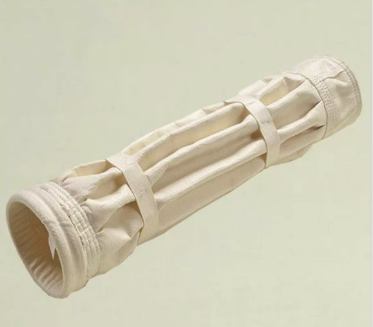
- In pleated bags, cloth area in the same housing increases 2-3x; but pushing A/C too low doesn't always help — cake formation and cleaning balance must be considered together.
- All calculations are performed using real gas conditions (operating temperature and pressure).
Air-to-cloth ratio reference values by sector (pulse-jet, needle felt, m/min)
| Application | Low | High | Note |
|---|---|---|---|
| Cement kiln / raw mill | 0,8 | 1,0 | High temperature, alkaline, fine dust; PPS/P84/fiberglass |
| Cement mill | 1,0 | 1,2 | PES needle felt; high dust load |
| Clinker cooler | 0,8 | 1,0 | Abrasive, hot |
| Coal mill / petcoke | 0,8 | 1,0 | Explosive dust, antistatic |
| Lime / calcination | 0,9 | 1,1 | Hydrolysis risk |
| Asphalt plant | 1,0 | 1,3 | Nomex/aramid, moisture |
| Foundry (shot blasting, melting) | 0,9 | 1,2 | Sparks, abrasive |
| Steel / electric arc furnace (EAF) | 1,0 | 1,2 | Very fine oxide dust |
| Mining – crushing/screening | 1,0 | 1,3 | Abrasive, coarse |
| Chemical / pharma | 1,0 | 1,5 | Product recovery |
| Welding / laser / plasma fume | 1,2 | 1,8 | Very fine; cartridge alternative |
| Wood / furniture | 1,5 | 2,0 | Coarse fiber, explosive |
| Food / grain / sugar | 1,5 | 2,5 | Hygienic, explosive |
| Silo vent / nuisance dust | 1,5 | 2,5 | Intermittent duty |
| Waste incineration (municipal/industrial) | 0,8 | 1,0 | Acid dew point, PTFE membrane |
| Biomass combustion (biomass boiler) | 0,8 | 1,0 | Fly ash; acid dew point risk |
| Coal-fired power plant (fly ash) | 0,7 | 0,9 | Very fine fly ash, high dust load |
| Glass industry (glass melting furnace) | 0,8 | 1,0 | Fine glass furnace fume; usually with lime injection |
| Marble / travertine (cutting, crushing-grinding) | 1,0 | 1,3 | Coarse, abrasive stone dust |
| Brick-tile / ceramics | 1,2 | 1,5 | Clay/earth-based, medium-fine dust |
| General industrial dust | 1,0 | 1,2 | Default |
- Values are for pulse-jet + needle felt. Reverse-air / mechanical-shaker systems use 0.5-0.9 m/min.
- With ePTFE membrane fabric, the upper limit can be raised 10-15%.
- Because cloth area increases with a pleated bag (HanStarBag), the calculated A/C in the same housing drops noticeably; the target range itself doesn't change.
- These are reference values; dust load (g/m³), particle size, moisture and stickiness are decisive in the final design. Consult Hantech engineering for final sizing.
Frequently asked questions
What is air-to-cloth ratio and why is it expressed in m/min?
Air-to-cloth ratio (A/C) is the filtration velocity found by dividing gas flow (m³/min) by total filter cloth area (m²). The m/min unit directly shows how fast the gas passes through the cloth surface. The same A/C value lets you compare systems of very different scale directly.
What happens if the A/C ratio is too high?
Pressure drop (ΔP) rises quickly, bag life shortens, and the cleaning system may fall behind. At high A/C the dust cake has to be cleaned more aggressively, which accelerates fabric fatigue. Sustained high A/C also increases the risk of exceeding emission limits.
Is there a downside to too low an A/C ratio?
Yes — more cloth area means a larger housing, more bags/cages and higher investment cost. At very low A/C some dusts never build an adequate cake layer, which can even reduce filtration efficiency. The economic optimum usually sits in the lower-middle of the sector range.
What A/C ratio suits a cement kiln filter?
The reference range for a cement kiln/raw mill line is 0.8-1.0 m/min. This low band reflects the harsh cleaning conditions from high temperature, alkaline content and very fine dust. Do not design close to the limit values without verifying against real process data (flow, temperature, dust load).
How does Nm³/h vs m³/h affect the calculation?
Nm³/h is the volume at normal conditions (0°C, 1013 mbar), while A/C is always calculated with the volume at real operating temperature. A hot gas expands, so the real m³/h value comes out noticeably larger than Nm³/h. Skipping this correction makes the calculated A/C look lower than it is and can lead to an undersized system.
How does a pleated bag change the A/C ratio?
In a pleated (HanStarBag) design the cloth surface is folded to multiply within the same Ø×L envelope, so single-bag area in the same housing grows 2-3x. This noticeably lowers the calculated A/C for the same flow, or reduces the bag/housing count needed to hit the same A/C target. The target A/C range itself doesn't change — only the bag count or housing size needed to reach it shrinks.
Longer bags lower A/C — why not just make them as long as possible?
A longer bag gives more cloth area and a lower A/C, but the pulse-jet cleaning pulse weakens as it reaches the bottom section of the bag. Above roughly 6-8 meters the risk of cake build-up and uneven cleaning in the lower zone rises, which can create locally high ΔP and premature wear. That's why very long bags call for either a verified nozzle-venturi set or a pleated/shorter-multiple-bag alternative.
My existing filter's A/C came out high — what should I do?
First verify the flow — real process flow often differs from the original design flow, which is a common reason A/C reads high. If the flow is correct, either increase cloth area (longer/more bags, or switch to pleated) or verify cleaning performance with an HT-PULSE nozzle-venturi set. For a lasting fix we recommend scheduling a site survey with the Hantech Filter team.
Other calculators
This tool is for preliminary sizing and checking purposes. Results vary with dust load, particle distribution, moisture, temperature fluctuation and cleaning system performance. Final design and bag/cage selection should be verified with the Hantech Filter engineering team using real site data.

Inputs
Results
Formulas and method
This tool is for preliminary sizing and checking purposes. Results vary with dust load, particle distribution, moisture, temperature fluctuation and cleaning system performance. Final design and bag/cage selection should be verified with the Hantech Filter engineering team using real site data.