
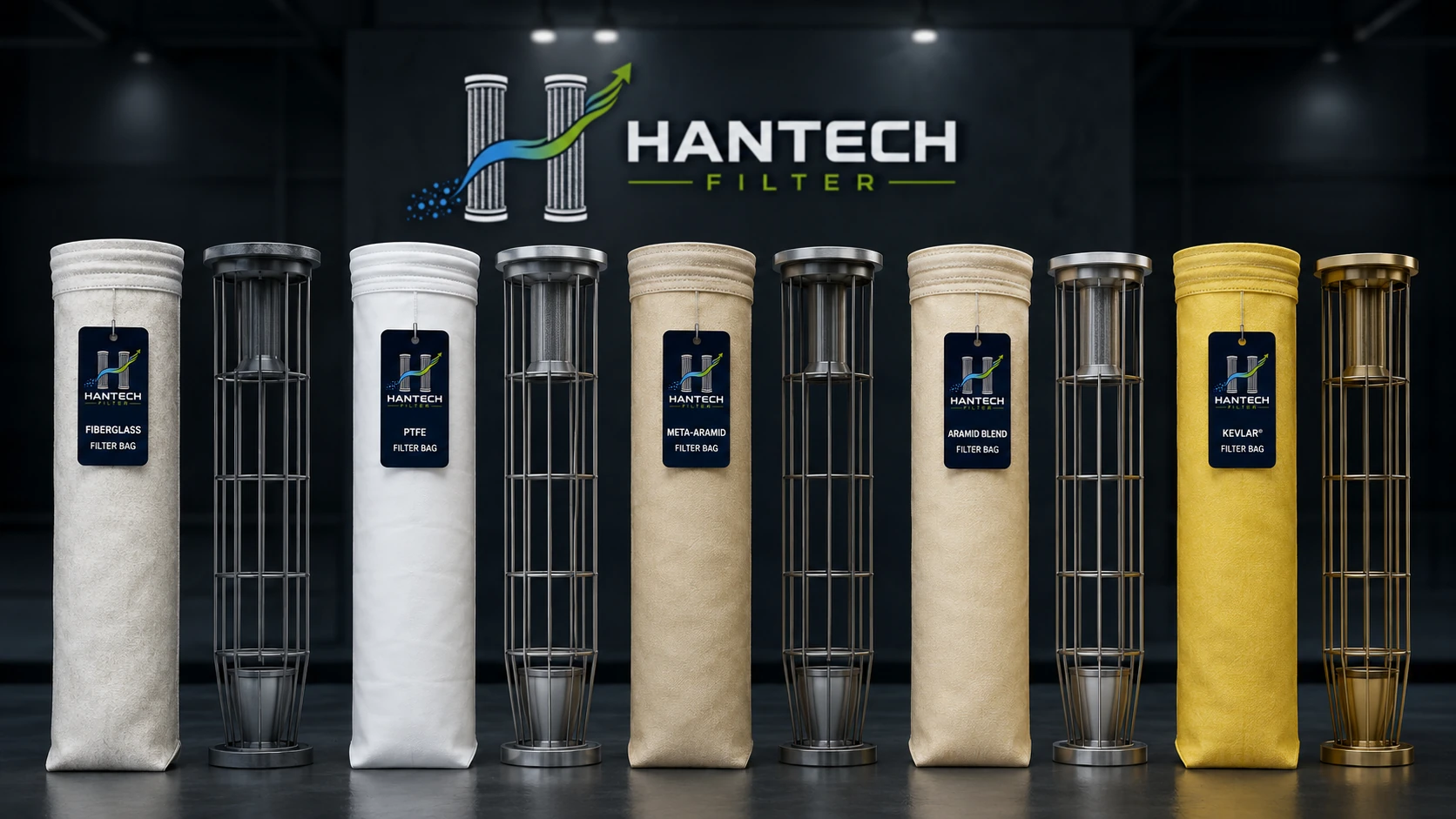
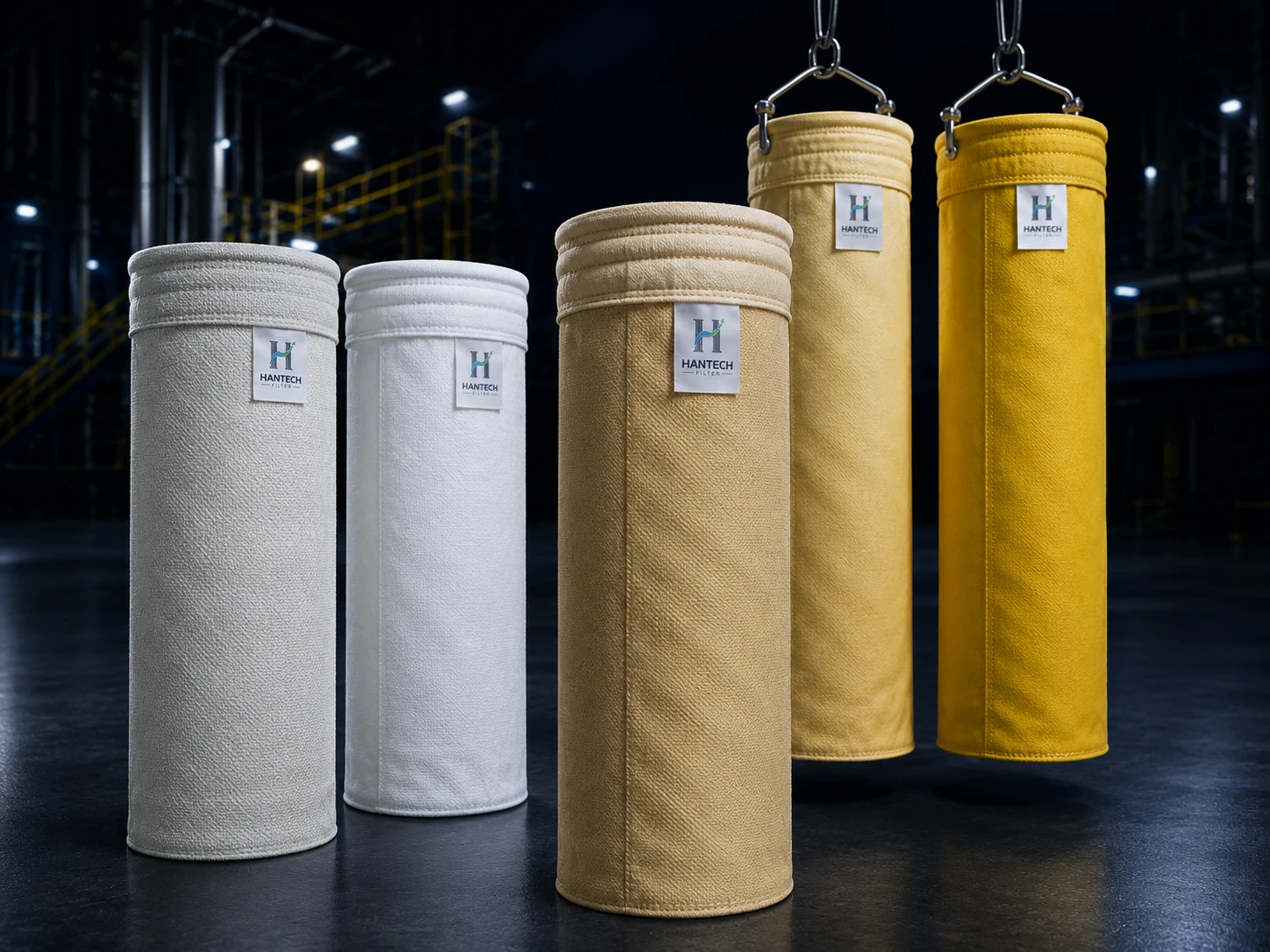
PPS filter bags are selected by jointly checking temperature, moisture, acid/alkaline gases, and oxidation risk. Hantech Filter provides technical selection, verified sourcing, and field application support.
What Is a PPS Filter Bag?
PPS filter bags are a polyphenylene sulfide filter bag family considered for medium-to-high temperatures beyond polyester/PES limits and for certain chemical/moisture risks. They can be a candidate for drying, boiler, waste heat, mineral processes and jet-pulse filters handling chemical gases.
The values here are a general technical selection reference. Hantech Filter clarifies the scope of media selection, dimension/construction control, verified supply and field application support based on your process data; final limits must be verified with the manufacturer datasheet and real process records.
In Which Processes Is It Considered?
| It's a must. | PPS comment | Hantech decision |
|---|---|---|
| 160–190°C typical operating range | PPS can be a strong candidate at medium-to-high temperature. | The continuous/peak limit is verified against the datasheet and process conditions. |
| 200°C short peak | Short peaks can be assessed as a training/RFQ basis; duration and chemical environment are decisive. | If peaks are long or frequent, Aramid, P84, or PTFE are compared. |
| Acidic/alkaline gas + moisture | PPS can be a balanced option under certain conditions. | SOx/SO3, NOx/NO2, HCl, HF, moisture, and dew point are all needed together. |
| High O₂ / oxidation | This can be PPS's critical weak point. | If O₂ is high, PPS is not selected automatically; alternative media and finish options are compared. |
| Low emissions + fine dust | A membrane/surface finish may be required; the carrier media decision remains separate. | Justified by dust micron size, emission target, and dP trend. |
Temperature, Humidity, and Chemical Resistance
The 160–190°C range for PPS can be read as a preliminary selection range; a short peak of roughly 200°C is only assessed together with peak duration, repetition frequency, gas chemistry, and datasheet limits. Humidity, acid dew point, SOx/SO3, NOx/NO2, HCl, HF, and alkaline components change the decision jointly, not individually.
Field dP diagnosis example
- dP after new bags
- Stable within the 900–1100 Pa range → the system may be balanced.
- Rapid Rising
- Rapid rise above 1800–2200 Pa → dust is embedding into the felt, pulse cleaning is insufficient, the A/C ratio is too high, or there may be a moisture/caking problem.
- Low dP + high emissions
- Leakage, bypass, bag-to-cage mismatch, or installation error should be checked.
This observation shows the risk of selecting PPS based on the temperature rating alone. The same media can run stably under the correct A/C ratio and cleaning regime, yet cause a rapid dP rise in moist or sticky dust.
Oxidation and O₂ Risk
O₂ data is the critical gate in a PPS decision. If oxidation risk is high, PPS's temperature advantage alone may not be enough; P84, PTFE, aramid, or different surface/finish options are compared technically and economically. Hantech does not automatically sell premium media at this point, but if O₂/chemistry data weakens PPS, it also does not consider proceeding with the lowest initial cost to be safe.
Comparison of PPS, Aramid, P84, and PTFE
| Media | Strong side | Risk | Hantech comment |
|---|---|---|---|
| PES | Economical, dry, medium temperature | Hydrolysis under moisture + high temperature | If conditions allow, moving up to PPS may be unnecessary. |
| PPS | Temperature/chemistry balance | Oxidation/O₂ | A safe decision cannot be made without O₂ data. |
| Aramid | Mechanical strength in hot processes | Risk of acid/moisture | Evaluated carefully when acidic moisture is present. |
| P84 | High temperature and filtration performance | Chemical limit + cost | A strong candidate when needed; not an automatic premium choice. |
| PTFE | Chemical resistance | Cost + mechanical support requirement | It is not always the economically correct answer. |
I do not select PPS in this Condition
Information Required for a Quote
Minimum data set for a quote: normal/peak temperature and peak durations, O₂, SOx/SO3, NOx/NO2, HCl, HF, humidity, dew point, dust type/particle size/abrasiveness/stickiness, filter bag diameter/length/quantity, top/bottom construction, snap-band, cage OD/venturi, pulse pressure, dP trend, emission target, current failure photos, and membrane/finish requirement.
You can send this information via the PPS filter bag technical quote form. For the general product family, review the filter bags by process condition, including PPS page.
Related Technical Guides
To clarify the decision, you can read the PPS filter bag selection guide, process data for filter bag media selection, polyester PES filter bag technical guide and P84 filter bag comparison articles together.
Frequently Asked Questions
At what temperature is a PPS filter bag used?
For preliminary selection, a 160-190°C range and approximately 200°C short peaks can be taken as a basis; the actual limit must be verified against the manufacturer's datasheet, peak duration, humidity, gas chemistry, and O₂ level.
What is PPS's most critical risk?
In many applications, oxidation/O₂ risk is a critical gating factor. If O₂ is high, PPS is not automatically selected; P84, PTFE, aramid, or alternative finish options are compared instead.
Can PES be sufficient instead of PPS?
Yes. If the process runs at a lower temperature and is dry and chemically mild, a more economical PES media may be sufficient; Hantech prefers not to recommend premium media unnecessarily.