
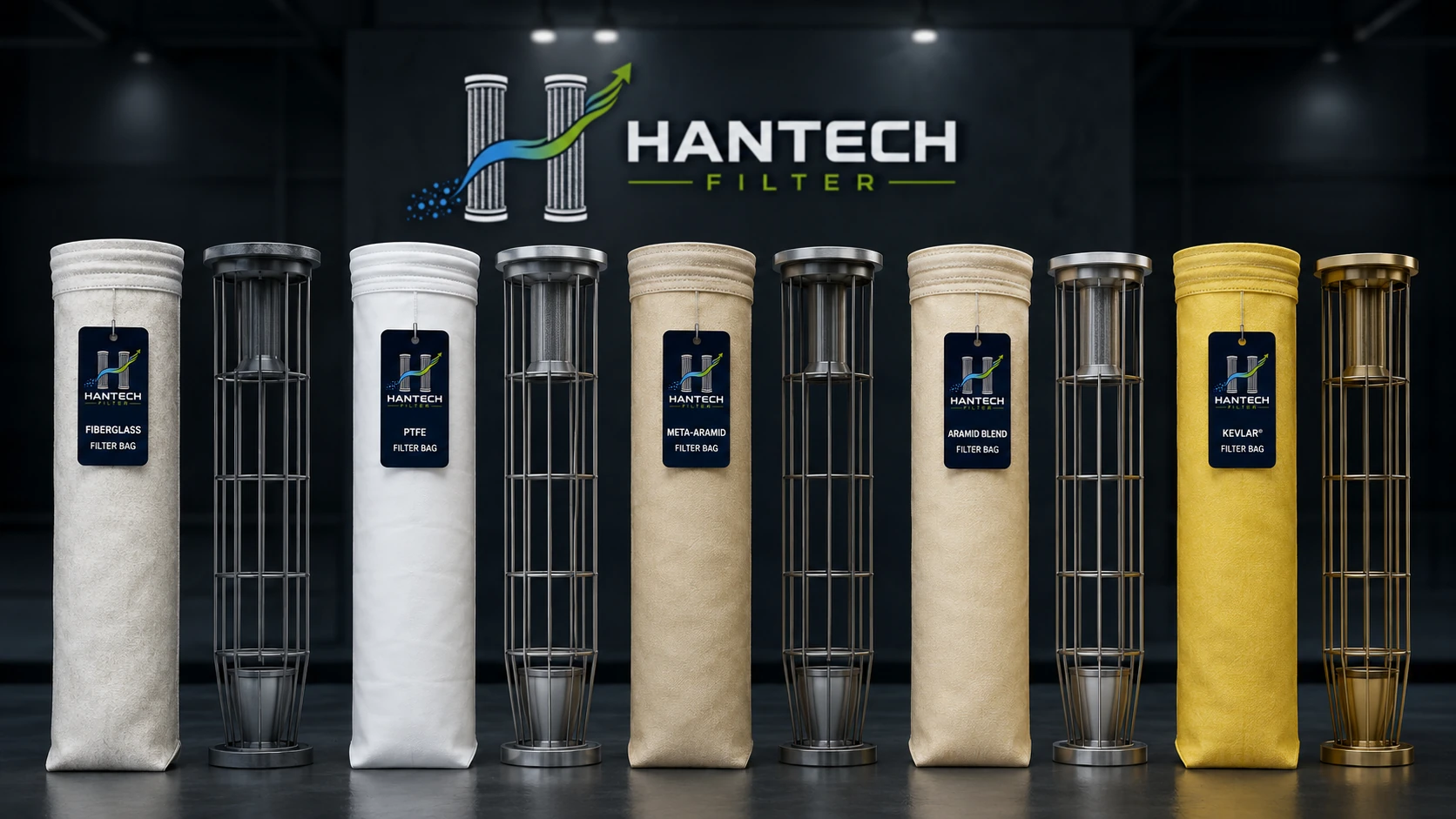
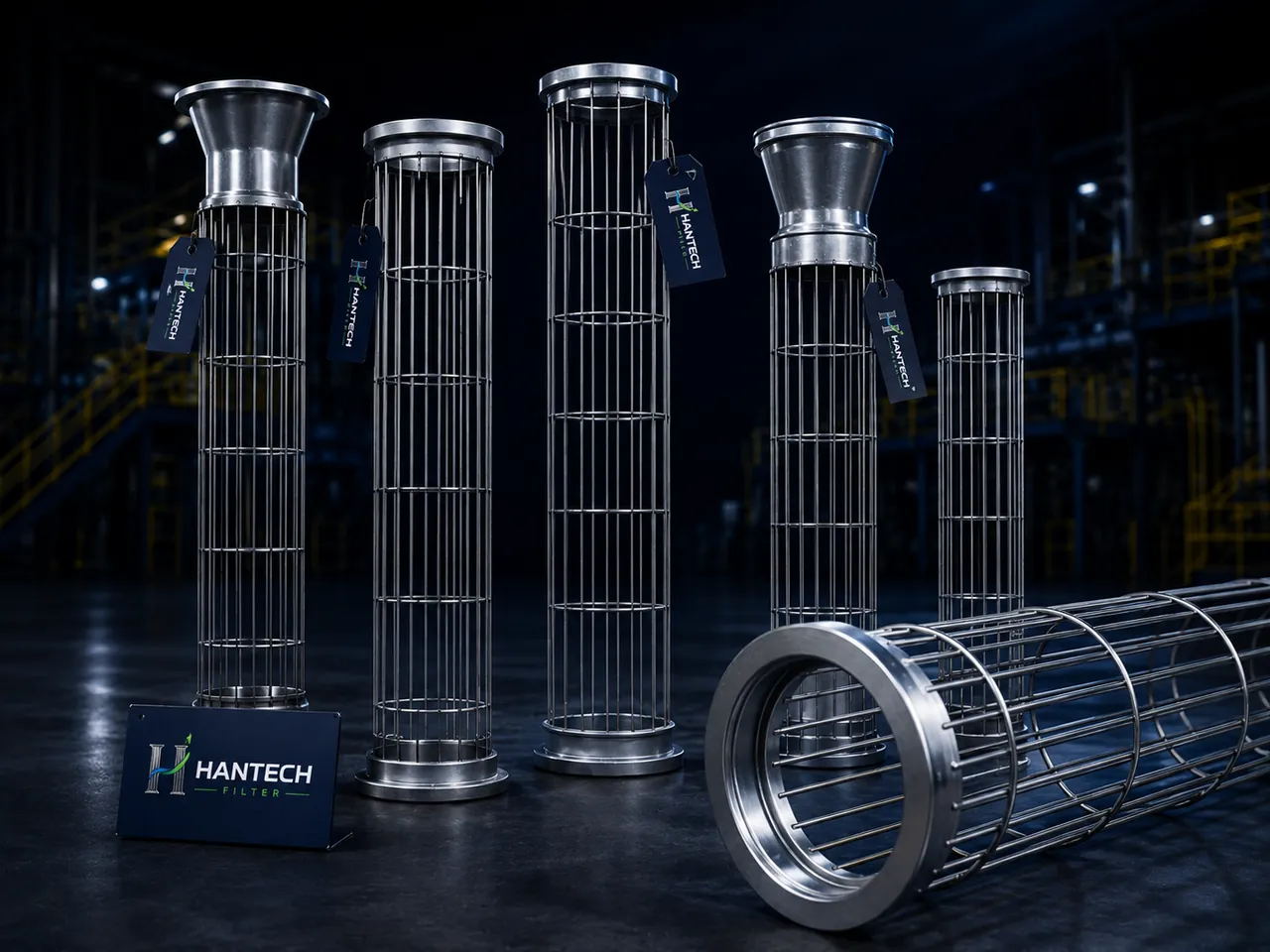
Filter cage selection is made based on bag diameter, cell plate hole size, wire count, coating, venturi, surface smoothness, and compatibility with pulse-jet cleaning. An incorrect cage can wear down even a correctly selected filter bag in a short time, creating a risk of leakage and high differential pressure.
What Is a Filter Cage and Why Does It Determine Bag Life?
The filter cage is the support component inside a baghouse filter that maintains the bag's shape and allows it to move in a controlled way during pulse-jet cleaning. Treating the cage as a simple wire skeleton is a serious mistake in the field. Wire count, wire diameter, ring spacing, weld quality, coating type, venturi compatibility and cuff connection all directly affect the bag's mechanical service life.
The right cage establishes dimensional and surface compatibility between the filter cages product family and filter bags. Finished bag diameter, lay-flat width, cage outer diameter, cell plate hole, snap-band size, and sheet thickness must each be verified separately. Assuming the cell plate hole directly from the nominal bag diameter is not correct.
How Are Wire Count, Wire Diameter, and Ring Spacing Selected?
| Cage parameter | Performance impact | Engineering interpretation |
|---|---|---|
| 12-wire standard filter cage | Economical and common application | May be sufficient for coarse/standard dusts; bag movement should be monitored. |
| 16-20 wire mesh | Better bag support | Provides more controlled surface behavior for long bags, fine dust, and membrane media. |
| Wire Diameter | Mechanical strength and weight | Thin wire causes deformation; thick wire adds weight and cost. |
| Ring gap | Filter bag flutter and friction | Too few cage rings create a risk of bag flutter and localized wear on the housing. |
| Welding Quality | Filter bag damage and installation safety | Burrs, weld protrusions, and sharp points can tear even good media. |
PTFE membrane bags require smoother support. In demanding membrane applications, a 20-wire SS304 cage with venturi can be a strong initial RFQ assumption; but the final choice must be finalized based on bag diameter, length, pulse pressure, gas chemistry, and site measurements.
Coating Selection: Galvanized, Cataphoretic (E-coat), Silicone-Coated, and Stainless Steel
| Coating / material | Eligible condition | Risk to Watch For |
|---|---|---|
| Galvanization | Standard dry processes | Corrosion risk increases under acidic moisture and high temperature. |
| Cataphoresis | Sites requiring a smoother surface and corrosion resistance | Coating continuity and transport damage should be checked. |
| Silicone coating | Applications where friction risk needs to be reduced | Process temperature and chemical compatibility must be verified. |
| SS304 stainless | Processes requiring moisture or chemical resistance, or membrane filter bag compatibility | A higher cost is not automatically a justification on its own. |
A stainless-steel cage is not automatically the right answer under all conditions. If the process is dry, chemical exposure is limited, and temperature is controlled, more economical coating options can be sufficient. Conversely, if there is humidity, acidic gas, condensation, or a long maintenance interval, a cheap cage can quickly come back as bag damage and leakage cost.
Venturi and Pulse-Jet Compatibility
The venturi is the part that helps carry the pulse-jet pulse into the bag in a more controlled way. A venturi is not mandatory in every filter; but with long bags, high dust loads, membrane media, or demanding cleaning conditions, its effect can be significant. The goal here is not to force more air, but to deliver the available air to the right point with the right geometry.
If the blow-pipe hole is not aligned with the bag center, the venturi is not seated correctly, or the cage top does not match the bag mouth, pulse energy is not used efficiently. In this situation, the problem is often addressed by raising operating pressure — but this approach can shorten bag life.
Snap-Band, Cell Plate, and Dimensional Tolerances
An improperly seated snap-band can show up as high emission alongside low dP. This is because dust can bypass through the neck area while the bag media appears to be working normally. For this reason, the dimension list is not just bag length and diameter — cage, cell plate, neck detail, and mounting method must all be recorded together.
Example Selection Scenario: Fine Cement Dust and Membrane Filter Bags
Sample process data
- Process
- Cement packaging filter
- Dust distribution
- High 1-10 µm fraction
- Bag
- 160 mm x 6,000 mm ePTFE membrane
- Objective
- Low emissions, stable dP
- Cleaning pressure
- 3-4 bar training/RFQ basis
- Cage candidate
- 20-wire SS304 filter cage with venturi
Under these conditions, I would not use a standard, burr-covered cage, because a membrane can be damaged faster by surface friction and incorrect support. Bag performance cannot be guaranteed without checking the weld quality, correct wire count, venturi alignment, and cage outer diameter. In this scenario, Hantech evaluates media selection, cage geometry, and pulse pressure together.
Common Mistakes and When It Should Not Be Used
If cages are to be reused, each cage must be checked for straightness, rust, weld burrs, broken rings, venturi integrity, and top connection condition. A bent or rusted cage puts the investment in new bags at risk.
What Dimensions Are Needed for a Quote?
For a filter cage quotation, please provide bag diameter, bag length, cage outer diameter, wire count, ring spacing, whether a venturi is present, top connection type, cell plate hole size, sheet thickness, coating requirement, process temperature, moisture/chemical risk, and a photo of the existing cage. If possible, a photo of the old cage taken on a flat surface and details of the top connection should also be sent.
Submit your technical details through the quote form. Cage selection should often be evaluated together with filter bag selection, the pulse-jet cleaning system, and pulse-jet valve failure symptoms.
Frequently Asked Questions
Why does wire count matter in a filter cage?
Wire count affects how well the filter bag is supported, its movement during pulsing, and local friction risk. Longer filter bags and sensitive media may require greater support.
Is a stainless-steel cage always required?
No. If the process is dry with low chemical exposure, more economical coatings may be sufficient. Under conditions like moisture, acidic gas, or membrane bags, stainless steel becomes a stronger candidate.
Should a venturi be used?
This depends on the filter design. A venturi can provide an advantage in applications with long bags, challenging dust, and where pulse energy management is required.
Can an existing cage be used with a new bag?
It should only be reused if it passes straightness, rust, burr, weld, and dimensional checks. A damaged cage can wear out a new bag in a short time.
Why should the cell plate hole be measured separately?
Hole diameter and sheet thickness are critical for snap-band seating and sealing. Estimating directly from the nominal bag diameter is risky.