
Filter bag type is not selected based on a temperature table alone; dust micron size, moisture, chemical gases, dP trend, A/C ratio, cage compatibility, and emission target must be evaluated together.
Why Is Filter Bag Type a Critical Choice?
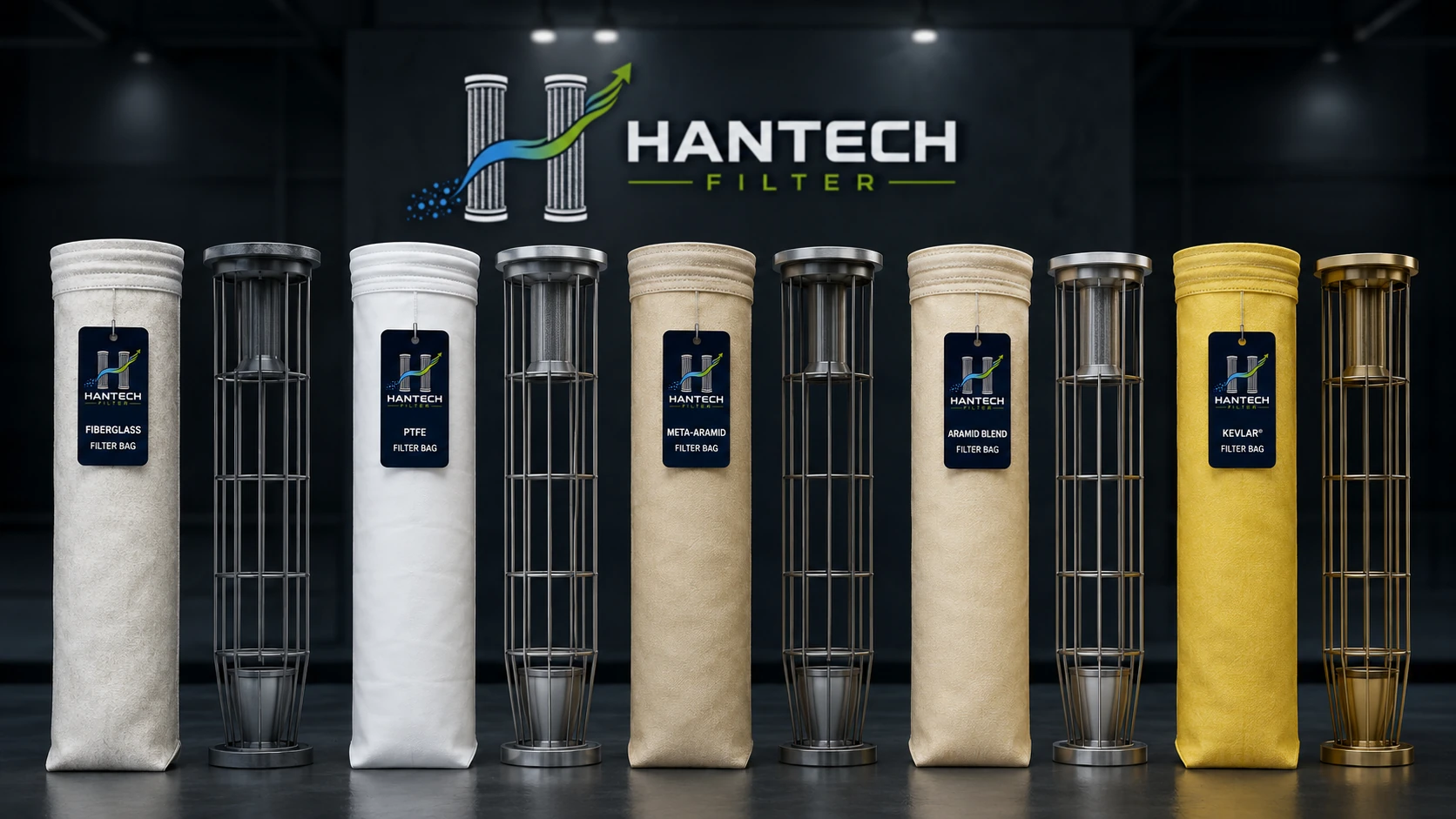
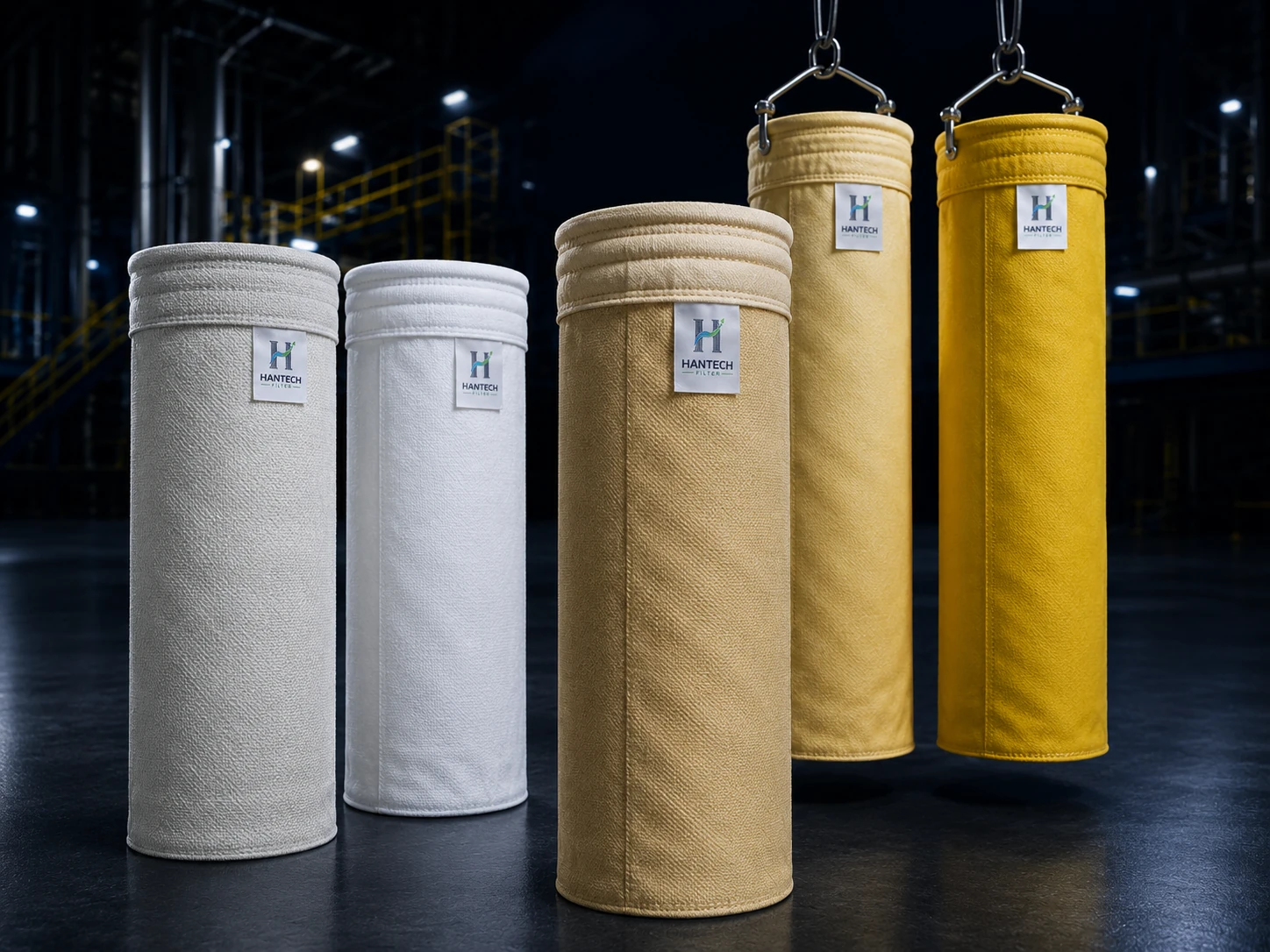
Filter bag types consist of different media families such as polyester/PES, antistatic polyester, oil-and-water-repellent polyester, PPS, meta-aramid/Nomex, P84, PTFE, fiberglass, and membrane constructions. These names aren't just fabric labels; they also drive decisions on temperature, moisture, chemical resistance, dP behavior, cleaning system, and bag life.
For Hantech Filter, correct bag selection is not a matter of looking up a catalog temperature rating. Particle size distribution, particle shape, abrasiveness, moisture/dew point, SOx/SO3, NOx/NO2, HCl, HF, O2, filtration velocity, pulse-jet pressure, cage surface, and snap-band/cell-plate compatibility are all evaluated together.
Quick Selection Matrix for Filter Bag Types
| Bag type | Typical area of use | Risk to Watch For |
|---|---|---|
| Polyester / PES | Dry, medium-temperature cement, silo, packaging, feed, and mineral dusts | Hydrolysis under moisture + high temperature |
| Antistatic PES | Lines with combustible/explosible dust risk | ATEX/grounding design is also required |
| Oil-water repellent PES | Medium-temperature processes with moisture/oil-aerosol risk | Does not substitute for chemical resistance |
| PPS | Hot gases and certain chemical gases | High O2/oxidation |
| Meta-aramid / Nomex | High temperature, asphalt, hot mineral processes | Acidic humidity |
| P84 | High temperature and fine-dust performance | Cost and chemical limits |
| PTFE | Premium option for aggressive chemistry and high temperature | It is not economical under every condition |
| Glass fibre | High temperature and dimensional stability | Brittleness, filter cage/installation sensitivity |
How to Select? Hantech Decision Tree
The first screening is done by temperature and chemical resistance. The second screening is based on how the dust behaves on the filter surface: does it embed into the felt, does the cake release cleanly from the surface, is the emission target low, does dP rise quickly after a new bag is installed? The third screening is mechanical: are the cage outer diameter, wire count, venturi, snap-band size, and cell plate hole all correct?
Temperature and Chemical Resistance Table
| Media | Normal operating assessment | Short peak | Welding discipline |
|---|---|---|---|
| PES | 110-140°C | 150°C | RFQ/field basis; manufacturer data is verified |
| PPS | 160-190°C | 200°C | Read together with O2 and gas chemistry |
| Aramid | 180-200°C | 220°C | Acid/moisture risk is checked |
| P84 | 220-240°C | 260°C | Datasheet and gas chemistry are required |
| PTFE | 240-250°C | 260-280°C | Manufacturer and process confirmation required |
| Glass fibre | 240-260°C | 288°C | Construction and PTFE application matter |
This table is a preliminary selection guide, not a final design guarantee. For actual selection, moisture, acid/alkali, oxidation, dP trend, and the manufacturer's datasheet must all be checked together.
When Should I Choose a Premium Filter Bag?
Example Selection Scenario
Example
- Process
- Cement packaging filter
- Dust
- Fine 1-10 µm alkaline dust
- Heat
- 80-110°C
- Symptom
- dP rises rapidly with new bags
- Control
- A/C ratio, surface treatment, pulse, and moisture
In this scenario, PTFE is not always the first candidate. A PES 500 g/m² glazed/WOR option or an ePTFE-membrane option is compared based on the actual emissions target and dP behavior. The bag decision is not finalized until cage/snap-band compatibility has been verified.
Information Required for a Quote
For filter bag type selection, the filter bag diameter, length, quantity, top type, bottom detail, current media/weight (gsm), normal/peak temperature, humidity, gas chemistry, dust type, particle size distribution, dP trend, emission target, cage outer diameter, cell plate hole size, sheet thickness, pulse pressure, and damage photos should be shared.
Related products: filter bags, filter cages, and pulse-jet valves. You can submit your technical data through the quote form.
Frequently Asked Questions
Which filter bag is the best?
There is no single best filter bag. The right filter bag is selected based on process temperature, chemistry, dust characteristics, dP, and cost balance.
Is PTFE always better than PES?
No. PTFE offers high chemical and temperature resistance, but it can be an unnecessary premium in standard dry, moderate-temperature processes.
When is a membrane needed?
Considered when there is fine 1-3 µm dust, a low emission target, felt embedding, or sticky cake behavior.
Hantech Selection Map: How We Determine Bag Type
In the main guide, the filter bag type decision is handled in four stages: first, media unsuitable for the temperature and chemistry is eliminated; next, whether dust is caking on the surface or embedding into the felt is read from the dP trend; the third stage checks cage, snap-band, and pulse compatibility; and the final stage evaluates total cost of ownership.
| Decision step | Question | How does it change the selection? |
|---|---|---|
| 1. Temperature | Is PES safe, or is PPS/Aramid/P84/PTFE required? | Incorrect media causes aging and shrinkage. |
| 2. Chemistry/humidity | Is there a risk of SOx, HCl, HF, O2, or dew point? | Different media may be required at the same temperature. |
| 3. Dust behaviour | Is the dust 1-3 µm, sticky, or abrasive? | A membrane, WOR treatment, pre-separator, or lower A/C ratio may be required. |
| 4. Mechanical fit | Are the cage, cell plate, and snap-band correct? | Good media fails when paired with poor mechanics. |
| Does premium media actually solve the real risk? | Overselling is avoided and the right cost level is found. |
Comparative Applications
Cement, lime, MDF, feed, chemical, asphalt, and metal processes cannot be assessed with the same filter bag logic. For example, PES 500 glazed/WOR can be economical and sensible for cement packaging, while aramid may be the right choice for a hot asphalt line, and PTFE or fiberglass PTFE for high-temperature chemical duty. On the MDF side, an antistatic approach and spark safety tend to take priority.
| Sector/process | First candidates | Data that changes the decision |
|---|---|---|
| Cement packaging | PES glaze/WOR, membrane alternative | Fine dust, dP, emission target |
| Raw meal/clinker hot line | PPS, Aramid, P84, fiberglass | Temperature, humidity, SOx/NOx, wear |
| MDF Wood | PES, antistatic PES | Combustible dust and spark risk |
| Chemical drying | PPS, PTFE, P84 | HCl/HF/acid/moisture/O2 |
| Asphalt plant | Aramid, P84, fiberglass | Hot peaks, oily components, installation |
I Would Not Choose Premium Media Under These Conditions
This section also summarizes Hantech's sales approach: more expensive media is recommended only when there is a genuine process risk or emissions target. Otherwise, an economical media with the right surface finish, together with cage and pulse corrections, can be the safer choice.
Worked Example: Preliminary Media Type Screening
Sample decision
- Process
- Cement packaging filter
- Heat
- 85-105°C
- Dust
- Dry, medium-to-fine cement dust
- Complaint
- dP rises above 1900 Pa 3 months after new bags
- First candidate
- PES 500 g/m² glaze or oil-water repellent PES
- An option not to be selected right away
- PTFE; A/C ratio, pulse, humidity, and cage are checked first
If the problem in this scenario is rising dP rather than emissions alone, the first question is not the price of PTFE. Bag area, flow rate, pulse pressure, compressed-air dryness, nozzle alignment, cage surface, and hopper discharge arrangement are checked first. If dust is embedding into the felt, a membrane or different surface finish is discussed — but a premium media is never selected before the mechanical/pulse problem is resolved.
Technical Review and Update Note
Technical review: Doğuhan Kırmacı — industrial filtration, filter bag selection, dust collection systems and field applications.
This guide has been prepared based on manufacturer technical limits, Hantech's RFQ evaluation practice, field failure symptoms, and bag-cage-pulse compatibility. The values are for preliminary selection; process records, dimensions, and the manufacturer's datasheet must be verified for the final quote.