
A worked technical guide to asphalt filter bag selection using temperature, moisture, gas chemistry, actual flow and air-to-cloth ratio.
Preparation method: manufacturer application information, process risks and engineering examples with explicit assumptions were assessed together. Numerical examples are not field measurements.
Where should selection begin?
Asphalt plant filter bag selection starts by identifying the actual gas operating envelope and cleaning method. Plant capacity or one maximum temperature is not enough. Continuous and peak temperature, aggregate moisture, fuel, gas chemistry, dust loading, flow and existing filtration area belong in one assessment. Meta-aramid may suit hot mineral dust, but moisture and challenging chemistry require product-specific and field verification. Compare suitability limits, cleanability and total operating cost before choosing a more expensive medium.
This is a preliminary selection method. Numerical examples use assumed educational inputs, not approved plant design data. Dimensions and purchasing scope are covered in the RFQ guide, while damaged-bag diagnosis is covered in the troubleshooting article. This keeps procurement and failure analysis distinct from selection.
- Operating envelope → temperature, moisture and chemistry
- Screening → exclude unsuitable media
- Area → actual flow and available surface
- Compatibility → supports, cleaning and TDS
How do fabric and dust cake work?
Particles are captured by the fabric and developing dust cake as gas passes through the filter. Cleaning releases accumulated dust to sustain flow. Embedded contamination, wet sticky cake and inadequate cleaning can all cause high differential pressure, but need different remedies. Media selection must therefore consider both cake release and the system's ability to clean the surface.
Read temperature and moisture on the same timeline
Dryer outlet and baghouse inlet are different measurement locations. Duct losses, air ingress and low-load operation can leave collector surfaces cooler than the gas sensor. Record startup, steady production, hot holding and shutdown separately. There is no universal condensation temperature: water and acid dew points depend on composition and moisture. An acceptable average temperature does not rule out brief excursions or cold surfaces.
Higher aggregate moisture changes the water load removed during drying. In an educational case with 100 t/h of dry aggregate, increasing dry-basis moisture from 3% to 5% raises water input from 3 to 5 t/h, a difference of 2 t/h. Do not apply this calculation directly to wet-basis percentages; state the basis. The result does not select a medium by itself, but explains why the same recipe can produce different gas moisture and thermal loads.
Media screening matrix
| Candidate | Reason to assess | Screening before approval |
|---|---|---|
| Meta-aramid | Hot mineral dust and mechanical durability | Combined temperature, moisture and chemistry; actual TDS |
| PPS | Alternative where gas chemistry allows | Oxidation, oxygen and excursion conditions |
| P84 / PTFE | Conditions that limit other candidates | Cost, scrim, cleaning and product limits |
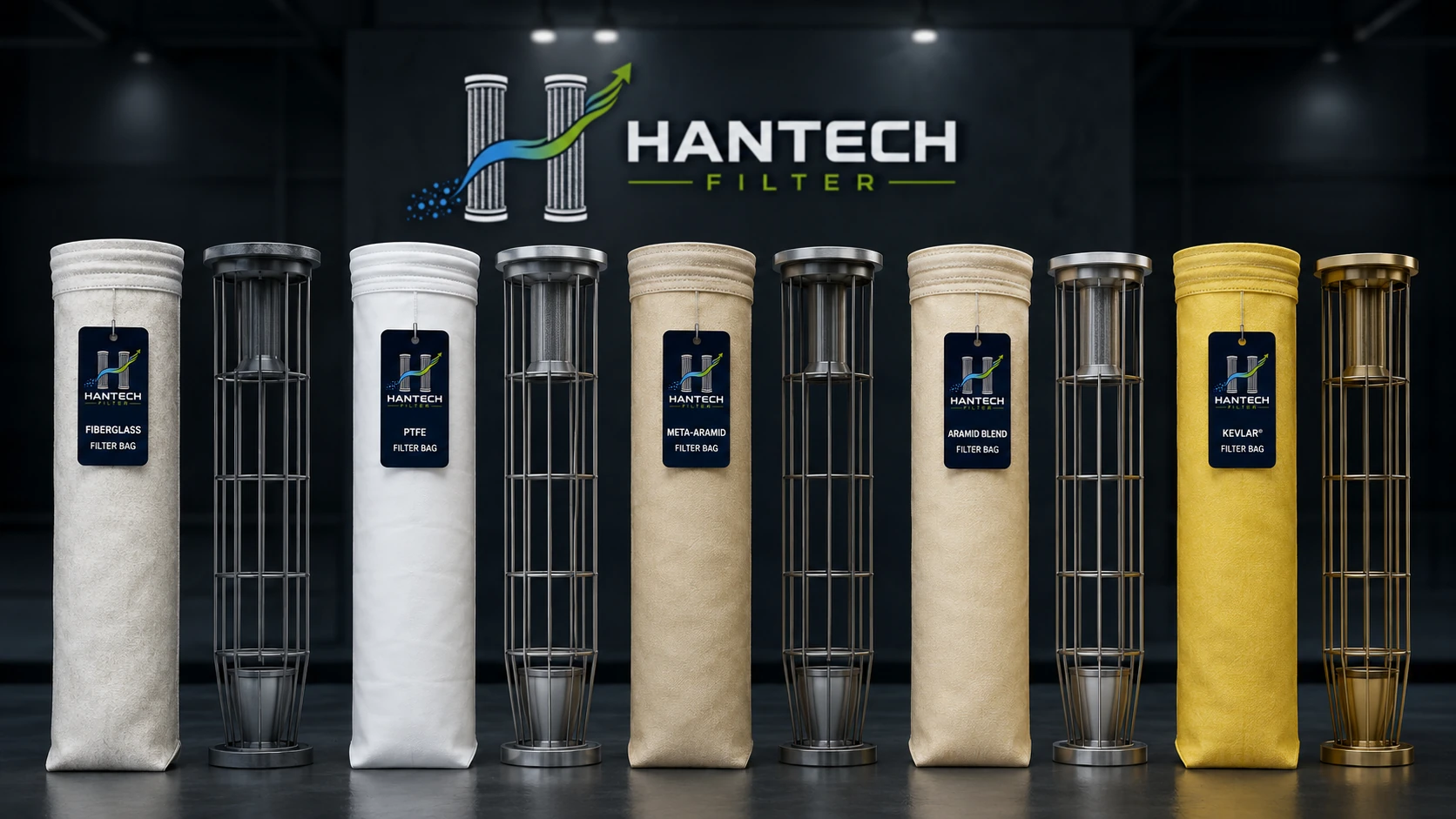
| Fiberglass-based | Suitable high-temperature systems | Flexing, support and cleaning compatibility |
| Polyester | Separate suitable lower-temperature dust sources | Do not automatically apply to dryer exhaust |
This table is not a temperature guarantee. Different scrims, finishes and membranes on the same fibre can have different limits. Obtain continuous temperature, excursion temperature and permitted duration from the product TDS. Operation below a temperature limit does not automatically establish chemical suitability. Hantech's assessment first eliminates unsuitable candidates, then compares mechanical fit and operating cost.
Worked filtration area and air-to-cloth calculation
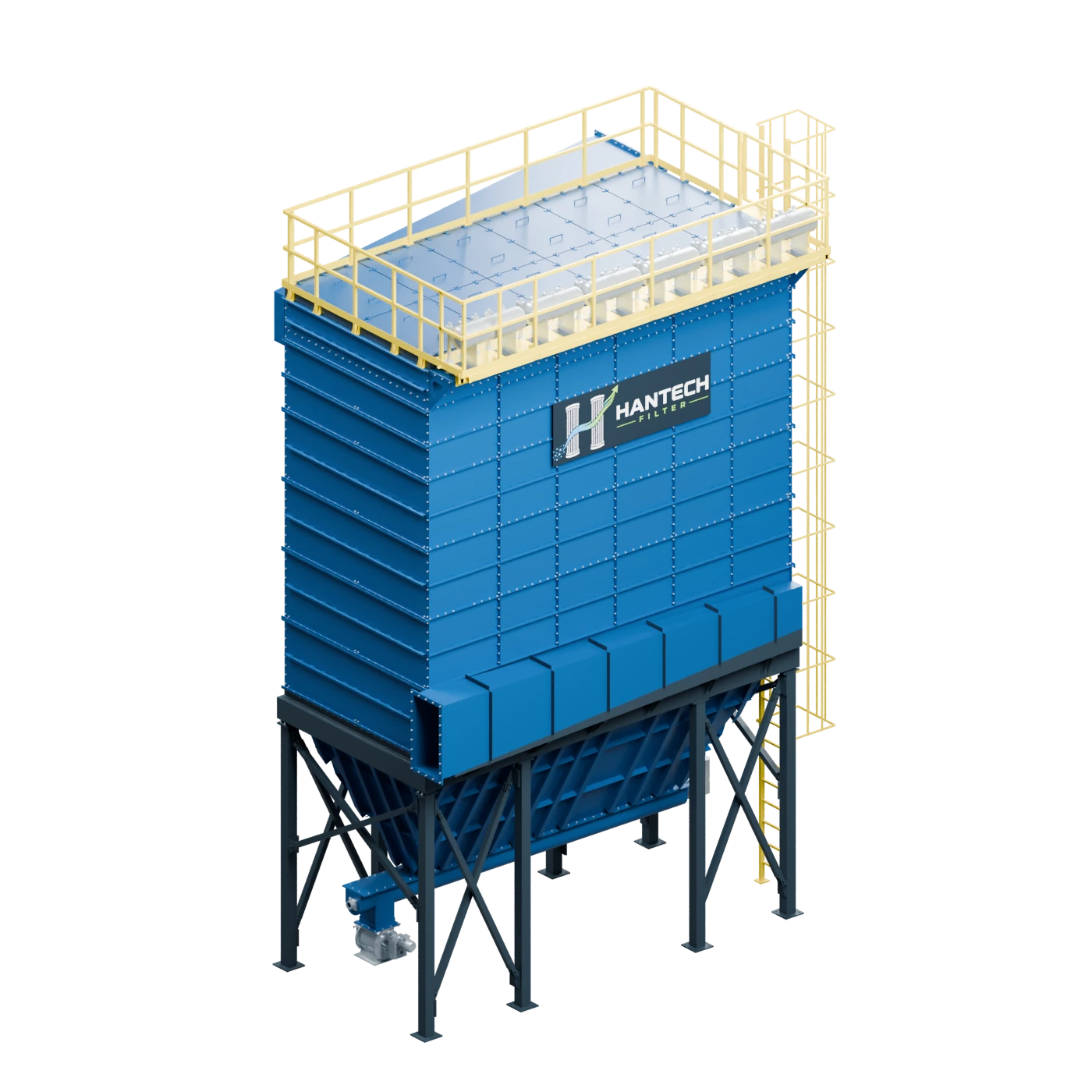
For an illustrative round-bag collector, assume actual flow Q = 48,000 m³/h, bag count N = 480, effective diameter D = 0.160 m and effective length L = 4.0 m. Using cylindrical effective area, one bag has A₁ = π × D × L = 2.011 m² and gross area A = N × A₁ = 965.1 m². Air-to-cloth ratio is Q / (60 × A) = 0.829 m/min. This represents average volumetric flow through the cloth while every bag is filtering.
If one of six equal compartments is genuinely isolated from filtration during cleaning, available area becomes 965.1 × 5/6 = 804.2 m². At unchanged flow, net air-to-cloth ratio rises to 0.995 m/min, a 20% increase. Do not apply this area reduction in the same way to online pulse cleaning where the compartment remains in filtration. The result is not a suitability approval: dust loading, size distribution, moisture, cleaning and internal upward velocity still require checks.
Normal flow cannot be inserted directly into this calculation. Convert it to operating volume using temperature and absolute pressure, keeping the dry/wet basis consistent. For example, 30,000 Nm³/h referenced to 0°C becomes 30,000 × 433.15 / 273.15 = 47,573 m³/h at 160°C, at the same absolute pressure and molar flow. If water-vapour content or pressure changes, this simple ratio is insufficient. A wrong flow basis can make inadequate filtration area appear sufficient.
Select membrane and cleaning conditions together
An ePTFE membrane may be evaluated for fine dust, a defined low-emission target or dust penetration into the felt. It does not raise the substrate temperature limit, remove condensation or automatically capture gaseous contaminants. If existing media meet emissions and pressure-drop requirements with dry dust, adding a membrane simply as a premium upgrade may be unnecessary. Justify it with measured emissions and differential-pressure behaviour.
There is no universal cleaning pressure or duration. Evaluate the OEM and media supplier's approved range together with valves, reservoir recovery, blow-pipe alignment, venturi and bag length. Supply dry compressed air of appropriate quality. Forcing wet cake with higher pressure may increase fabric and seam loading without addressing the cause. Applying pulse-jet pressure advice to reverse-air cleaning is a fundamental mismatch.
Hantech selection note: what comes first?
If flow is unverified, do not derive bag count from plant tonnes per hour alone. With cold surfaces or water ingress, do not treat hydrophobic finish as a guaranteed condensation remedy. Damaged cage welds cannot be compensated for by premium fabric. Where excursions exceed the operating envelope, have process controls and protection assessed before merely upgrading the bag grade. This sequence helps avoid losing a suitable product to unsuitable operating conditions.
The selection file should record measurement dates and locations, temperature trend, fuel and aggregate conditions, flow basis, existing area, cleaning method, pressure-drop history, emissions target and support dimensions. Record the same conditions when trialling new bags. This helps distinguish effects of fabric, recipe changes and corrected leakage. A comparison without field data cannot support a firm lifetime or energy-saving promise.
- Aramid filter bag technical scope
- Filter bag media options
- Asphalt filter bag RFQ guide
- Asphalt baghouse failure diagnosis
- Request selection assessment using your process data
Frequently Asked Questions
What is the best bag for an asphalt plant?
There is no universal best bag. Identify suitable candidates from cleaning method, temperature, moisture, gas chemistry and mechanical fit.
Is air-to-cloth ratio sufficient on its own?
No. Net area, dust loading, cleaning, internal velocity and moisture must be considered together. Worked examples are not suitability guarantees.
Does membrane increase temperature resistance?
It does not automatically raise the substrate limit. The approved TDS for the complete construction governs.
Can collector flow be determined from plant output?
Tonnes per hour alone are insufficient. Use design or measured data covering drying, fuel, moisture, air ingress and operating conditions.