
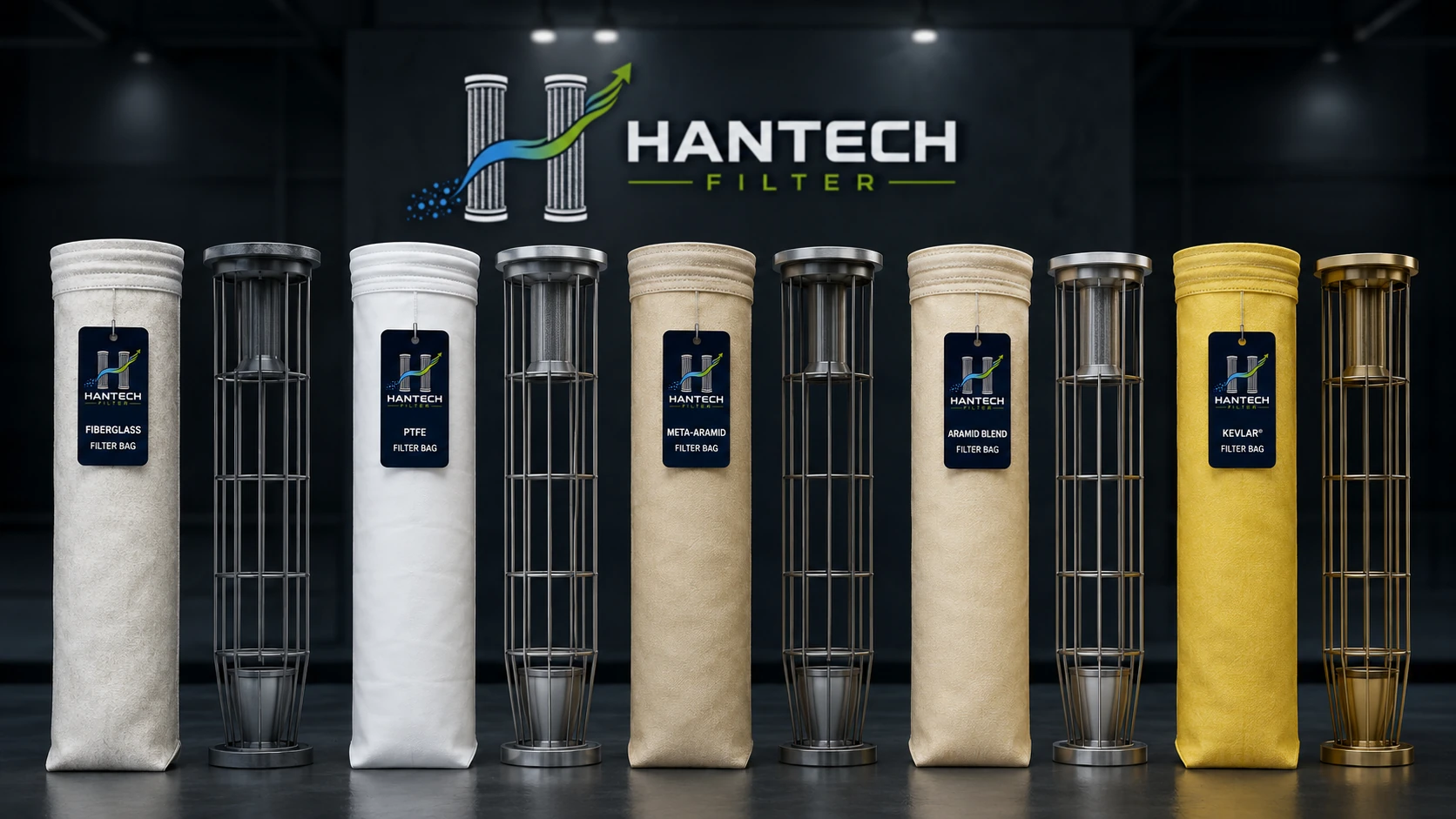
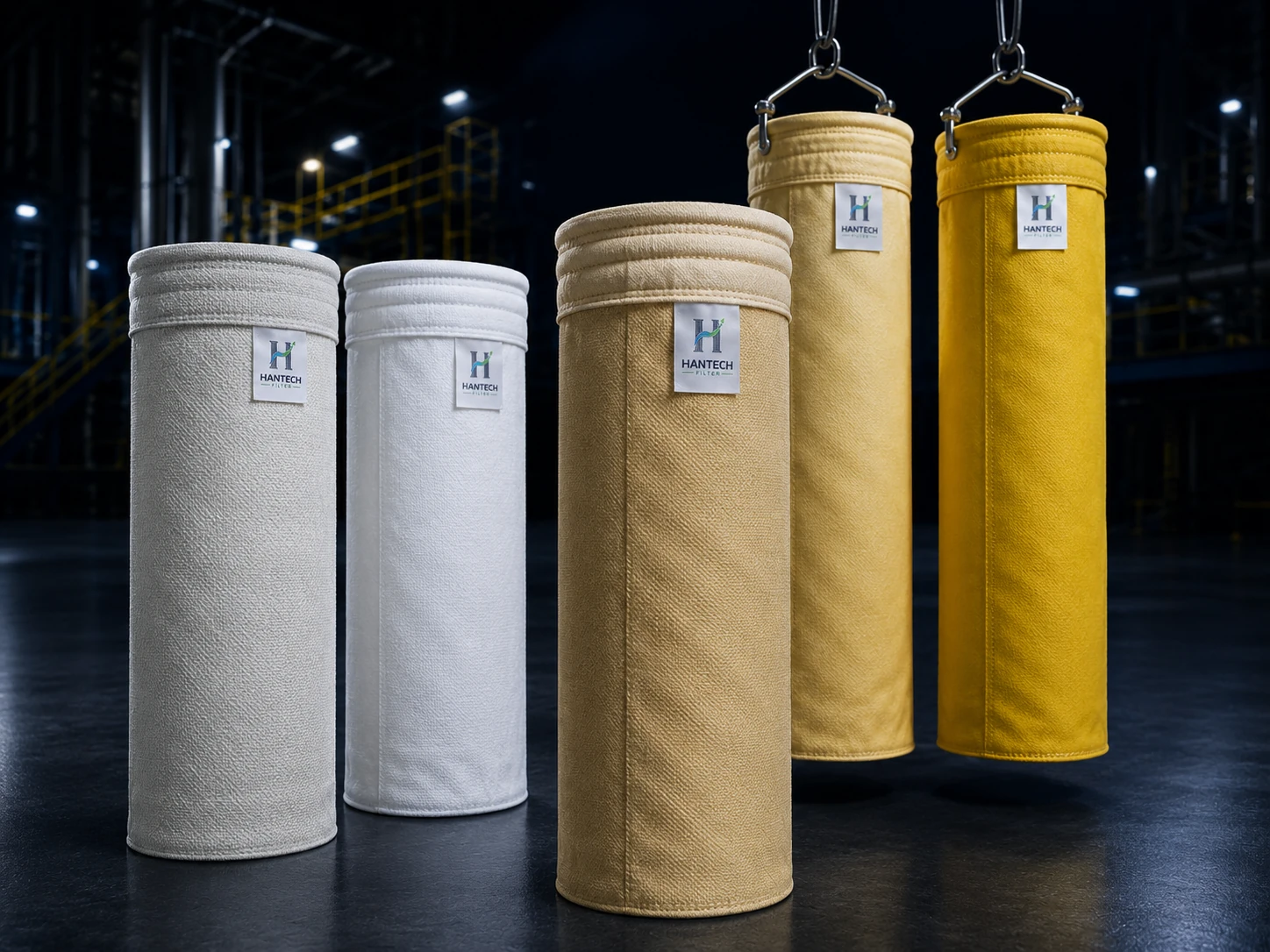
Define your asphalt plant filter bag specification using cleaning method, bag dimensions, support compatibility and operating data.
Preparation method: manufacturer application information, process risks and engineering examples with explicit assumptions were assessed together. Numerical examples are not field measurements.
What is an asphalt plant filter bag?
An asphalt plant filter bag is a replaceable element that captures mineral dust from aggregate dryer exhaust. A correct specification covers more than the fabric name: cleaning method, finished dimensions, attachment, temperature history and moisture load all matter. Meta-aramid products often searched for as Nomex are candidates for hot asphalt applications, but are not an automatic choice for every plant. Two plants with the same rated production capacity may need different bag constructions. A quotation must first define a product that fits the existing collector and suits its actual operating conditions.
This guide helps maintenance and purchasing teams request comparable quotations against one specification. Ordering replacement bags is different from designing a complete new collector. If actual flow, available filtration area or cleaning capacity is inadequate, changing bags alone may not solve the problem. The examples below are educational, not customer measurements, guarantees or stock declarations.
How do the dryer, pre-separator and baghouse work together?
- Dryer → mineral-laden gas
- Primary separation → coarse dust removed
- Baghouse → fine dust retained
- Hopper → controlled dust discharge
Depending on plant design, dryer exhaust first passes through a coarse-particle separator. Fine mineral dust reaches the baghouse and is captured as gas passes through the fabric. Cleaning releases the dust into the hopper. Returning collected material as filler depends on the mix recipe and material-handling design. Even good fabric cannot clean effectively under persistent dust accumulation when hopper conveying or discharge equipment is not working.
Batch and continuous plants may have different gas paths. The point where reclaimed asphalt pavement, or RAP, enters the process must also be established. Mineral-dust bags should not be assumed to remove all bitumen-related blue smoke, odour or gaseous components. First distinguish particles, aerosols and gases, then assess the appropriate control method.
Identify the cleaning method before ordering
| System | Order check | Mismatch risk |
|---|---|---|
| Pulse-jet | Cage, venturi, top attachment and seam orientation | Local wear and poor pulse distribution |
| Reverse air / reverse pulse | OEM support elements, attachment and cleaning motion | Mechanical incompatibility of a pulse-jet bag |
| Cassette or special geometry | Drawing, cassette dimensions, sealing and installation direction | Fit cannot be specified by nominal diameter alone |
A commercial cleaning-system name alone is not enough. Review photographs of the top attachment and a removed bag together with the equipment drawing where available. Applying a round pulse-jet measurement sheet to a cassette or differently supported filter can produce an incorrect order. Even apparently sound supports should be checked for corrosion, distortion, burrs and joint condition.
Dimensions that must stay separate on the measurement sheet
Finished bag diameter, flat width, cage outside diameter, tube-sheet hole diameter and snap-band dimensions are separate inputs. Tube-sheet thickness also affects seating. A used bag may have shrunk through thermal or chemical exposure, so production dimensions should not be copied from it alone. Without an approved drawing, measure the bag, support and tube sheet together, and close the uncertainty through sample acceptance.
Educational example: an ideal, unstretched cylindrical body with a flat width of 250 mm has an approximate geometric diameter D = 2 × 250 / π = 159.2 mm. This is neither an order diameter nor a hole diameter. Seam construction, measurement tension, shrinkage after use and manufacturing tolerances must be considered separately. For bags described loosely as about 160 mm, verify the seating dimensions rather than ordering a snap band from the nominal label.
Compare technical scope, not just fabric names
When comparing meta-aramid, PPS, P84, PTFE or fiberglass, specify continuous temperature separately from short excursions. A single maximum temperature is insufficient without excursion duration and frequency. Chemical suitability must account for gas moisture, fuel-related components, oxygen and condensation. A manufacturer's data for one weight, scrim and finish should not be generalized to an entire fibre family.
| Quotation item | Written information to request |
|---|---|
| Media | Fibre, scrim, mass per area and tolerance; product-specific TDS |
| Surface finish | Scope of membrane, impregnation or water/oil-repellent treatment |
| good air permeability | Value, units, test pressure and method |
| Construction | Finished dimensions, seam, top and bottom details |
| Acceptance | Sample approval, lot traceability and delivery scope |
Equal-looking permeability figures are not directly comparable when test pressures differ. Likewise, higher fabric weight alone does not establish better filtration or longer life. Specifying both the TDS revision and delivered construction prevents the same product name from concealing different technical scopes.
What changes the price of an asphalt filter bag?
Price depends on finished surface area, selected media, finish, seam and attachment details, quantity, sampling and delivery conditions. Separate bag price from supports, installation and downtime. Define acceptance criteria if existing cages will be reused. An expensive bag installed on a burred cage can wear prematurely even when its media selection is correct.
Illustrative scope example: quoting only 480 bags for a 480-bag collector is different from quoting 480 bags, supports replaced after inspection, installation labour and startup follow-up. Spares should be specified separately from the plant's maintenance plan; a universal spare percentage is not appropriate. Choosing the lowest price before aligning scope can create unexpected items during a shutdown.
When bag replacement alone is not the right scope
Recurring burns in the same area, persistent wet cake or rapidly increasing pressure drop on a new set require root-cause evidence. Upgrading fabric alone may preserve the underlying problem unless protection systems, burner control, insulation, air leakage, cleaning and hopper discharge are assessed. A failure-location map describes the issue better than a product name.
Our engineering assessment checks mechanical fit, then temperature and chemical suitability, then cleanability. Product approval is incomplete while any of these remains uncertain. An ePTFE membrane cannot correct wrong dimensions, and aramid does not make incoming hot particles safe. Suspected flame or fire requires the plant's authorized safety and operations team before a replacement-bag order.
RFQ package and delivery acceptance
Provide plant and line type, collector make/model, cleaning method, bag count, approved dimensions, support drawing, continuous/peak temperature records, flow measurement conditions, fuel type, aggregate moisture and failure photographs. Include emission-target measurement and reference conditions. Mark unknown fields for measurement or confirmation instead of guessing them.
On delivery, check labels and lot identity, fabric and finish, dimensional tolerances, seams, attachment and packaging. Verify sample seating and support fit before installing the entire set. After startup, track temperature, flow, differential pressure and emission indicators on the same timeline. These records help compare not just service duration but the conditions that governed it.
- Filter bag product options
- Asphalt plant filtration solutions
- Asphalt bag media and filtration area selection
- Distinguishing blinding and heat-damage symptoms
- Request a technical quote with dimensions and process data
Frequently Asked Questions
Can I order by the name Nomex alone?
No. Fibre, finished dimensions, finish, cleaning method and support compatibility must be specified together. A brand name alone is not a specification.
Is an old bag sample sufficient?
A sample helps, but a used bag may have shrunk or suffered damage. Compare it with the tube sheet, support and approved drawing.
Is there a standard price or fixed lead time?
Firm pricing and lead time require an agreed specification, quantity and delivery conditions. Sampling and production scope must be considered together.
Must cages be replaced with the bags?
Not always. Check corrosion, burrs, distortion and dimensional suitability; replace supports that fail acceptance.