

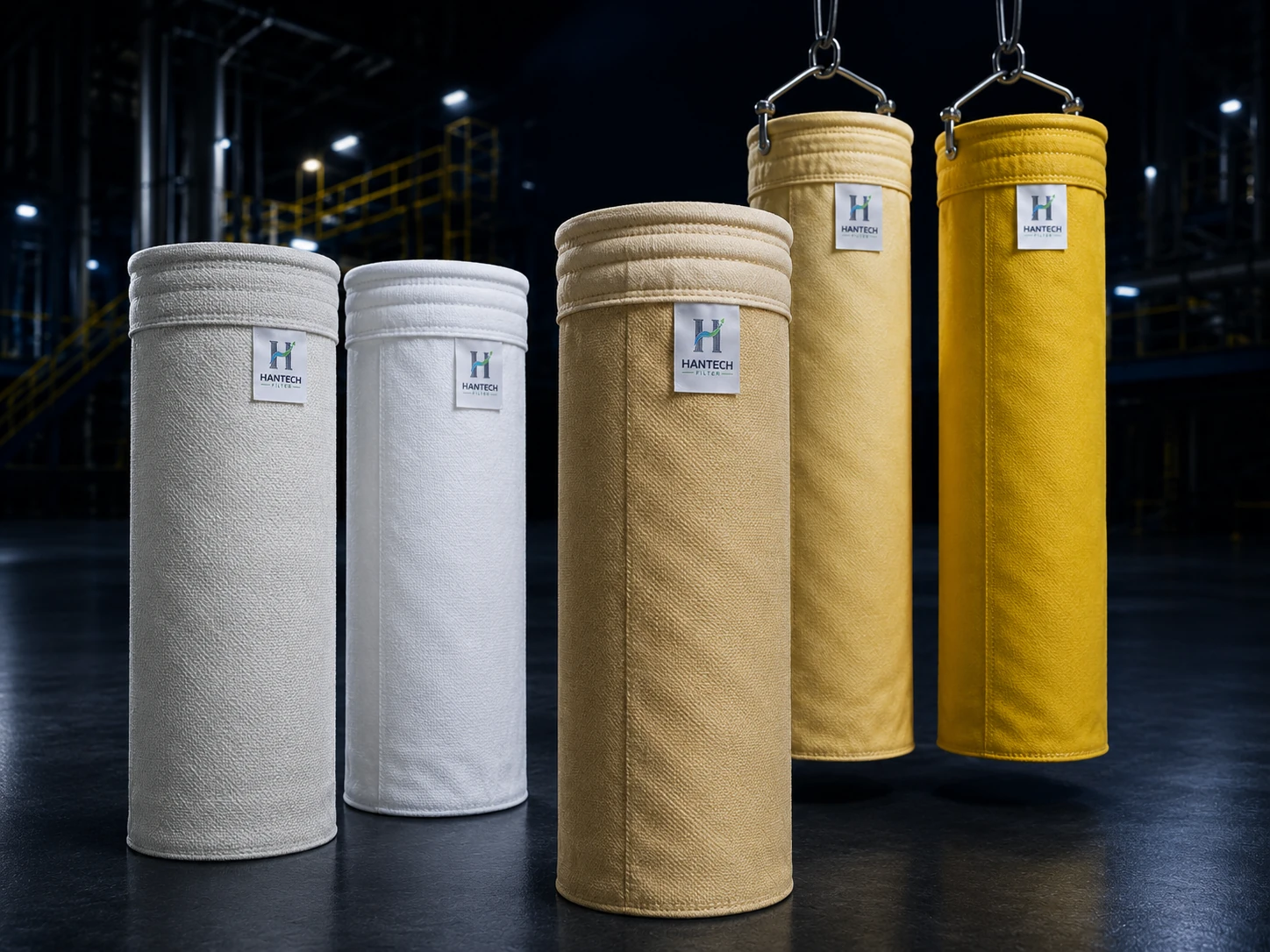
Filter bag sizing is more than the width and length of a used bag. Measure the bag, cage, snap-band and tube sheet together to create a production-ready technical data set.
Which Dimensions Are Required When Measuring a Filter Bag?
To take a usable filter bag measurement, record at least the finished length, lay-flat width or diameter, top style, snap-band construction, bottom detail and seam direction. A production-ready data set must also include the cage outside diameter and length, venturi detail, tube-sheet hole diameter and plate thickness. Measuring an old bag with a ruler and ordering the same dimensions can repeat shrinkage, elongation or a previously mismatched part.
The safest method is to inspect the removed sample, cage and tube sheet as one set, take each critical measurement at least twice and state clearly whether the sample is new or used. This guide shows the measurement sequence, required photographs and quote data step by step.
Identify the Sample Before Measuring
| Control | Why is this necessary? | How to record it |
|---|---|---|
| Sample condition | A used bag may have shrunk or elongated because of temperature, moisture and mechanical load. | Mark it as new, used or damaged. |
| Filter and row location | Different compartments may show different dimensions or damage. | Record the filter name, row and bag number. |
| Process side | The dust-side and clean-gas direction affect interpretation of the top and bottom details. | Take overview and close-up photographs before removal. |
| Measuring tool | A flexible tape, caliper and rigid rule serve different measurement tasks. | Record all dimensions in millimetres. |
Maintenance and removal must follow the plant's energy-isolation, personal protective equipment and safe-work procedures. Pulling a dirty or damaged sample straight for measurement can distort its true finished dimensions.
Step-by-Step Filter Bag Measurement
How Do You Convert Lay-Flat Width to Diameter?
When a cylindrical bag is laid completely flat, you see two layers of fabric across its width. Ignoring seam and tolerance effects, the geometric relationship is D = 2 × W / π. Here W is the lay-flat width and D is the theoretical diameter. For the reverse conversion, use W = π × D / 2.
Worked example
- Lay-flat width W
- 251 mm
- Formula
- D = 2 × 251 / π
- Theoretical diameter
- 159.8 mm
- First Comment
- The sample indicates an approximately Ø160 mm size class.
- Production decision
- Do not release it for production until the cage OD, tube-sheet hole, plate thickness and snap-band sample are confirmed.
This calculation is only a geometric cross-check. Fabric thickness, seam allowance, in-service deformation and manufacturing tolerance affect the result; theoretical diameter alone is not proof of the order size.
How Do You Measure the Cage, Venturi and Tube Sheet?
| Part | Measurement required | Field note |
|---|---|---|
| Cage | Maximum outside diameter, overall length, section count and wire count | Measure the diameter at the top, middle and bottom in two perpendicular directions; record any bow or out-of-roundness. |
| Venturi | Throat diameter, overall height and cage seating detail | Use a photo to show whether it is welded to the cage or removable. |
| Tube sheet | Clean hole diameter and plate thickness | Do not measure a burred, worn or oval hole at one point; compare several holes. |
| Snap-band | Band width, groove spacing and bead/cord count | Show a close-up of the section that seats in the tube sheet. |
| Bottom connection | Closed disc, reinforcement band and hook/chain detail | For reverse-air or shaker systems, describe the top and bottom connections together. |
The cage should support the bag without continually stretching or rubbing the fabric. The snap-band must seat consistently around the tube-sheet hole. Final tolerances should be set by the bag/cage manufacturer's drawing and sample approval.
How Can Symptoms Reveal a Measurement Error?
| Site indication | Possible dimensional/fit problem | First Check |
|---|---|---|
| Dust leakage at the bag top | Snap-band section, hole diameter or plate thickness mismatch | Measure the clean hole and bag-top section together. |
| Bag tears in a longitudinal line | Cage diameter/wire, burr, weld or out-of-roundness problem | Inspect the cage visually and dimensionally with suitable gloves, not bare hands. |
| Bag bottom strikes or folds | Bag-to-cage length or bottom-connection mismatch | Compare the finished bag length and total cage length from the same reference points. |
| Excessive force is required to install a new bag | Bag width/diameter is too small or the snap-band is incorrect | Do not force the installation; recheck the sample, cage and tube-sheet dimensions. |
| Emissions rise while ΔP remains low | Top seal leak, tear or bypass | Inspect sealing points instead of changing only the media. |
When I Would Not Produce Directly from the Sample
Measurement and Photo Checklist for a Quote
Include the following with the quote request: bag quantity; finished length; lay-flat width or confirmed diameter; top and bottom styles; media/finish; cage OD, length and wire count; venturi detail; tube-sheet hole diameter and plate thickness; normal/peak temperature; dust type; moisture/chemistry; current ΔP and failure symptom. Overview photos plus close-ups of the bag top, bottom, cage ends and caliper readings speed up the quotation.
See the filter bags and filter cages pages for related products and the snap-band guide for top construction. Send the measurement sheet and photographs through the Hantech technical quote form.
Technical Review Note
Technical review: Doğuhan Kırmacı — dimensional compatibility of filter bags, cages and tube sheets. This guide standardizes field measurement; final production tolerances must be confirmed with an approved sample or technical drawing.
Frequently Asked Questions
How is filter bag diameter calculated from lay-flat width?
Theoretical diameter is calculated with D = 2 × W / π. For example, a 251 mm lay-flat width gives approximately 159.8 mm; confirm it against the cage and tube sheet before production.
Is a used filter bag sufficient as a sample?
Not always. Because shrinkage, elongation and deformation may have occurred, samples from different rows should be measured together with the cage and tube sheet.
Which measurements are required for a snap-band bag?
Provide the clean tube-sheet hole diameter, plate thickness, snap-band width/groove profile and a close-up section photograph.
Is a physical sample required for a quote?
If dimensions conflict, the top detail is non-standard or the media cannot be verified, a physical sample or approved technical drawing is strongly recommended.