
Select bags separately for sand preparation, shakeout, blasting and melting duties. Includes net-area calculations, a failure matrix and an RFQ checklist.
Preparation method: manufacturer application information, process risks and engineering examples with explicit assumptions were assessed together. Numerical examples are not field measurements.
Why is one bag specification risky across a foundry?
Foundry filter bag selection starts by separating extraction points: sand-preparation dust, shakeout dust and melting fume are not the same contaminant. Polyester considered for a dry, relatively cool duty may become unsuitable when gas temperature or chemistry changes. PPS or aramid cannot be selected merely because the site is a foundry either. Assess temperature profiles, moisture, fine-particle content, abrasion, gas chemistry and cleaning together. The most expensive media cannot compensate for poor extraction connections or hot particles reaching the bags.
This guide helps foundry maintenance and purchasing teams prepare process-specific specifications. Example numbers are not design recommendations; results require measured flow and manufacturer limits. The bags discussed filter dust-laden air, not inclusions in molten metal.
Working principle and process-selection table
The hood captures contaminants at source, the duct transports them, the bag surface separates particles, and pulse cleaning plus hopper equipment remove collected solids. If any link is inadequate, changing bags alone will not restore overall performance. Particle capture does not demonstrate gaseous-pollutant removal or acceptable workplace exposure.
| Duty | Key risk | First selection input |
|---|---|---|
| Sand preparation and transfer | Fine mineral fraction and abrasion | Particle distribution, moisture, actual flow |
| Shakeout and hot casting areas | Variable temperature and moisture | Temperature record over the cycle |
| Abrasive blasting / shot cleaning | Coarse abrasive particles | Pre-separation and inlet distribution |
| Melting-furnace extraction | Fine fume, hot particles, chemistry | Alloy/process, gas analysis and risk assessment |
Media and mechanical-fit selection criteria
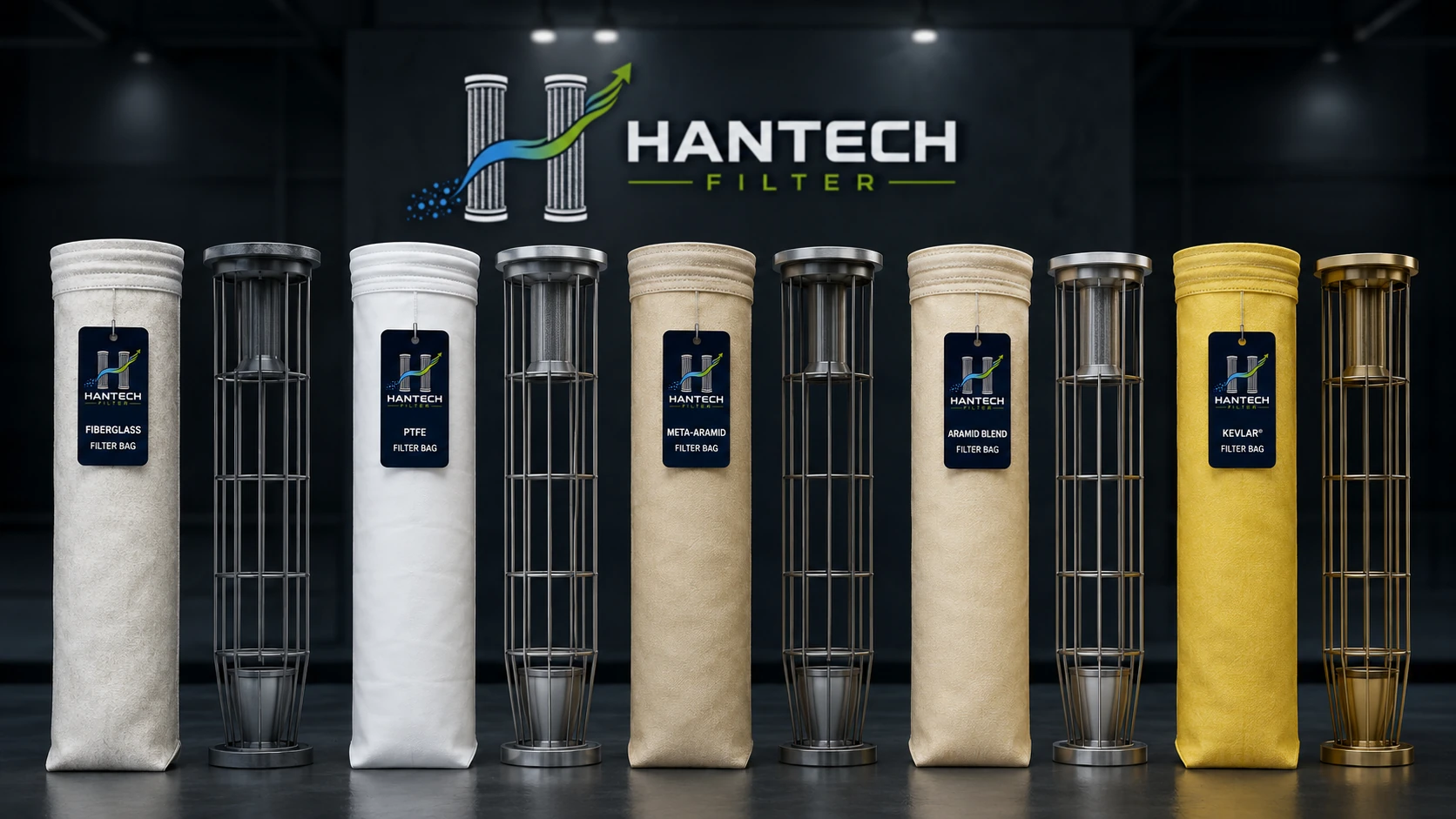
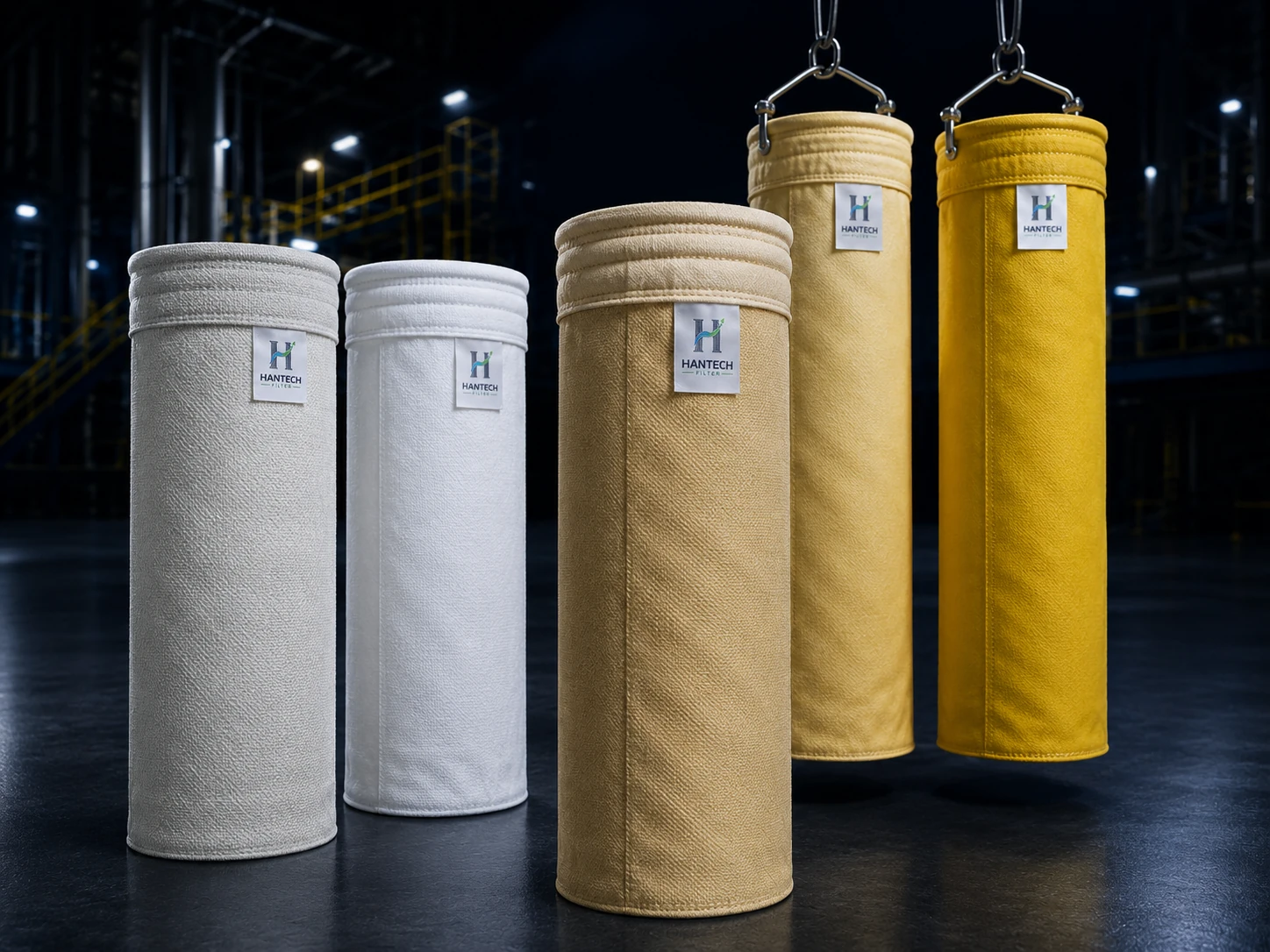
Temperature limits apply to the complete selected bag, not just the fibre name. Verify seams, surface treatment and membrane backing where used. A membrane may be a candidate for fine fume, but it does not resolve condensation, sparks or poor cleaning geometry. Record bag diameter, cage outside diameter, tube-sheet opening and snap-band dimensions separately. An aged sample must be checked for shrinkage and wear before it defines manufacturing dimensions.
If combustible or reactive metal dust may be present, safety assessment precedes media selection. Antistatic fabric alone is not fire or explosion protection, and combining dusts in one system needs separate assessment. We would not prescribe a high-temperature-labelled bag as the sole response to observed sparks or hot particles. Qualified specialists must establish source control, suitable separation and protection arrangements.
Worked example: net filter area with one compartment offline
Assume 400 bags, 0.160 m diameter, 4 m active length and 40,000 actual m³/h. Gross area = 400 × π × 0.160 × 4 = 804.25 m². With all bags online, air-to-cloth ratio = 40,000 / (60 × 804.25) = 0.829 m/min. If one of five equal compartments is fully isolated and the same flow is maintained, net area becomes 643.40 m² and net loading 1.036 m/min. A 20% reduction in area increases velocity by 25%.
The result does not make 1.036 m/min acceptable for every foundry. Fine-particle content, cake release, cleaning capacity and manufacturer limits still matter. Fan flow may change in practice; the example assumes constant flow. The key Hantech decision is not to count isolated maintenance area as available capacity in a quotation. Measure flow and differential pressure during the same production cycle.
Common mistakes and failure diagnosis
| Symptom | Check order |
|---|---|
| Repeated wear along cage wires | Cage finish, bag clearance, pulse alignment |
| Holes concentrated in one row | Inlet distribution, hot particles, local abrasion |
| Rapid pressure rise after cleaning | Actual flow, fines loading, header recovery, discharge |
| Low pressure drop but outlet dust | Bag seating, tears, bypass and instrumentation |
If only inlet-side bags wear in an illustrative blasting collector, investigate flow distribution before specifying heavier fabric throughout. Replacing bags without changing inlet impingement can repeat the damage. Conversely, simultaneous pressure rise across every compartment is less likely to originate from a single cage defect. Inspections require safe shutdown, energy isolation and site dust-handling procedures.
RFQ package and technical assessment
Provide simultaneous duty combinations, alloy and sand/binder information, flow basis, temperature excursions and their duration, moisture, existing media and bag dimensions. A row/compartment damage map and differential-pressure time series are more useful than a single torn-bag photograph. A technical quotation should identify active area, mechanical fit, media limits and missing safety data separately.
- Filter bag options for foundry duties
- Bag and filter cage compatibility
- Foundry dust and fume collection systems
- Request a technical quote for your foundry process
Frequently Asked Questions
Can polyester bags be used in a foundry?
It can be a candidate for suitable dry, low-temperature duties, not a universal specification for the whole foundry.
Is PPS the automatic choice for furnace fume?
No. Assess chemistry, oxidation, moisture and the complete bag's approved temperature limits together.
Will a cyclone capture all fine fume?
No. Coarse-particle pre-separation and final fine-particle filtration are different duties.
Should gross or net area be used?
State both explicitly; when a compartment is isolated, assess loading against the net area actually online.