
Industrial aspirator selection must be made by reading the suction point, duct losses, filter differential pressure, fan curve, dust characteristics, and energy consumption together.
What Is an Industrial Aspirator?
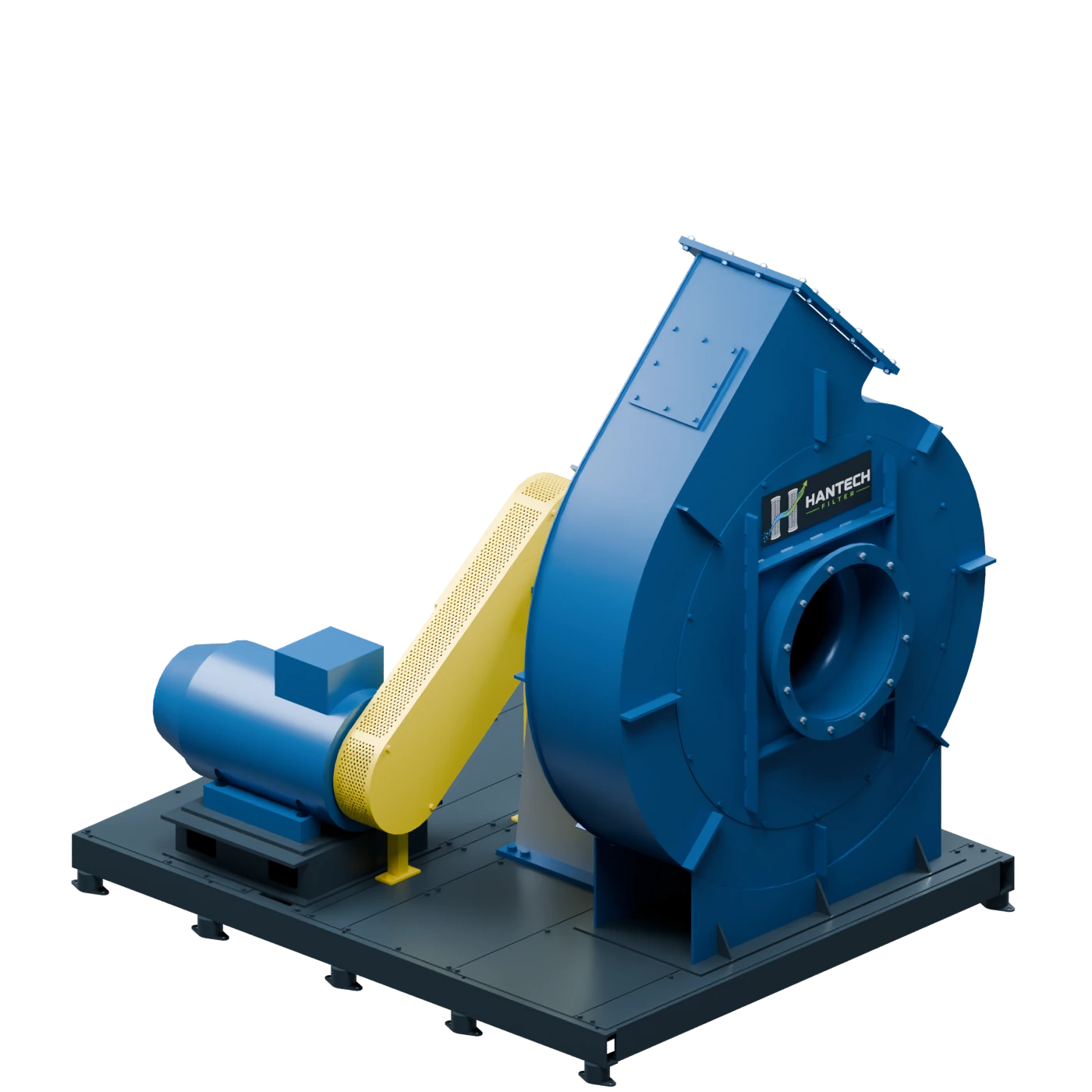
Industrial extraction fan is a suction solution that captures dusty or contaminated air at the process point and transports it in a controlled way through the duct, filter, and fan system. On the purchasing side it often looks like just a fan, but field performance depends not on the fan's power alone but on the resistance of the entire system.
Hantech Filter evaluates exhaust fan requirements together with the intake hood, ductwork, filter, fan curve, and maintenance access. The goal is not simply to select a high-kW motor, but to deliver the required extraction with the least unnecessary energy use and the lowest maintenance risk.
Selection Matrix
| Data | How does it affect the decision? | Hantech check |
|---|---|---|
| Capture point geometry | Determines the required capture flow rate | Hood opening and welding distance are checked |
| Duct length/elbows | Increases the static pressure requirement | Duct loss calculation is performed |
| Filter dP | Changes the fan operating point | Clean/dirty filter trend data is required |
| Dust corrosivity | Affects impeller and housing material | Particle type and velocity are checked |
| Noise & Energy | Determines operating cost | Instead of throttling with a damper, the correct fan curve is sought |
When Should I Choose a Larger Aspirator?
Worked Example: Preliminary Suction Flow Check
Example
- Suction point
- 3 transfer points
- Target flow rate per point
- 3,000 m³/h training basis
- Total process flow
- 9,000 m³/h
- Leakage/balance margin
- 10% sample
- Front fan flow rate
- 9,900 m³/h
- Next check
- The fan curve is read against the total pressure loss of duct + filter + stack.
This calculation is only a first estimate. For actual selection, duct velocity, filter dP, dust type, temperature, and the fan curve must be verified. The same flow rate produces completely different fan behavior at different static pressures.
Information Required for a Quote
For an industrial aspirator, the number of suction points, hood dimensions, duct diameter/length data, existing fan nameplate, filter type, dP trend, dust characteristics, temperature, motor kW/RPM, vibration-balance complaints, and target suction performance should be provided. For the relevant product family, air handling equipment can be reviewed, and for the calculation logic, the fan flow rate and static pressure guide; technical requests can be submitted via the quote form.
Frequently Asked Questions
Are an industrial aspirator and a fan the same thing?
In practice, "aspirator" is often used to mean a fan-driven extraction system; however, the correct choice requires evaluating the fan, ductwork, filter, and extraction geometry together.
Does extraction definitely increase if motor kW is increased?
No. If system resistance is high or the hood/duct is poorly designed, a larger motor may not deliver the expected extraction.