
Assess PPS bags for coal and biomass boilers using fuel, oxidation, moisture and actual flow data. Work through a net filtration-area example.
Preparation method: manufacturer application information, process risks and engineering examples with explicit assumptions were assessed together. Numerical examples are not field measurements.
What does a PPS filter bag do in boiler flue gas?
PPS filter bags are candidates for capturing fly ash from coal and biomass boiler flue gas under suitable operating conditions. Selection should not rely only on boiler output or fuel name. Assess actual inlet flow, temperature changes, moisture, oxygen and other gas components together. Suitability for certain hot, moist duties does not mean unlimited resistance in every combustion stream.
This guide focuses on bag replacement and technical specifications for existing baghouses. It is not a boiler, stack or fire-protection design. The calculation is an educational example with explicit assumptions, not a field measurement or design approval. Waste-incineration gas should not be assigned the same material specification simply because it resembles a biomass duty.
How do fuel and the gas path change bag selection?
Equipment between combustion and the baghouse changes temperature and particle loading. Include the economiser, pre-separation, duct leakage and any gas-treatment steps in the assessment. Evaluate fly-ash size and abrasion alongside variations in fuel moisture and chemistry. Boiler outlet temperature should not be assumed to equal the temperature experienced by the bags.
| Variable | Why does it matter? | Required evidence |
|---|---|---|
| Fuel blend | Ash and gas chemistry can change | Representative fuel and ash analyses |
| Temperature transitions | Excursions and cold starts present different risks | Time records at the filter inlet |
| Oxygen and oxidising components | PPS oxidation suitability must be checked | Actual gas analysis and product data sheet |
| Moisture and condensation | Cake adhesion and chemical conditions change | Moisture, gas composition and cold-surface assessment |
| Ember or spark carryover | Bag material does not replace fire protection | Site-specific risk review and OEM protective arrangements |
Oxidation and condensation boundaries for PPS
A single universal safe oxygen percentage or temperature for PPS would be misleading. Behaviour depends on temperature, gas composition, exposure duration and the fibre, scrim and finish combination. Use the continuous and short-term limits for the manufacturer's specific product. A membrane is not an absolute barrier protecting the underlying PPS from every chemical effect.
Checking the upper temperature limit is only half the task. Assess possible water or acid condensation on cold surfaces and the sticky cake it may create. Dew point depends on gas composition, so one minimum temperature should not be assigned to every boiler. Hantech treats the operating window as a combination of upper material limits and lower condensation risks. If that window is unverified, new bags alone are not a reliable operating solution.
Media comparison: a higher price does not guarantee suitability
| Candidate | Reason to evaluate | Check before deciding |
|---|---|---|
| PPS felt | Candidate for suitable hot, moist gas conditions | Oxidation, product limits and cleaning compatibility |
| Membrane-laminated PPS | Fine ash and surface-filtration requirements | Supports, seams, pulse conditions and PPS substrate limits |
| PTFE-based alternative | Assessment of chemistry challenging for PPS | Construction, mechanical durability and total cost |
| Other high-temperature media | Separate candidates according to the operating envelope | Moisture and chemistry, not temperature alone |
This matrix is not a product approval. Gas analysis, sample assessment and written technical limits are required for the selected media. Add the outlet target and fine-particle fraction when choosing surface treatment. Higher fabric weight does not automatically deliver longer life or lower emissions; cleanability and mechanical support also affect performance.
Normal versus actual flow: calculating available area
Assume a dry flow of 12,000 Nm³/h referenced to 0 °C. The filter operates at 150 °C, reference and filter absolute pressures are equal, and composition and dry basis remain unchanged. Using the ideal-gas approximation, actual flow = 12,000 × (150 + 273.15) / 273.15 = 18,589.79 m³/h. This simplified example excludes added water vapour. A real assessment must verify normal reference conditions, the absolute-pressure ratio and dry-to-wet basis conversion.
For 240 bags with a diameter of 0.16 m and active length of 6 m, area is A = 240 × π × 0.16 × 6 = 723.82 m². With all bags online, v = 18,589.79 / (60 × 723.82) = 0.428 m/min. If one of four equal compartments is isolated, available area falls to 542.87 m² and velocity at the same flow rises to approximately 0.571 m/min. Losing one compartment therefore increases face loading by about one third.
These velocities are not design recommendations. Evaluate them against ash characteristics, cleaning capacity, inlet distribution and the emission target. Active filtration area is not fabric cutting area. Upward velocity between bags is another check: apparently sufficient total surface area cannot by itself correct poor flow distribution inside the housing.
Illustrative scenario: bag problems after a fuel change
Suppose differential pressure increases and bag life shortens after a fuel-blend change, despite unchanged boiler load. The first step is not ordering thicker PPS bags. Compare fuel moisture, ash analysis, actual flow, temperature records and gas composition before and after the change. Investigate air leakage and oxidising conditions separately from moisture-related cake behaviour. Brittle fabric alone does not establish a chemical diagnosis; inspection and, where appropriate, material analysis are needed.
If hot-particle carryover is suspected, changing fabric does not replace a protective system. Follow the site's risk assessment, manufacturer instructions and safe-shutdown procedures. Track pressure, outlet dust and bag-damage locations on the same timeline after investigation. One trouble-free week, without comparison at similar load, cannot justify a long-term life guarantee.
RFQ checklist for boiler filter bags
Start with fuel type and blend, boiler load range, gas-path layout, flow bases, inlet temperature history, moisture and gas analysis. Add bag quantity, active dimensions, compartment arrangement, cleaning method, cage and venturi drawings, attachment, tube-sheet dimensions and hopper discharge. Share the existing bag data sheet, damage photographs and required outlet performance. Ask for written construction details, tolerances, acceptance checks and operating limits as well as the material name.
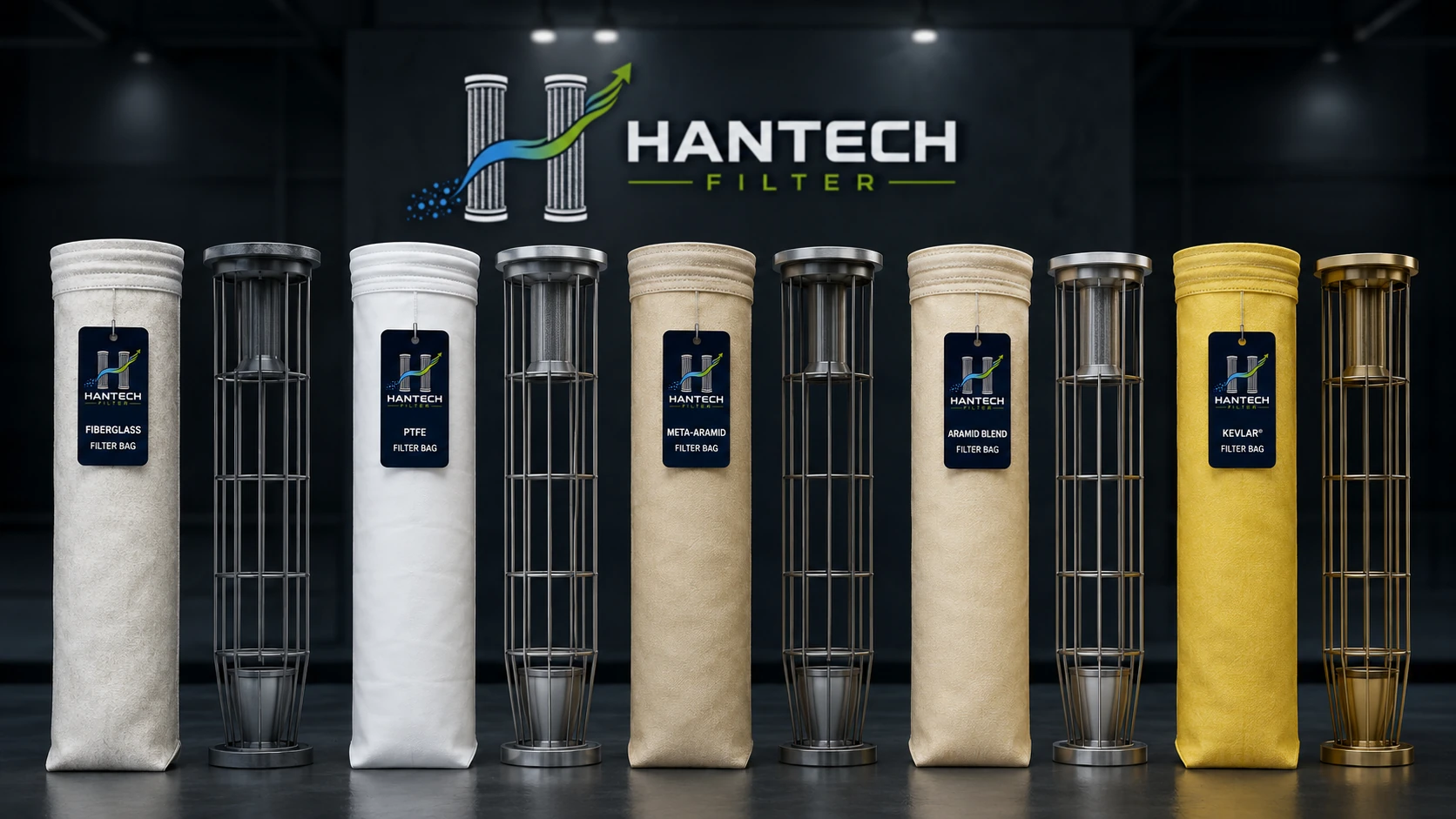
- PPS and other filter bag options
- Cage and venturi compatibility for boiler filters
- Request a technical quote using your boiler gas data
Frequently Asked Questions
Can every biomass boiler use PPS?
No. Fuel and gas conditions vary. Verify PPS suitability against temperature, moisture, oxidation and the selected bag's technical limits.
Is there one oxygen limit for PPS?
No single limit applies to every product and process. Assessment must consider temperature, other gas components and exposure duration for the specific product.
Can Nm³/h be used directly in filtration-area calculations?
Bag face velocity requires actual flow at filter conditions. Verify reference temperature, absolute pressure and dry-versus-wet basis.
Can all area be counted with a compartment offline?
No. Available net area decreases. The same flow through less area increases face loading, so that operating state needs a separate check.