
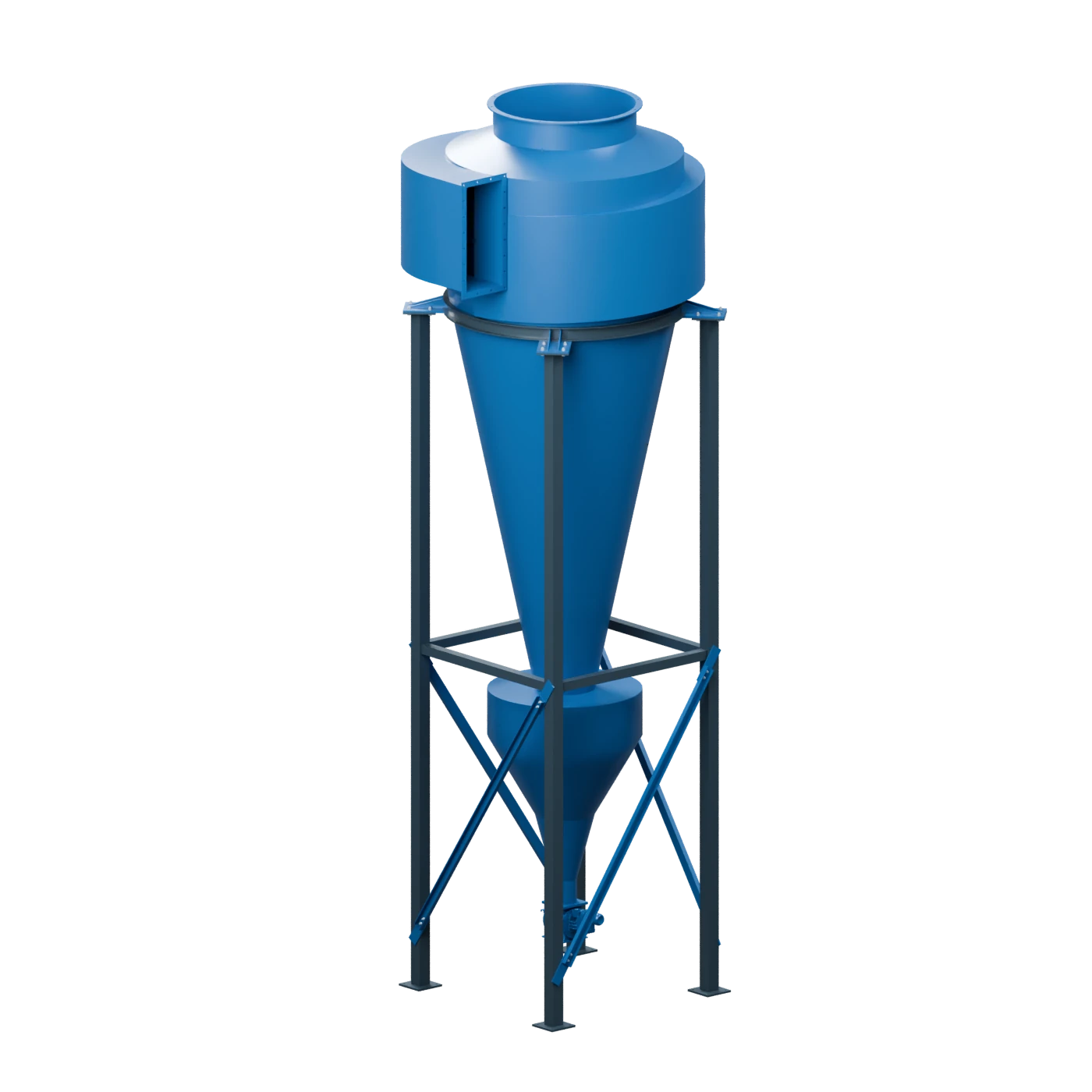
A cyclone dust collector is an industrial pre-separator that removes coarse, abrasive particles by centrifugal action, reducing filter load, spark risk, and maintenance cost ahead of a baghouse filter.
What Is a Cyclone Dust Collector?
A cyclone dust collector is a mechanical pre-separator that spins dust-laden air inside a cylindrical-conical body to separate coarse, heavy particles from the gas stream. In industrial plants, a cyclone dust collector is most often positioned ahead of a baghouse filter or cartridge filter. The goal is to reduce the coarse, abrasive load reaching the final filter, making bag life, differential pressure behavior, and the maintenance plan more predictable.
Since a cyclone filter uses no filter media, it is not a substitute for a baghouse filter in the classic sense. In processes with a low mg/Nm³ emission target, it should generally be regarded not as the final solution but as engineering support equipment ahead of the baghouse filter system. When correctly selected, it becomes a dust collection cyclone that works together with the fan, ductwork, hopper, rotary airlock, and final filter; when incorrectly selected, it creates additional pressure loss and discharge problems.
How Does a Cyclone Separator Work?
Tangential inlet, outer vortex, inner vortex, and controlled dust discharge
- Dusty air enters the cyclone through a tangential inlet.
- A fast-rotating outer vortex forms inside the housing.
- Heavy particles are carried to the outer wall by centrifugal effect.
- Particles drop into the hopper through the conical section.
- The cleaned gas rises through the inner vortex.
- The rotary airlock discharges dust in a controlled manner.
The fundamental force driving separation in this flow is the centrifugal effect. Denser, larger particles are carried to the outer wall faster, while small, light particles can escape with the gas stream to the outlet. For this reason, cyclone efficiency should be thought of not as a single percentage but as a curve that varies with particle size.
5 Critical Engineering Parameters in Cyclone Selection
If cyclone selection is based on body diameter alone, two kinds of problems show up in the field: either efficiency stays low and coarse dust carries through to the filter, or pressure loss ends up too high and fan suction performance drops. That's why flow rate, dust load, particle size, density, and allowable pressure loss must be read together.
High-efficiency cyclones focus on separating smaller particles but can generate higher pressure drop. A high-throughput approach, on the other hand, prioritizes handling high flow rates. From Hantech's perspective, the right choice is not the model that looks most efficient in the catalog, but the configuration that performs in the best balance with the process's dust characteristics, fan capacity, and ultimate filtration target.
How Does Cyclone Efficiency Vary With Particle Size? What Is d50?
d50 refers to the particle diameter at which a cyclone reaches approximately 50 percent separation efficiency. For example, if a cyclone's d50 value is 12 µm, roughly half of the particles around 12 µm are separated; efficiency increases for coarser particles and decreases for finer ones. For this reason, there is no single absolute answer to "down to how many microns does a cyclone filter capture?" — the real answer depends on the particle size distribution, flow rate, density, and cyclone geometry.
| Particle behavior | Cyclone effect | Engineering interpretation |
|---|---|---|
| > 40 µm coarse mineral dust | Generally strong pre-separation | Suitable for reducing the load ahead of the baghouse filter. |
| 15–40 µm mixed process dust | Medium/high contribution depending on process data | d50, density, and flow rate must be calculated together. |
| 1-10 µm fine powder | Limited pre-separation | A baghouse filter is required for final emission control. |
| Sticky or moist dust | May behave erratically | The conical section, hopper, and discharge carry a blockage risk. |
This section is especially relevant to searches for cyclone efficiency, cyclone d50, cyclone particle size, and cyclone separator efficiency. However, overstating efficiency would be wrong; a cyclone is most often used not as a replacement for the final filter, but to help the final filter run more effectively.
Why Does Cyclone Pressure Loss Matter?
Adding a cyclone is not “free separation.” All the pressure losses in the fan → duct → cyclone → filter → stack chain must be calculated together. If cyclone pressure loss is kept too low, separation efficiency can suffer; if it's kept too high, fan flow rate can drop or energy consumption can rise. This balance becomes especially critical when retrofitting a cyclone onto an existing line.
If a cyclone is planned to be added to an existing line later, the fan's actual airflow–static pressure operating point should be checked, not just its motor power. The motor nameplate alone isn't enough information. Duct resistance, elbows, filter differential pressure, the stack side, and production load must all be evaluated together.
In Which Industries Are Cyclones Used?
| Sector | Typical processes | The role of the cyclone |
|---|---|---|
| Cement | Crusher, clinker, raw meal, coal, and raw material transfer | Reducing the coarse/abrasive load before the filter |
| Mines and minerals | Crushing, screening, drying, transfer | Pre-separating abrasive particles |
| Iron and Steel | Mineral/dust transfer, foundry processes | Reducing coarse particle and spark risk |
| Lime and gypsum | Crushing, grinding, packaging | Balancing the baghouse filter load |
| Wood / MDF | Chips, fiber, coarse particles | Separating bulky coarse particles |
| Grain / feed | Extraction at transfer, screening, and hopper top points | Controlled discharge of product/dust load |
The purpose of cyclone selection is not always the same across these industries. In some facilities the priority may be extending bag life, in others reducing spark or coarse-particle risk, and in others improving hopper discharge behavior. This is why even a request originating from a search for "cyclone filter price" or "industrial cyclone manufacturer" must be clarified with technical process data.
The Difference Between a Cyclone Filter and a Baghouse Filter
| Characteristics | cyclone | Baghouse filter |
|---|---|---|
| Separation principle | CENTRIFUGAL | Filtration |
| Coarse particle | Perfectly alright. | Affordable |
| Fine particle | Limited | Perfectly alright. |
| Filter media | No | Yes, |
| Pressure loss | Relatively low/medium | the quality of the surface. |
| Pre-separator | Perfectly alright. | — |
| Final emission control | Generally not sufficient | Affordable |
That is why the right question is usually not “cyclone or baghouse filter?” The more accurate engineering question is: does this process need a cyclone + baghouse filter combination, or is a baghouse filter alone sufficient? If the coarse/abrasive load is high, a cyclone can serve as a strong pre-separator that protects the filter; if a fine emission target applies, the baghouse filter remains the final control equipment.
When Should a Cyclone Not Be Used?
Under these conditions, the cyclone is not automatically rejected; but the selection is made more carefully. In some processes, a baghouse filter alone instead of a cyclone, and in others a different pre-separator or multi-cyclone, may be more appropriate.
Example Cyclone Selection: Clinker Transfer Line
Sample process data
- Process
- Clinker transfer
- Flow Rate
- 20,000 m³/h
- Gas Temp
- 120°C
- Dust
- Corrosive mineral
- Inlet dust load
- 25 g/Nm³
- Particle
- Mostly >20 µm
Under these conditions, a cyclone can be considered ahead of the baghouse filter to reduce the coarse particle load. However, for the final selection, the actual particle size distribution, dust density, target separation efficiency, fan operating point, and hopper discharge capacity must be checked. If the existing fan has no static pressure reserve, adding a cyclone may relieve the filter while reducing the suction flow.
In this scenario, Hantech evaluates not just the cyclone housing but also the inlet duct velocity, the discharge of the conical section, the sealing of the rotary airlock, and the remaining dust load on the baghouse filter together. As a result, the quotation is shaped by system behavior, not just equipment price.
Common Engineering Mistakes
The first mistake is selling or buying a cyclone as if it were a final emission-control device that can replace a baghouse filter. The second mistake is selecting based on cyclone diameter alone. The third mistake is failing to plan how dust in the lower hopper will be discharged; if the rotary airlock leaks, the system draws false air, separated dust can be re-entrained, and efficiency can drop.
The fourth mistake is failing to add the cyclone pressure loss to the fan calculation. The fifth is not accounting for wall buildup and cone blockage with moist or sticky material. Most of these mistakes can be caught at the quotation stage with a few right questions.
What Information Is Needed for a Quote?
For a cyclone dust collector or cyclone separator quotation, please provide the process name, approximate flow rate, inlet dust load, particle size distribution, dust density, temperature, moisture, operating hours, current fan information, duct diameters, and the amount of dust to be discharged. Photos of the current system, the fan nameplate, hopper dimensions, and a site drawing, if available, also speed up the selection.
By sharing your technical data through the quote form, you can evaluate together whether a cyclone is needed, fan suitability, and the final filtration system. Hantech Filter treats the baghouse filter, pulse-jet cleaning, rotary airlock, and cyclone as a single integrated system.
Frequently Asked Questions
Down to what micron size does a cyclone separator capture dust?
There is no single absolute limit. Efficiency varies with particle size, density, flow rate, and cyclone separator geometry. The d50 value refers to the particle diameter corresponding to approximately 50% separation efficiency.
Can a cyclone separator replace a baghouse filter?
Generally, no. A cyclone can be an effective pre-separator for coarse particles, but a baghouse filter or similar final filtration stage is required to meet low-emission targets.
What is the separation efficiency of a cyclone?
Efficiency is not a single number; it is evaluated against the particle-size curve. It can be high for coarse particles and limited for fine particles.
How much pressure loss does a cyclone separator have?
Depends on the model, flow rate, and design point. It must always be evaluated together with the fan's flow-static pressure operating point.
Can a cyclone be used as a pre-filter?
Yes. It can be used, particularly ahead of a baghouse filter, to reduce coarse and abrasive dust loading.
Is a rotary valve required under the cyclone?
Most continuous industrial applications require a rotary airlock for controlled, leak-tight discharge.
Is the cyclone connected before or after the fan?
Layout depends on the process design. A decision should not be made without calculating fan, ductwork, and filter pressure losses together.
What is the difference between a multicyclone and a single cyclone?
A multicyclone, with multiple small cyclone cells operating in parallel, can offer a more compact footprint and a different efficiency/pressure balance. It requires a separate engineering assessment.