
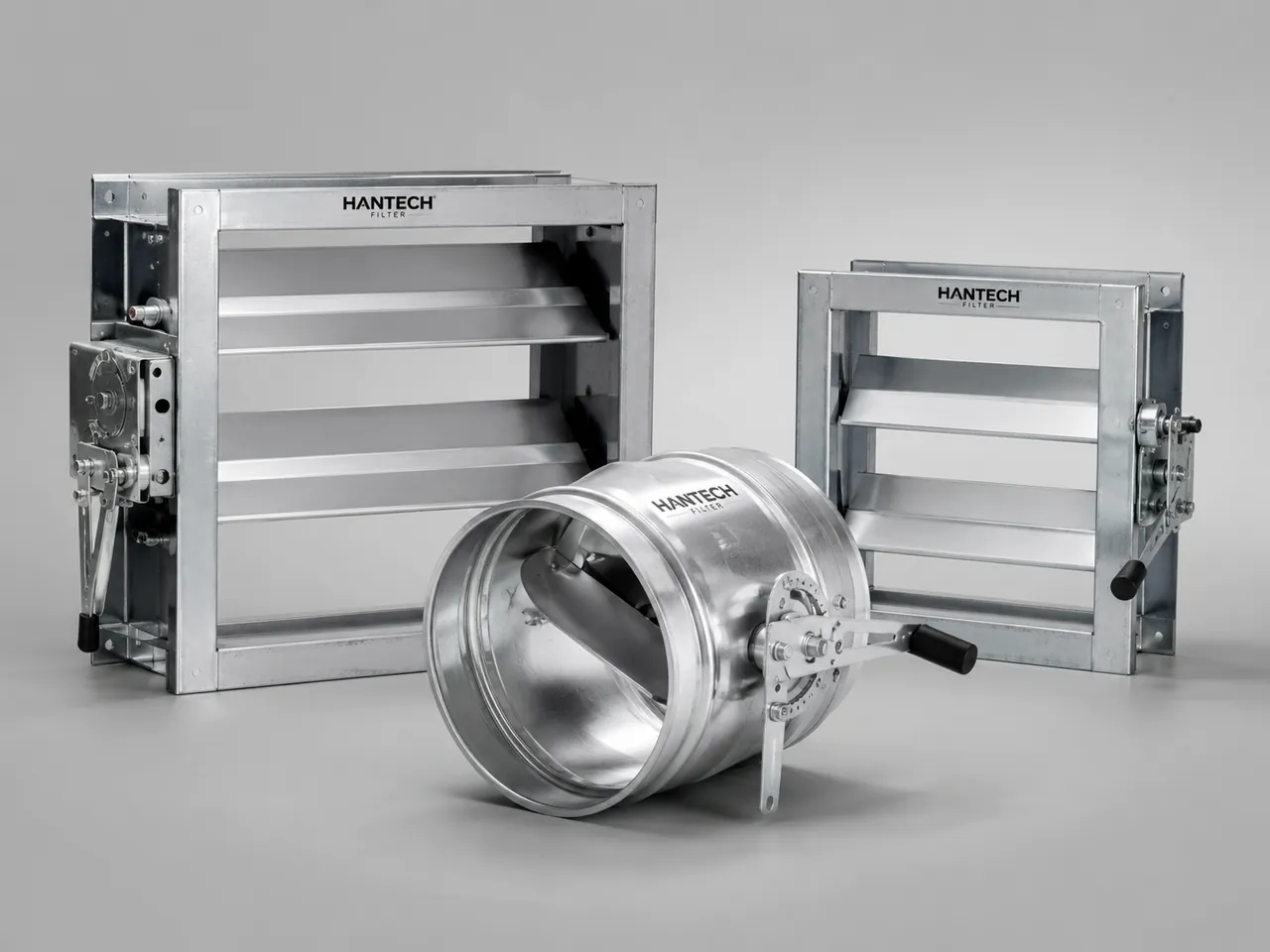
Air/gas damper selection must be made based on type, the leakage class concept, actuator-material compatibility, the fail-safe position, and whether the duty is branch balancing or isolation.
What Is a Damper / Klape? What Duty Does It Perform?
A damper (klape) is a flow-control device used to shut off, modulate, or redirect air/process gas flow in a duct or baghouse line. This article covers air/gas dampers; the slide/diverter klapes that shut off material flow under silos and bunkers are a different duty group and are covered separately on the klapes product page.
Choosing the right damper is not just about finding a housing that fits the duct diameter; the duty (shutoff/modulation/diversion), sealing requirement, temperature and dust abrasiveness, actuator type, and the safe position at a fault (fail-safe) must all be assessed together.
Damper Types and Applications
| Type | Duty | Typical use | Limitation |
|---|---|---|---|
| Manual slide damper (blast gate) | Fixed setting / isolation | Branch balancing, occasional maintenance isolation | No automation; not suited to frequent cycling |
| Motorized/pneumatic damper | Remote-controlled open/close or modulation | Compartment isolation, automated process | An actuator, air/electrical supply, and fail-position design are required |
| Backdraft/check damper | Passively blocking reverse flow | Multiple fans running in parallel, lines with a feedback risk | May not close fully at a low pressure differential; sealing is limited |
| Iris damper | Fine flow adjustment inside the duct | Single lines with a variable flow requirement | The mechanism can jam in abrasive/sticky dust |
| Guillotine damper | Full shutoff, hot/heavy-duty isolation | Hot/abrasive dusty ducts, compartment isolation | Heavier, higher cost; requires the correct blade/seat material |
The Leakage Class Concept: the EN 1751 Reference
In damper selection, the word "sealed" on its own is not enough. Standards such as EN 1751 offer a reference concept that classifies how much air leaks past a damper in the closed position; as the class rises (for example from Class 1 toward Class 4), the allowed leakage falls. This article does not give a specific leakage-rate figure; the exact leakage class and test data must be confirmed from the product OEM's datasheet.
For compartment isolation dampers (for example, taking one compartment of a multi-compartment baghouse offline for maintenance), sealing becomes critical; leaking air distorts the compartment's dP reading and can carry unfiltered dust to the stack side. For dampers used for branch balancing, a repeatable position setting matters more than absolute sealing.
Material and Actuator Selection Under Temperature and Abrasive Dust
| Criterion | Effect on selection |
|---|---|
| Heat | A standard carbon-steel body/blade is generally suitable for moderate temperatures; alloy material or extra insulation may be needed for high temperature/continuous hot gas |
| Corrosive dust | A wear-resistant coating or a replaceable wear part is considered for the blade/seat surface |
| Moisture/corrosive gas | A stainless or corrosion-resistant material and seal must be selected |
| Actuator | For a pneumatic cylinder, the dust seal/gasket condition is checked; for an electric actuator, torque and duty cycle are checked |
| Manual lever | Can be an economical solution at easily accessible points that do not need frequent cycling |
Fail-Open or Fail-Close? The Safety Logic
| Application | Typical fail-safe position | Rationale |
|---|---|---|
| Baghouse bypass damper | Varies by application; determined by a process safety analysis | The wrong position can lead to overpressure or an unfiltered gas leak |
| Fan outlet isolation damper | Fail-open may generally be preferred (to prevent pressure buildup) | Staying closed can build up pressure/create a damage risk on the fan side |
| Fire/explosion isolation damper | Application-specific; fire-safety/ATEX engineering sign-off required | A wrong assumption can increase the risk of flashback or overpressure |
| Compartment maintenance isolation damper | Locked closed during maintenance, a defined position during normal operation | Maintenance safety cannot be assured without a lockout procedure |
The positions given here are general tendencies, not a universal rule; in every system the fail-safe position must be determined together with a process safety analysis, an ATEX assessment, and the fan/system pressure behavior. A wrongly assumed fail-safe position can cause overpressure or backflow at the moment of a fault.
Placement: Branch Balancing or Compartment Isolation?
On multi-point dust collection lines, the manual slide damper on each suction branch is used to balance flow between the branches (branch balancing); the goal is not absolute sealing but a repeatable, stable setting.
In multi-compartment baghouse systems, the isolation damper takes on a different duty: while it takes one compartment offline for online cleaning or maintenance, it must provide genuine sealing without disturbing the operating flow of the other compartments. Using a light slide meant for branch balancing in this role can cause a false dP reading and lower overall system performance because of leaking air.
Common Field Damper Failures
| Site indication | Possible root cause | Check order |
|---|---|---|
| Damper will not open/close (mechanical binding) | Dust packing or buildup in the blade path | The blade path and seal are cleaned and checked for wear |
| Actuator does not respond | Loss of air/electrical supply or a solenoid/cylinder fault | The supply line, solenoid, and cylinder/motor are checked individually |
| Compartment dP reading is inconsistent | Leakage at the isolation damper (loss of sealing) | Damper sealing condition and seal wear are checked |
| Unexpected pressure/backflow in the system during a fault | Incorrectly defined fail-safe position | The fail-safe position is reviewed again against the process safety requirement |
When I Would Not Choose This Damper
Worked Example: A Preliminary Branch-Balancing Damper Check
Example balancing check
- System
- A central dust collection line with 3 suction points
- Target flow (each branch)
- 3,000 m³/h
- Measured flow
- Branch 1: 3,800 m³/h - Branch 2: 2,900 m³/h - Branch 3: 2,300 m³/h
- First Comment
- Branch 1 is pulling too much, Branch 3 too little; the system is unbalanced
- Action
- Branch 1's damper is throttled to cut the excess flow, and Branch 3's throttling is eased
- Next check
- Total system resistance changes after throttling; the fan operating point must be re-read
This example only shows the balancing logic; the actual amount of throttling is adjusted step by step based on the measured flow, duct resistance, and fan curve. Over-throttling one branch can raise the system's total static pressure and shift the fan operating point, which is why branch balancing is a measure-adjust-remeasure loop, not a one-time setting.
Information Required for a Quote
For a damper/klape quote, share the duct diameter/cross-section, duty type (shutoff/modulation/diversion/isolation), the process gas temperature and dust character, the required sealing level, the manual/pneumatic/motorized actuator preference, the cycling frequency, and the target fail-safe position at a fault. For the relevant product family, see ventilation equipment, and for material klapes, klapes; the fan flow rate and static pressure guide helps with the flow-balancing calculation logic. Technical requests can be submitted via the quote form.
Frequently Asked Questions
Are a damper and a klape (gate valve) the same thing?
In everyday use the terms can overlap, but the flow-control dampers in an air/gas duct and the material klapes under a silo/bunker require different duties and designs.
Is a manual slide damper sufficient for every application?
No. If frequent cycling, remote control, or automation synchronization is needed, a motorized/pneumatic damper is preferred.
Should the fail-safe position always be closed?
No. The correct position depends on the application; in some scenarios fail-open is safer, in others fail-close is. The decision is made with a process safety assessment.