
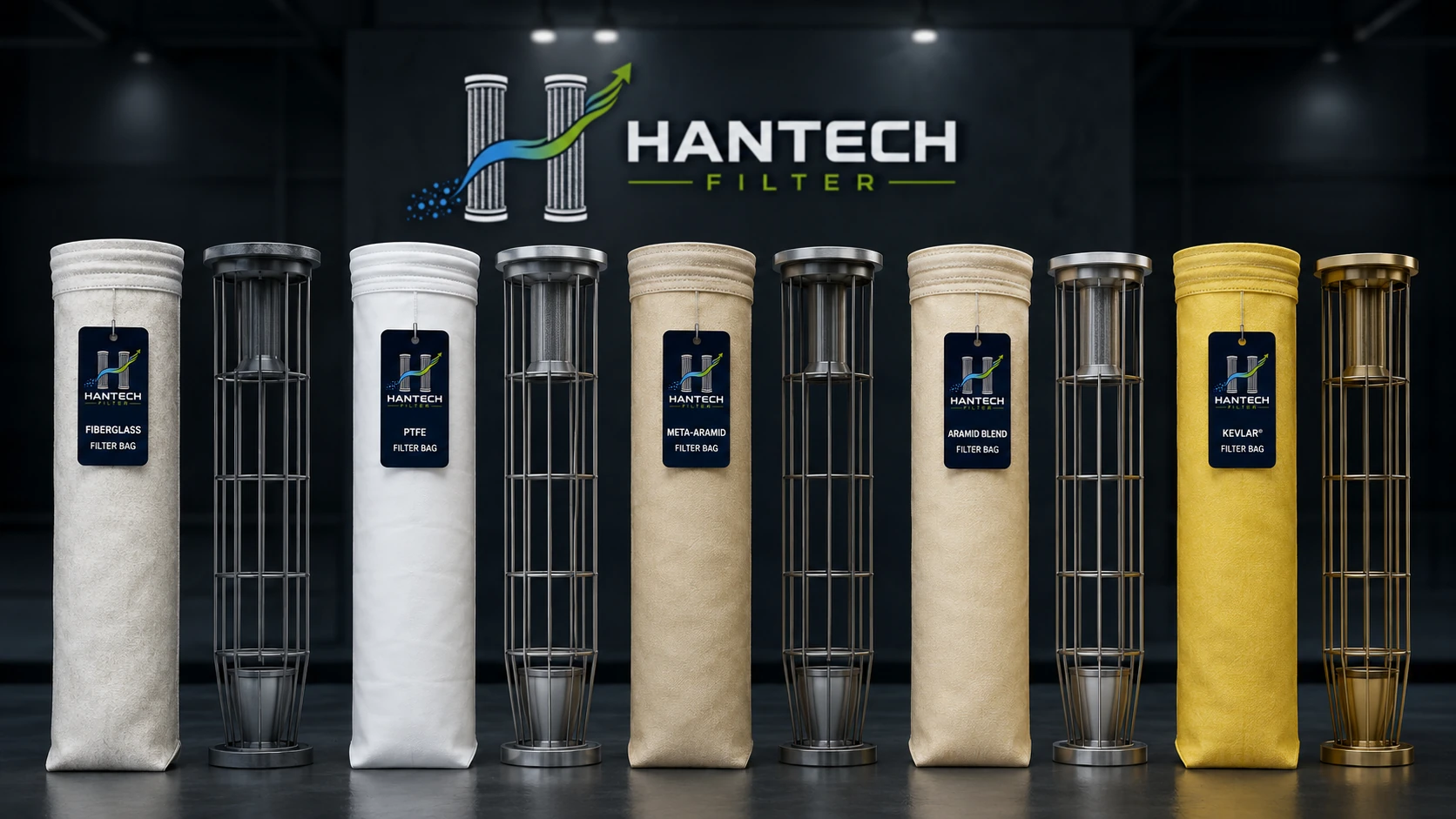
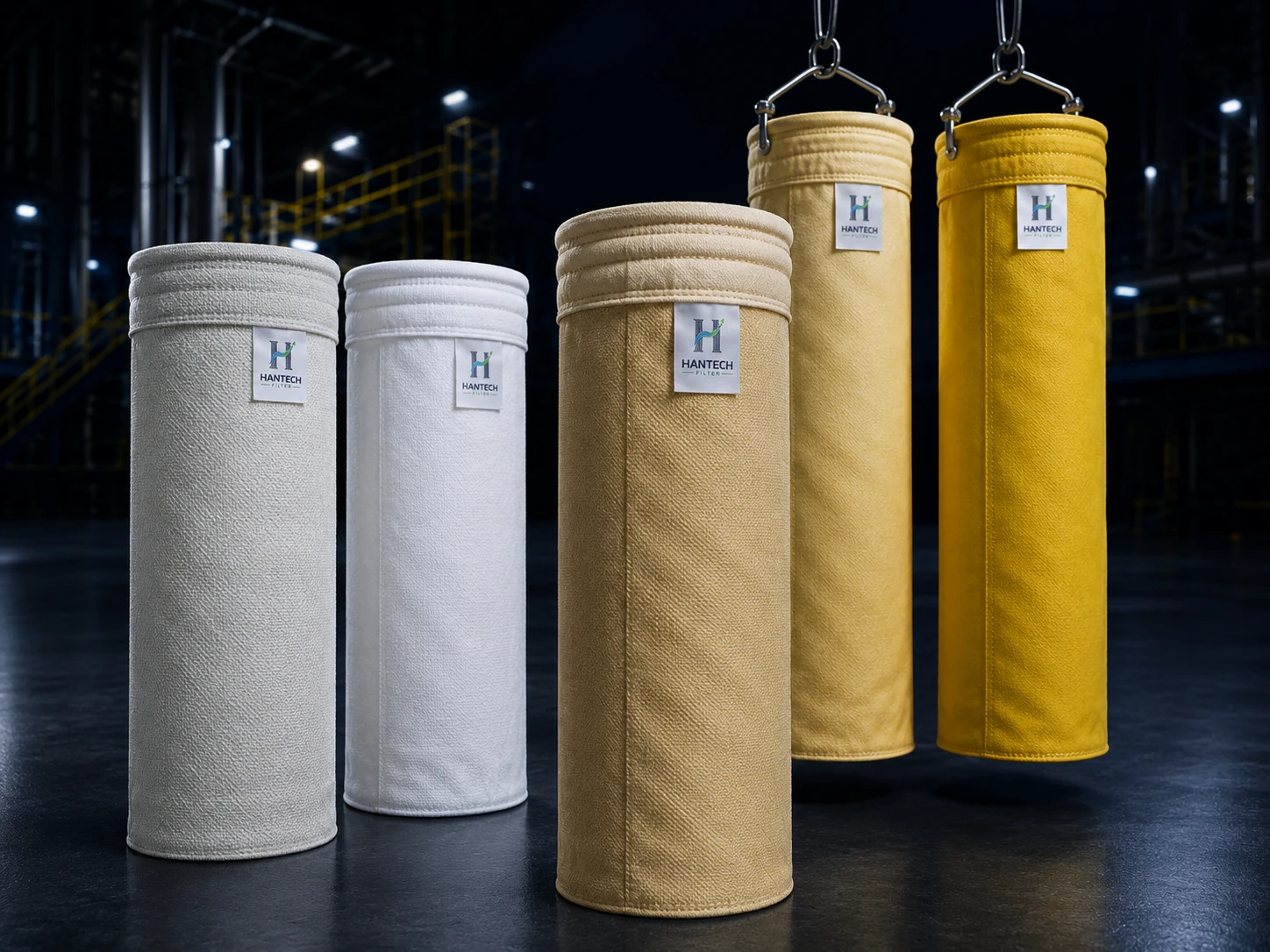
Choosing a more expensive media alone is not enough to extend filter bag life. Flow rate, A/C ratio, dP trend, pulse-jet pressure, cage surface, snap-band seating, moisture, dew point, dust micron size, and hopper discharge arrangement must all be checked together.
Why Can't Filter Bag Life Be Explained by Media Quality Alone?
Extending filter bag life isn't simply a matter of switching the bag fabric for a more expensive material. In the field, premature bag blinding, tearing, mouth leaks, high differential pressure, or poor emission performance usually don't stem from the bag itself, but from the combined breakdown of airflow, filtration velocity, pulse-jet cleaning, cage surface, snap-band seating, moisture, dew point, dust particle size, and hopper discharge behavior.
The right approach is to view the bag not as the system's only consumable, but as a precision process component operating within the baghouse filter system. When quoting filter bags, Hantech Filter evaluates not only diameter, length, and quantity, but also temperature, humidity, chemistry, dust distribution, cage outer diameter, cell plate hole, pulse pressure, and dP trend together.
How Does It Work? The System Chain That Determines Filter Bag Life
Dusty air enters the filter housing, velocity distribution determines the load reaching the bag surface, dust cake forms on the bag surface, and the pulse-jet pulse knocks this cake off in a controlled way. When this cycle is healthy, dP moves within a defined band. When the cycle breaks down, the bag either becomes overloaded, is mechanically fatigued by excessive pulsing, or becomes impossible to clean due to a moist/sticky cake.
For this reason, quoting a single guaranteed lifespan for a filter bag is not sound engineering practice. The same PES bag may run for a long time on a dry, moderate-temperature silo filter, yet blind quickly on a line with fine, sticky dust near the dew point. Hantech interprets the expected life range from process data under these conditions; it does not make unconditional life claims.
Decision Support Matrix for 10 Technical Checks
| Control | Why does it affect life? | Data to check on site |
|---|---|---|
| 1. Flow rate and A/C ratio | High filtration velocity embeds dust into the felt. | m³/h, number of filter bags, diameter, length, total area |
| 2nd dP trend | Provides early indication of blinding, leaks, or inadequate cleaning. | Shift chart, Pa value after new bags |
| 3. Dust particle-size distribution | Fine 1-3 µm dust may require a surface finish or membrane. | Particle distribution, emission target |
| 4. Moisture and dew point | Increases sticky cake and hydrolysis risk. | Gas temperature, relative humidity, insulation |
| 5. Temperature and peaks | Causes media shrinkage, aging, or seam weakening. | Normal and short peak temperature records |
| 6. Gas chemistry | SOx, NOx, HCl, HF, O2, and an alkaline environment change the media selection. | Gas analysis and process recipe |
| 7. Cage surface | Burrs, rust, and incorrect diameter mechanically abrade the filter bag. | Cage OD, wire count, weld inspection |
| 8. Snap-band seating | Mouth leakage produces low dP + high emissions. | Cell plate hole and sheet thickness |
| 9. Pulse jet setting | Insufficient pulsing raises dP; excessive pulsing fatigues the bag. | Pressure, duration, sequence, blow-pipe alignment |
| 10. Bunker emptying | A full hopper can cause dust to be re-entrained. | Rotary airlock, screw conveyor, level, air leakage |
Sample Calculation for A/C Ratio and Filter Area
Sample process calculation
- Flow Rate
- 48,000 m³/h
- Bag size
- Ø160 x 6,000 mm
- Bag count
- 192
- One bag area
- π x 0.16 x 6.0 = 3.02 m²
- Total filter area
- 192 x 3.02 = 579.8 m²
- A/C ratio
- 48,000 / 60 / 579.8 = 1.38 m/min
This value may look acceptable for dry, medium-grain mineral dust, but can remain high with 1-3 µm fine cement dust or a moist, sticky cake. In that case, rather than simply changing the bag brand, filter area, surface finish, the need for an ePTFE membrane, pulse energy, and air distribution should all be checked together.
Risk Matrix for Media, Temperature, and Chemistry
| Media | normal operation; | Short peak | Lifetime risk |
|---|---|---|---|
| Polyester / PES | 110-140°C | 150°C | Hydrolysis under moisture and high temperature |
| PPS | 160-190°C | 200°C | Oxidation with high O2 |
| Aramid / Nomex | 180-200°C | 220°C | Acidic moisture effect |
| P84 | 220-240°C | 260°C | Chemical limit and cost |
| PTFE | 240-250°C | 260-280°C | Mechanical support and cost |
| Glass fibre | 240-260°C | 288°C | Brittleness, filter cage, and installation sensitivity |
PTFE or ePTFE membrane is not always automatically the correct choice. If the process temperature and chemistry stay within the limits of more economical media such as PES, PPS, or Aramid, and the emission target is not very aggressive, it should first be checked whether these options are technically sufficient. Conversely, if there is fine-dust penetration, a low mg/Nm³ target, or felt embedding, a membrane becomes the strong candidate.
Pulse-Jet Adjustment, Cage, and Snap-Band Checks
Under these conditions, I always inspect the old cages before installing a new bag. Burred welds, rust, bent wire, broken rings, or an incorrect venturi will wear out even a well-selected media quickly. If there is a leak at the collar, dP can look low while dust emission at the stack rises; this leads the operator to the wrong diagnosis.
When Should It Not Be Used, or When Isn't a Filter Bag Change Alone Enough?
Information Required for a Quote
If a quotation or site assessment is requested for a filter bag life issue, please provide bag diameter, length, quantity, neck type, current media, operating temperature, peak temperature, dust type, particle distribution, moisture, dP trend, pulse pressure, cage outer diameter, cell plate hole size, sheet thickness, fan information, and the date of the last bag change. Photos, images of bag damage, and a short operating video speed up diagnosis.
You can share your data through the quote form. This topic should often be evaluated together with the filter bag selection, baghouse filter pressure drop, filter cage selection, and pulse-jet valve failure guides.
Frequently Asked Questions
How many years should a filter bag last?
A single warranty period is not accurate. Service life depends on flow rate, temperature, chemistry, dust characteristics, A/C ratio, pulse settings, cage condition, and maintenance discipline.
What is the first check to extend filter bag life?
First, the dP trend, flow rate, and filter area should be checked together. Then the media, pulse-jet system, cage, and hopper discharge should be examined.
Does a PTFE membrane bag always have a longer service life?
No. It can be advantageous for fine dust and low-emission targets, but it can be damaged by an incorrect cage, excessive pulse pressure, or a damp process.
Can an existing cage be used with a new bag?
It should only be reused if it passes checks for rust, burrs, bending, broken wires, venturi condition, and outer diameter.
Is Low dP a Good Result?
Not always. If low dP is seen together with high emissions, check for a bag-mouth leak, bypass, or a torn bag.