
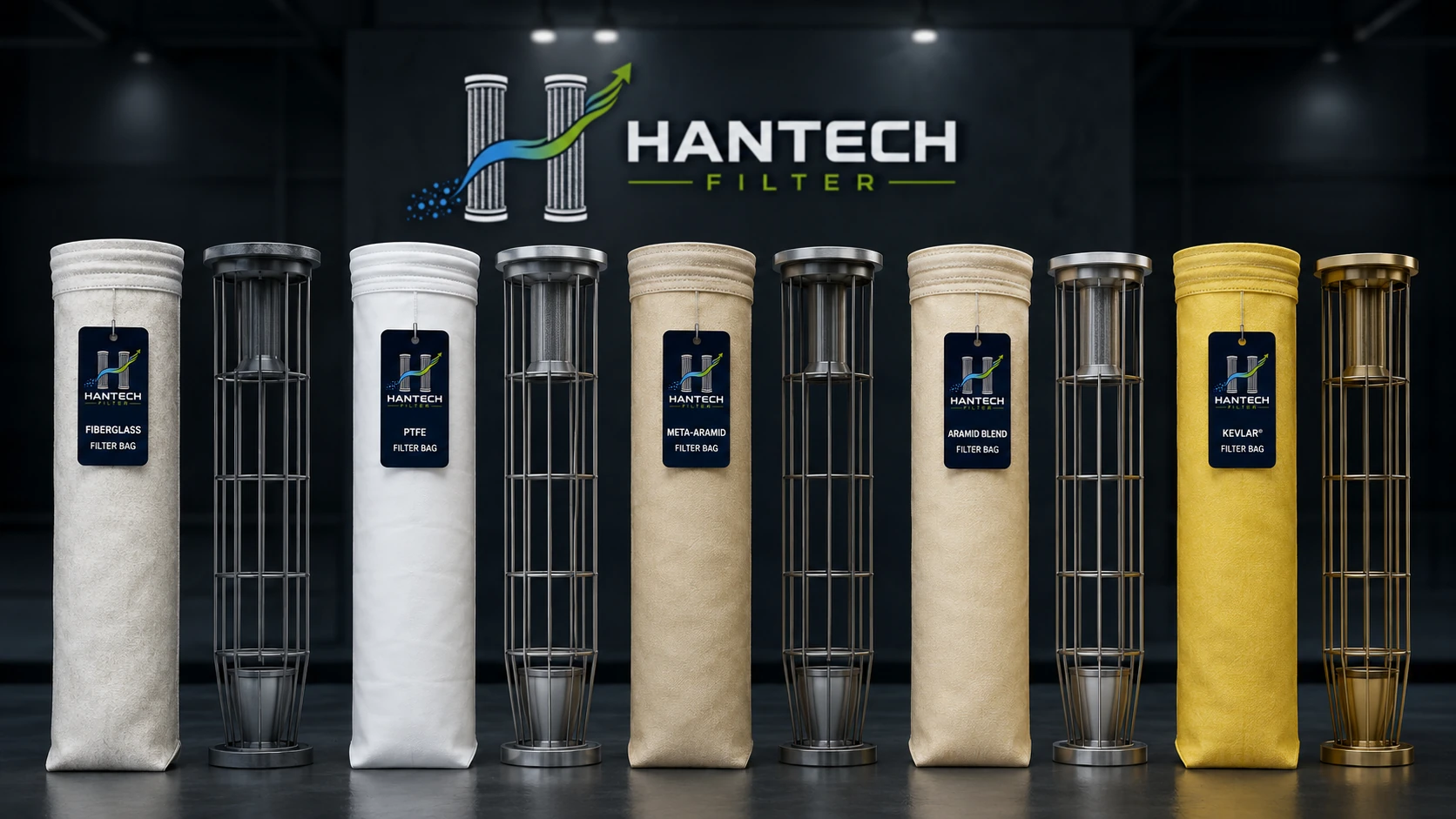
Filter bag selection at cement plants must be made separately for the raw mill, clinker, cement mill, silo, and packing points, based on temperature, moisture, alkalinity, abrasiveness, particle size distribution, SOx/NOx risk, cage fit, and pulse-jet cleaning conditions.
Not Every Point in a Cement Plant Needs the Same Filter Bag
Filter bag selection at cement plants is not just a matter of specifying bag diameter and length. Points such as the raw mill, clinker transfer, cement mill, silo top, packing line, and coal mill each have different dust characteristics, temperature, moisture behavior, and maintenance risk. The same-size bag that runs stably for years at one point may blind, tear, or generate high differential pressure within a few months at another.
Cement dust is generally fine, alkaline, and abrasive at some points. Process temperature, dew point, gas components such as SOx/NOx, moisture, and pulse-jet cleaning quality determine bag life. For this reason, Hantech Filter evaluates filter bag selection together with the filter cage, snap-band size, cell plate hole, venturi, and compressed air system.
Decision Table for Raw Meal, Clinker, Mill, Silo, and Packing
| Process Dew Point | Typical risk | Bag selection comment |
|---|---|---|
| Raw meal mill / raw mill | Temperature variation, humidity, fine mineral dust | The choice of PES, PPS, or Aramid is made by reading temperature, humidity, and chemistry together. |
| Clinker transfer / cooler area | Abrasiveness, hot peaks, coarse particles | Wear, inlet distribution, and pre-separation needs are checked. |
| Cement mill | Fine dust, high dP, alkaline environment | Surface treatment, A/C ratio, and pulse cleaning become critical. |
| Filter on top of silo | Short cycle time, high local dust load, maintenance access | A compact bag/cartridge solution, easy maintenance, and correct pulse settings are required. |
| Packing filter | Fine fugitive dust, low emission expectations | A glaze/WOR surface, a suitable membrane, or a more controlled media can be considered. |
| If a coal mill is present | Temperature, flammability, ATEX, and chemical risk | Antistatic properties, grounding, process safety, and gas analysis are essential. |
This table is a starting point; the final selection must be made using data from the field. At the same cement plant, an economical PES 500 glaze WOR may be suitable for the packaging filter, while another line with high temperature and chemical exposure may require PPS, aramid, P84, or fiberglass + PTFE membrane.
Media Selection: PES/PE, PPS, Aramid, P84, Fiberglass, and PTFE Membrane
| Media | Typical usage logic | Attention |
|---|---|---|
| PES / PE 500 glaze WOR | Standard dry, medium-temperature cement dusts | Hydrolysis and dP risk are monitored under moisture + high temperature. |
| PPS | Higher temperature and certain chemical conditions | Oxidation/O2 level must be checked. |
| Aramid / Nomex | Mechanical strength at high temperature | Caution is required under acidic moisture conditions. |
| P84 | High temperature and fine-dust capture | Cost and chemical limits are evaluated together. |
| Glass fibre | High temperature and dimensional stability | Brittleness, filter cage surface, and installation sensitivity are important. |
| ePTFE membrane | Low emissions, fine dust, and surface filtration | It is not always the automatic choice; cage/pulse compatibility is essential. |
A PTFE membrane is a powerful tool in cement plants, but because it is costly it should not be selected automatically. If the dust is predominantly 10 µm and above, the emission target is not very aggressive, and the cake releases well from the surface, a more economical media with the right surface treatment may be sufficient. If there is fine dust in the 1–3 µm range, a low mg/Nm³ target, felt embedding, or sticky cake behavior, a membrane becomes the stronger candidate.
Temperature, Humidity, SOx/NOx, and Chemical Resistance
In cement processes, the catalog temperature rating alone is not a sufficient selection criterion. Normal operating temperature, short-term peaks, start-stop behavior, condensation risk, humidity, SOx/NOx, HCl/HF, and O2 must all be assessed together. As a general training/RFQ guideline for polyester, normal operation can be taken as 110-140°C, continuous maximum as 140°C, and short peaks as 150°C; for higher values, the manufacturer's datasheet and actual process conditions must be verified.
| Risk combination | Possible Outcome | Technical Check |
|---|---|---|
| Moisture + high temperature | Hydrolysis, sticky cake, rapid dP rise | Dew point and insulation check |
| SOx/NOx + NO | Acidic environment and media aging | Gas analysis and chemical resistance matrix |
| High O2 + PPS | Oxidation risk | O2 and temperature range verification |
| Hot peaks | Filter bag shrinkage, embrittlement, or seam weakness | Peak temperature records and alarm history |
| Fine alkaline powder | Embedding into the felt and high dP | Surface treatment, membrane, A/C ratio |
Cage, Venturi, Snap-Band, and Pulse-Jet Compatibility
In a cement plant, the right filter bag can still end up with a short life if paired with a poor cage. Cage outer diameter, wire count, ring spacing, burr-free welds, coating, venturi presence, snap-band size, cell plate hole, and sheet thickness must each be verified individually. Cage surface finish and bag-to-cage fit are especially critical for membrane and fiberglass filter bags.
On the pulse-jet side, not every bag calls for the same pressure. For membrane bags, a 3-4 bar range with a 4 bar maximum is a safer training/RFQ guideline; for standard felts, settings can differ depending on the process and manufacturer approval. If the blow-pipe hole isn't aligned with the bag centerline, cleaning energy doesn't reach the bag properly, dP rises, and operators often look for the wrong fix by raising the operating pressure.
Example Field Scenarios
Scenario 1: Packing filter
- Dust
- Fine cement, high 1-10 µm fraction
- Symptom
- dP rapidly rises above 2000 Pa after new bags
- Control
- A/C ratio, surface treatment, pulse alignment, and moisture
- Comment
- The need for a glaze/WOR surface or membrane is evaluated using process data.
Scenario 2: Clinker transfer point
- Dust
- Abrasive minerals and coarse particles
- Symptom
- Localized tearing on the filter bag body
- Control
- Inlet distribution, cage burrs, pre-separator, and inlet plate
- Comment
- Rather than simply choosing a more expensive bag, the source of wear should be addressed.
Although both scenarios occur in the same industry, they call for different engineering answers. In a packaging filter, fine-dust and dP behavior take priority, while in clinker transfer, wear and mechanical impact tend to dominate.
Common Mistakes and When I Wouldn't Use This Media
I do not select standard PES on a raw-meal line with moisture and borderline temperature just because it is cheaper. Likewise, I do not automatically push a PTFE membrane on a dry, moderate-temperature packaging line without an aggressive emissions target. The right decision strikes an economic and technical balance based on process data.
What Information Should Be Shared for a Quote?
For a cement plant filter bag quote, please share the process point, bag diameter and length, quantity, top type, bottom detail, current bag media, weight, surface treatment, normal/peak temperature, moisture or dew point risk, dust characteristics, dP trend, emission target, cage outer diameter, cell plate hole size, sheet thickness, pulse pressure, and photos of the existing bag/cage.
You can submit this information via the quote form. For related technical articles, the guides on filter bag selection, pressure drop in baghouse filters, filter cage selection, and pulse-jet valve failure can be read together.
Frequently Asked Questions
Which filter bag is most commonly used in cement plants?
PES/PE 500 glaze WOR is frequently considered for standard dry and medium-temperature applications; but if temperature, moisture, chemistry, or the emission target changes, PPS, Aramid, P84, fiberglass, or membrane options may be required.
Is a PTFE membrane mandatory in a cement filter?
It is not always required. It becomes a strong candidate when there is fine-dust penetration, a low emission target, or a felt-embedding problem.
Can the raw meal and packing filters use the same bag?
The dimensions may be similar, but the process conditions differ. Humidity, temperature, dust fineness, and dP behavior must be evaluated separately.
What causes high dP in cement dust?
A high A/C ratio, fine dust, moisture, incorrect surface treatment, weak pulsing, a blocked hopper, or the fan operating point can all cause high dP.
Are dimensions and quantity alone enough for a quote?
No. Process temperature, dust type, current media, dP trend, cage, and pulse data significantly improve the accuracy of the selection.