
Air slide fabric selection for cement and mineral dust conveying lines should be made by evaluating air permeability, pressure, incline, dust fineness, moisture, temperature, duct width, feed arrangement, and maintenance access together.
What Is Air Slide Fabric?
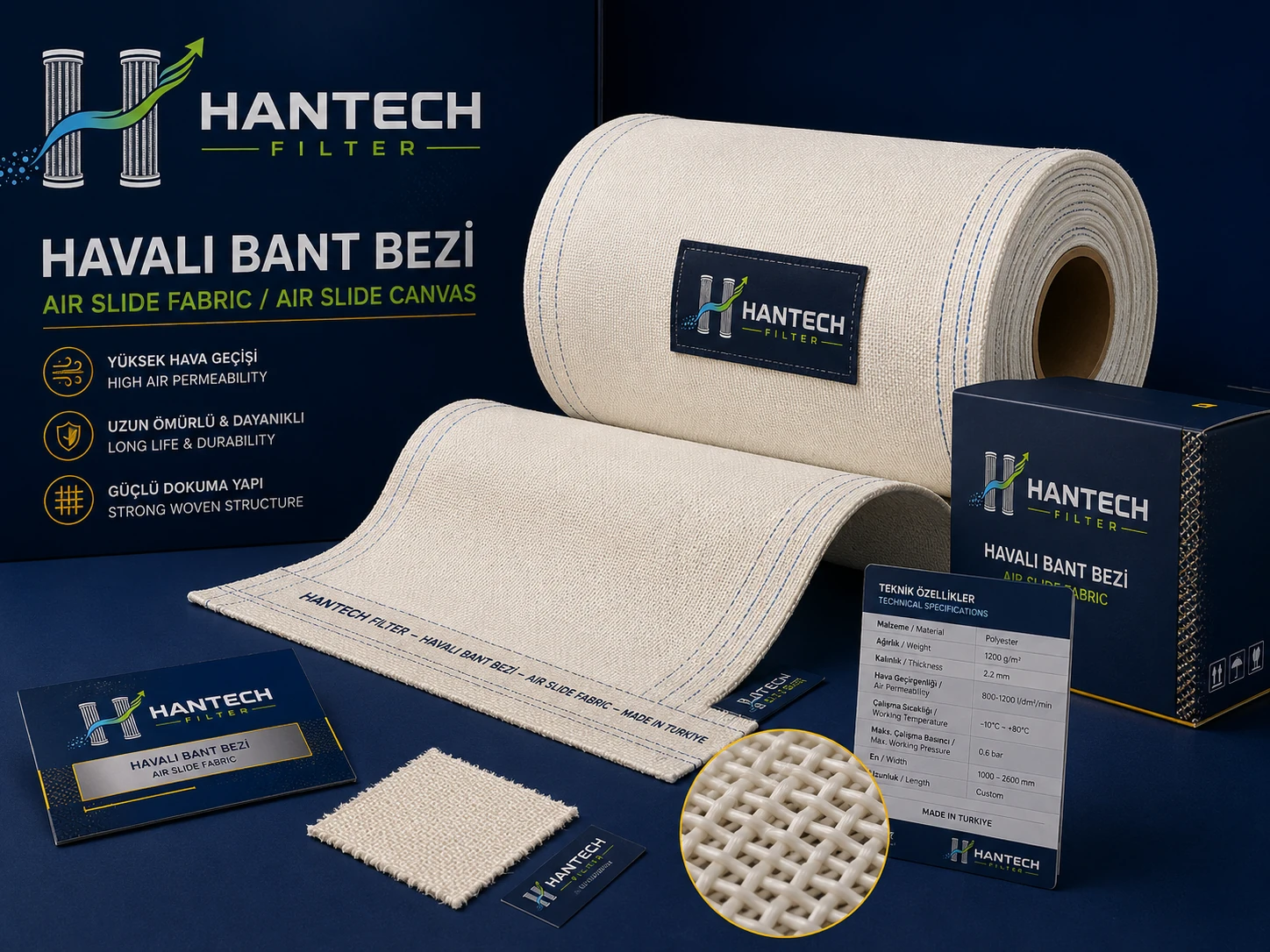
Air slide fabric is a textile layer that fluidizes fine dust material with low-pressure air in air slide or aeration conveying channels. For cement, raw meal, fly ash, lime, gypsum, and similar fine mineral dusts, the goal is to convey the material through controlled air distribution and channel slope rather than mechanical dragging.
From Hantech's perspective, air slide fabric is not selected on fabric thickness or price per meter alone. Air slide fabric works together with duct geometry, air pressure, blower capacity, material particle size, moisture, temperature, conveying distance, and feed arrangement. An incorrect fabric choice comes back as clogging, irregular flow, excess air consumption, product leakage, or maintenance downtime.
How Does an Air Slide System Work?
The blower feeds low-pressure air into the lower chamber of the channel. The air passes evenly through the air slide fabric and fluidizes the fine material in the upper section. The material then flows toward the outlet through channel incline and continuous air distribution. The more evenly the fabric distributes the air, the more stable the material bed becomes.
In this working principle, more air does not always mean better conveying. Too much air can cause material splashing, dust escape, and extra filter load. Too little air causes the material to settle in the line, bridge, and block. That is why air permeability, pressure, and material behavior must be selected together.
7 Critical Parameters for Selection
The biggest mistake in technical selection is taking the dimensions of the old fabric and reordering the same product without questioning any process changes. If the product fineness has changed, capacity has increased, the blower has been replaced, or a moisture problem has emerged, the same fabric can produce a different result.
Decision Support Table: Which Approach for Which Condition?
| Process requirement | Risk | Hantech selection interpretation |
|---|---|---|
| Dry and fine cement | Generally fluidizes well | Homogeneous air permeability and correct duct slope may be sufficient. |
| Damp raw meal or lime | Agglomeration, blinding, and irregular flow | Moisture source, temperature, and insulation are checked first. |
| Line with increased capacity | Existing fabric and blower may fall short | Airflow rate, duct cross-section, and fill ratio are calculated together. |
| Long-distance transport | Pressure drop and irregular feed | Zonal air distribution and maintenance access are evaluated. |
| Abrasive mineral dust | Wear on the fabric and channel surface | Material characteristics, velocity, and inlet point are checked. |
Air Slide Fabric, Screw Conveyor and Belt Conveyor Comparison
| Criterion | Pneumatic tape | Screw conveyor | Belt conveyor |
|---|---|---|---|
| SUITABLE MATERIAL: | Fine and fluid powder | Dust and granules, controlled volume | Granules, chips, and coarser product |
| Energy character | Low-pressure air is required | Motor-gearbox drive is required | Motor and belt friction are decisive |
| Dust escape | Can occur if sealing is inadequate | Can be controlled with an enclosed housing | Higher risk without an enclosed design |
| Self Care risk | Fabric blinding and air leakage | Screw wear and bearing/gland packing | Belt alignment, drum, and roller maintenance |
| Current Selection Note | Strong candidate for cement conveying | Strong for dosing/transfer beneath the filter | Suitable for coarse, high-capacity conveying |
The right question is often not "which equipment is better?" Is the material free-flowing or moist, how long is the distance, what is the capacity in tons/hour, is the line open or enclosed, and which design is the maintenance team used to? Without this data, equipment selection should not be reduced to a price comparison.
When Should Air Slide Fabric Not Be Used?
Under these conditions, Hantech does not automatically try to sell air slide fabric. On some lines, the moisture, feed, and air leakage problem must be solved first; on others, changing the equipment type may be the more correct approach.
Example Selection Scenario: Cement Mill Outlet
Sample process data
- Material
- Fine cement
- Capability
- 120 tons / hour
- Transport distance
- 18 m
- Duct width
- 500mm
- Symptom
- Weak flow at the end of the line, occasional clogging
- First Check
- Moisture, blower pressure, fabric surface, and feed distribution
In this scenario, simply switching to a more permeable fabric may not be the right move. If the problem is moisture or weak air distribution at the end of the line, a more permeable fabric can actually increase dust escape. Hantech first checks blower pressure, leakage in the lower chamber, fabric tension, channel incline, and material moisture, then finalizes the fabric type and installation detail.
frequent errors
| Error | Field result | Correction approach |
|---|---|---|
| Choosing fabric by price-per-meter alone | Short service life or clogging | Air permeability and process conditions are required together. |
| Trying to solve a moisture problem with the fabric alone | Recurrent blinding | Moisture source, temperature, and insulation are checked. |
| Not measuring blower pressure | Insufficient or excess air | Operating pressure and flow rate are recorded. |
| Neglecting edge sealing | Dust leakage and uneven bed | Gasket, retaining strip, and tension are checked. |
| Postponing duct cleaning | Local clogging and capacity drop | Planned maintenance and inspection doors are used. |
Information Required for a Quote
For an air slide fabric quotation, please share the material type, approximate capacity, duct width and length, current fabric size, layer/thickness details, operating temperature, moisture issues, blower pressure, line incline, clogging point, and available photos. If the old fabric shows product buildup or scorch marks, visual diagnosis improves the quality of the selection.
You can send this data via the quote form. For product links, the air slide fabric, screw conveyor, and rotary airlock pages can be reviewed together. Related articles: silo-top filter failures, cyclone dust collector, and baghouse filter retrofit.
Frequently Asked Questions
What materials is air slide fabric used with?
Used for cement, raw meal, fly ash, lime, gypsum, and similar fine, free-flowing dusts. May not be suitable for coarse or lumpy materials.
Why does an air slide clog?
Moisture, insufficient air, incorrect slope, fabric blinding, irregular feed, or buildup inside the duct can cause clogging.
Is a More Permeable Fabric Always Better?
No. Excess air can cause dust leakage and irregular flow. Permeability should be selected according to the process and blower capacity.
Is width alone enough when replacing the fabric?
No. Length, thickness, air permeability, temperature, material, and installation method are also required.
Should an air slide or a screw conveyor be selected?
Air slide fabric performs well with fine, free-flowing dust. For applications requiring dosed, enclosed, mechanical transfer, a screw conveyor may be more suitable.