
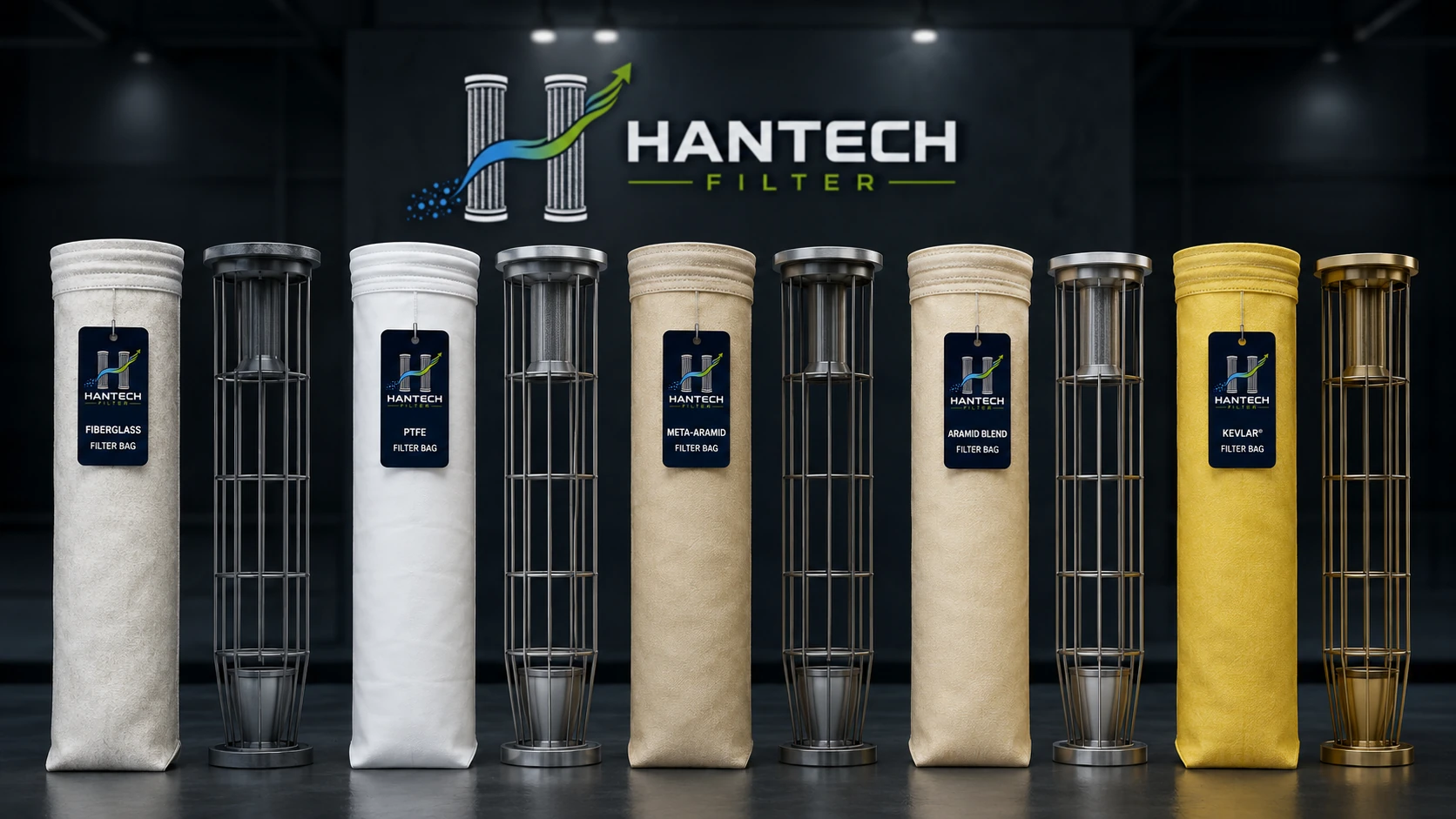
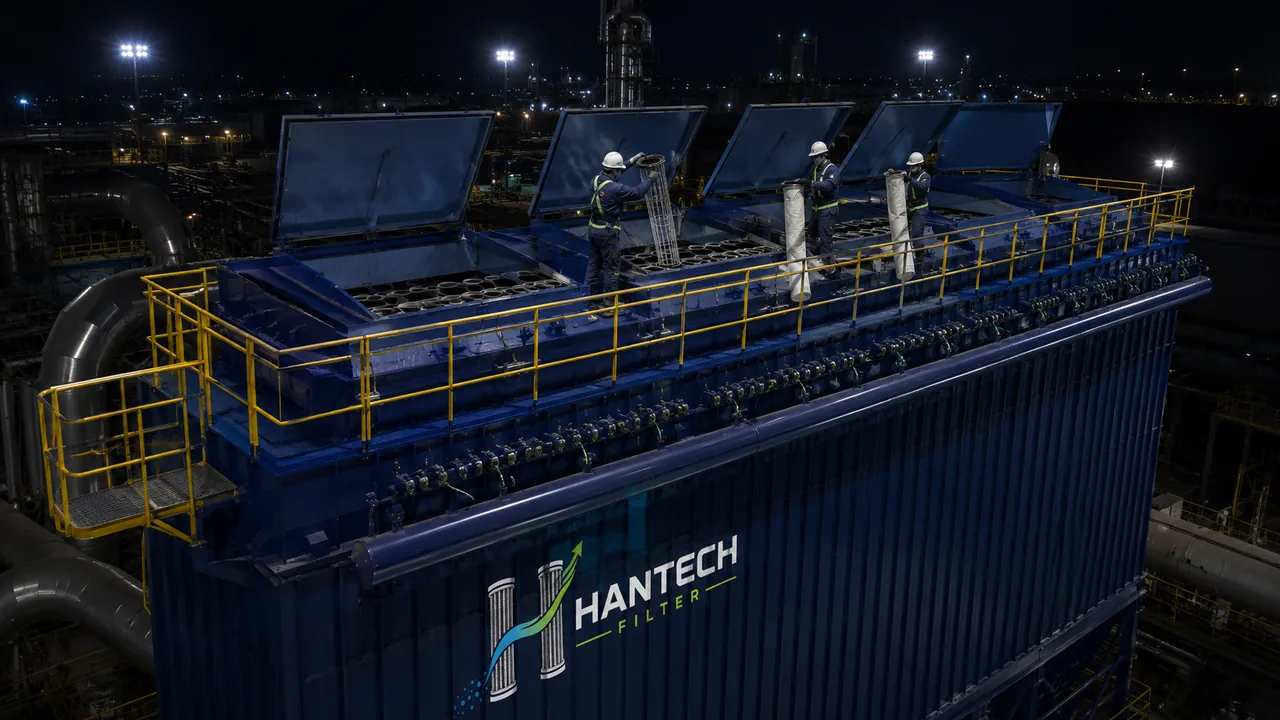
Silo-top filter failures are often not caused solely by a bag, cartridge, or valve problem; fill rate, tanker pressure, pulse air, the safety valve, leakage above the hopper, moisture, fine dust, and maintenance access must all be checked together.
What Is a Silo-Top Filter and Why Is It Critical Equipment?
Silo-top filters are compact dust collection equipment that filter the dusty air displaced from a silo during pneumatic filling or mechanical transfer. In cement, lime, gypsum, mineral, feed, flour, plastic raw material and chemical dust applications, operators tend to see the same problems: dust escape during filling, high differential pressure on the filter, weak valve cleaning, or fine dust accumulating around the silo.
From Hantech's perspective, the silo-top filter may look like a small component, but it is critical for operational safety and environmental cleanliness. If the filter doesn't work correctly, it affects not only emissions but also silo pressure, the safety valve, the level indicator, tanker unloading time, product loss and the dust exposure of the maintenance team. For this reason, the baghouse filter system, filter bag or cartridge, pulse valve and silo process data must be evaluated together.
How Does a Silo-Top Filter Work?
As material enters the silo during filling, the air inside wants to escape. This air carries the fine dust entrained with the product to the filter element. A dust cake forms on the bag or cartridge surface; the pulse-jet impulse drops this cake back into the silo. In a healthy system, leakage stays under control during filling, the filter dP falls after cleaning, and no dangerous pressure buildup occurs inside the silo.
Although this mechanism looks simple, field reality is more complex. If tanker pressure is too high, the material is very fine, moisture is present, filter area is undersized, or pulse air energy is insufficient, dust embeds into the surface and the filter blinds quickly. Conversely, if pulsing is too aggressive, the bag/cartridge fatigues and gaskets and connection points can be damaged.
Failure Symptom and First-Check Matrix
| Symptom | Possible cause | Initial site inspection |
|---|---|---|
| Dust escaping around the silo during filling | Blinded filter element, gasket leak, safety valve opening, or high fill flow rate | dP trend, cover gasket, safety valve, fill pressure |
| It's rising fast... | Insufficient filter area, fine dust embedding, moist cake, or weak pulse | Element surface, pulse sound, tank pressure, moisture/dew point |
| Valve is working but cleaning is weak | Air tank too small, compressor flow too low, diaphragm worn | Pressure drop and valve exhaust sound during the pulse |
| Silo safety valve opens frequently | Insufficient filter air relief or excessive fill pressure | Tanker pressure, filter surface area, vent line, and filling procedure |
| Low dP but dust is escaping | Bypass, torn element, an improperly seated gasket, or door leakage | Leak test, element sealing surface, cover latch |
This table is a starting point for failure diagnosis. In particular, if low dP and dust escape are seen together, it should not be assumed that the filter is cleaning well; leakage, bypass, or tear risk should be checked first.
Selection Parameters: Flow Rate, Dust, Moisture, and Filter Area
Filter area is often not scrutinized closely enough when selecting a silo-top filter. A small, inexpensive filter may handle filling on day one; but once production increases, the product gets finer, or tankers unload more often, dP rises and filling times get longer. In that situation, rather than simply buying a new bag or cartridge, the fill rate, air discharge area, and pulse system should all be checked together.
Filter Bag or Cartridge? Hantech Decision Table
| Criterion | Bag-type silo filter | Cartridge silo filter |
|---|---|---|
| Maintenance character | Filter bag and cage dimensions are tracked separately | Cartridge change-out can be quick |
| Fine dust behavior | Managed through media and surface finish | Cake buildup between pleats is monitored |
| Damp/sticky powder | Filter bag surface and pulse settings are critical | Pleat blinding can occur faster |
| Spare parts standard | Dimensions, neck detail, and cage are required | Cartridge diameter, length, and connection type are required |
| Current Selection Note | Robust in standard industrial applications | A strong candidate where compactness and quick change-out are required |
Hantech does not automatically favor a single solution in this choice. Product dust, fill cycle, maintenance team access, spare-parts standardization, emission expectations, and existing equipment dimensions are all considered together.
When Isn't Simply Replacing the Filter Element Enough?
Example Field Scenario: Dust Escape During Cement Silo Filling
Sample process data
- Process
- Cement silo tanker loading
- Filling flow rate
- About 70 tons/hour
- Symptom
- Dust escaping over the filter at the end of filling
- dP behavior
- Does not drop sufficiently after cleaning
- Initial finding
- Tank pressure drops from 5.5 bar to 3.2 bar during the pulse
- Risk
- Fine dust + insufficient pulse energy + possible gasket leakage
In this example, simply replacing the filter bag or cartridge may not be a lasting solution. Air tank volume, compressor supply, valve diaphragm, door gasket, and fill pressure must all be checked together. If the filter area is marginal relative to the fill rate, a larger filter or a different element geometry may be needed.
Maintenance Checklist:
| Period | Control | Note |
|---|---|---|
| Each filling observation | Dust leakage, safety valve movement, filling time | Any abnormal leakage is recorded. |
| Weekly | dP trend, pulse sound, cover and gasket inspection | Low dP plus leakage can indicate bypass. |
| Monthly | Valve, diaphragm, solenoid, air tank water drain | Water/oil filters on the compressed air line are monitored. |
| Planned stop | Element surface, cage/cartridge seating surface, silo-top safety | A damaged element must not be reused. |
Information Required for a Quote
For a silo-top filter, bag, cartridge, pulse valve, or spare part quotation, please provide the silo product, filling method, approximate fill rate, filter brand/model, element size, quantity, current dP behavior, valve diameter, air tank pressure, safety valve condition, and photos of the current fault.
You can submit your technical data through the quote form. For related product pages, baghouse filter systems, pulse-jet valves, filter bags, and filter cages can be evaluated together. Related articles: pulse-jet valve failure, pressure drop in baghouse filters, and filter bag life.
Frequently Asked Questions
Why does a silo-top filter leak dust?
The filter element may be blinded, the gasket may be leaking, the safety valve may be opening, the fill pressure may be high, or pulse cleaning may be insufficient.
If dP is high on a silo-top filter, what should be checked first?
Filling flow rate, element surface, pulse air, valve operation, moisture, and lid gasket must be checked together.
If the safety valve is opening, is the filter faulty?
Not conclusive on its own; but the filter's air venting may be inadequate, filling pressure may be too high, or the vent line may be faulty.
Which is better for a silo filter: bag type or cartridge type?
This varies according to process dust, maintenance access, spare-parts standard, and humidity behavior. There is no single automatic answer.
Is replacing the valve alone enough?
This helps if the valve is genuinely faulty; but if tank volume, compressed air supply, blow pipe, or filter area is insufficient, the problem will recur.